
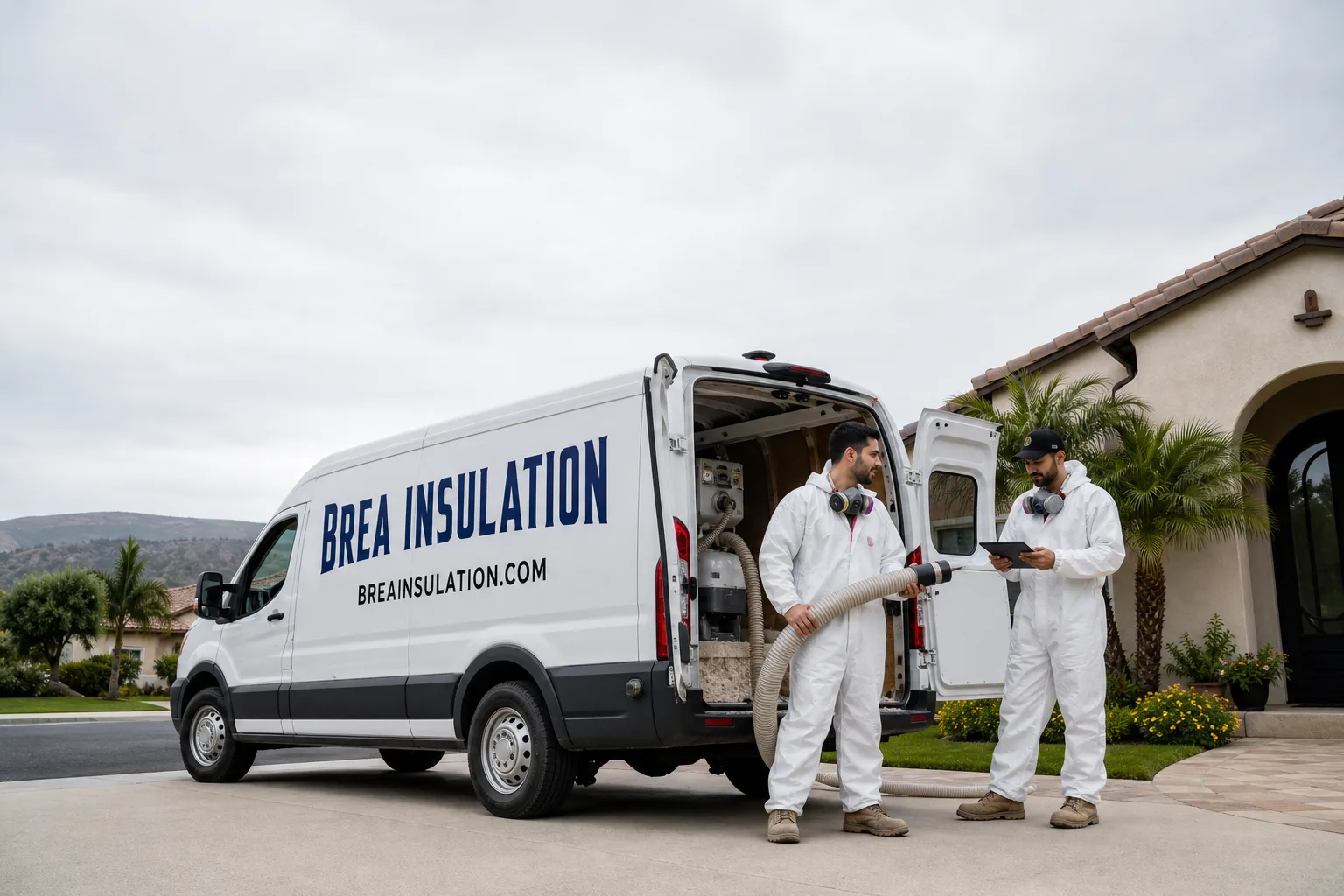
Fast, Reliable Spray Foam Insulation Across San Bernardino
Spray foam insulation in San Bernardino costs roughly $1.50 to $4.50 per board foot installed, depending on whether you need open-cell or closed-cell foam. Most attic jobs in a mid-century rancher run between $2,800 and $6,500, while full wall cavity work on older bungalows typically lands from $4,000 to $9,000. We work in San Bernardino weekly, from the tracts west of the 215 to the foothill subdivisions on the north edge, and our crews know exactly how the local heat reshapes what insulation actually has to do. Call (866) 858-4033 and we’ll give you a straight answer on your home before we ever schedule a crew.
Why Brea Insulation Is San Bernardino’s Preferred Spray Foam Insulation Company
Insulation is the only trade on our service board. That matters in a city like San Bernardino, where the difference between a good install and a bad one shows up on your August electric bill or in the dust that leaks through your walls during fire season. Phil Darnell built Brea Insulation around a single-trade model deliberately: no roofing, no HVAC, no handyman work on the menu. Every crew member runs spray foam jobs day in and day out, which means we’ve seen the failure modes that a generalist won’t catch until it’s too late.
We carry eight material brands, including Icynene and Demilec for spray foam, because San Bernardino’s housing stock doesn’t all need the same product. A 1958 tract home with a low-pitch attic west of the 215 needs something different than a 2015 foothill build with code-compliant framing. That’s the whole point of having a full bench: the home dictates the foam, not our inventory spreadsheet. When a San Bernardino homeowner calls us, a real person answers, asks about the house first, and schedules a free estimate at the property. We don’t sell over the phone.
Spray Foam Attic Insulation in San Bernardino
Spray Foam Attic Insulation in a San Bernardino home is usually either an open-cell application on the attic floor or a closed-cell seal on the underside of the roof deck, and which one you choose depends heavily on whether your attic has ductwork running through it. In the older tracts around San Bernardino, most HVAC ducts live in the attic, which means they’re sitting in air that hits 140°F or more on a July afternoon. Sealing the attic floor and duct boots with foam brings that temperature down dramatically before you add a single inch of R-value.
Closed-Cell Roof Deck Application
When we apply closed-cell foam to the roof deck in a San Bernardino home, we’re treating the attic as conditioned space. That keeps heat out of the duct zone and makes the whole system more efficient. We recommend this on homes where the furnace and ducts are already in the attic and the goal is summer comfort, not just winter heating.
Open-Cell Attic Floor Sealing
Open-cell foam on the attic floor air-seals the gap between the living space and the attic. We see this as the right call for San Bernardino homes with original 1960s ceiling penetrations around lights, ceiling fans, and bathroom vents. The big gain here is dust and smoke infiltration control, not just temperature.
Spray Foam Wall Insulation in San Bernardino
Spray Foam Wall Insulation in San Bernardino typically means injecting foam into existing wall cavities on older homes that were built with nothing in the walls, or framed with batt that’s long since settled. Downtown San Bernardino bungalows and some of the post-war homes near Baseline and E Street have empty wall cavities or newspaper-thin sheathing, which means the walls are basically a thermal sieve. That’s where closed-cell or dense open-cell foam changes the game.
Retrofit Cavity Injection
We drill small access holes and inject open-cell foam into existing cavities, filling the gaps the original builders never addressed. On a San Bernardino tract home from the 1960s, this is often the single biggest improvement we can make to interior comfort. The walls were often framed for a thinner world.
New Construction and Major Gut Work
When walls are open, closed-cell foam is the clear upgrade. San Bernardino homeowners doing a full gut remodel or a room addition get better R-value per inch and a vapor barrier built into the foam. If you’re already down to studs, this is the moment to specify Demilec or Icynene closed-cell.
Trusted Brands We Service in San Bernardino
Brea Insulation carries spray foam from Icynene and Demilec, two manufacturers whose products are tested for the kind of sustained heat San Bernardino sees every summer. We also stock Owens Corning fiberglass for hybrid jobs and GreenFiber cellulose for customers who want a recycled-content option in their walls or attic. Because we keep these materials on hand for San Bernardino jobs specifically, we’re not waiting on a distributor to ship something from Los Angeles when your attic is already open. You get a real product recommendation, not whatever’s left on the truck.
Common Spray Foam Insulation Problems We See in San Bernardino Homes
- Foam softening on 140°F+ roof decks: In west-side San Bernardino tract homes with low-pitch attics and minimal ventilation, open-cell foam applied too thin directly under a hot roof deck can soften and lose R-value. We specify extra thickness or a radiant barrier in those attics.
- Spray foam over knob-and-tube wiring: Homes near downtown San Bernardino built before 1950 often still have knob-and-tube circuits in the attic or walls. Spraying foam directly over that wiring can trap heat and create a fire hazard if the wiring hasn’t been updated first.
- Foam delaminating from dusty sheathing: San Bernardino’s dry, dusty air means attic sheathing gathers a fine layer of silt that prevents foam from bonding. Poor surface prep causes the foam to pull away, leaving gaps that let hot attic air bypass the insulation completely.
- Settled batt insulation hiding the real problem: In many 1950s and 1960s homes, we find original batt insulation has settled to a few inches and is doing almost nothing. Homeowners think they need more insulation, but the real fix is air sealing first, then foam where it counts.
Pricing for Spray Foam Insulation in San Bernardino, CA
Open-cell spray foam in San Bernardino runs $1.50 to $2.80 per board foot installed, while closed-cell foam runs $2.80 to $4.50 per board foot. A typical 1,200-square-foot attic in a mid-century rancher costs between $2,800 and $6,500 for open-cell, and $4,500 to $9,000 for closed-cell on the roof deck. Wall cavity injection on a 1,500-square-foot home usually lands from $4,000 to $9,000 depending on framing accessibility. What changes the price: attic accessibility, presence of knob-and-tube wiring, duct location, and whether we’re doing prep work like removing old batt or sealing penetrations. Call (866) 858-4033 for a free estimate at your San Bernardino property. We’ll give you a firm number, not a maybe.
We Also Serve Cities Near San Bernardino
Our crews handle spray foam jobs in Muscoy, Highland, Loma Linda, and Rialto on the same rotation we run through San Bernardino. If you’re in one of those surrounding communities, call (866) 858-4033 and we’ll get you on the schedule just as fast as a San Bernardino address. For more on our full Spray Foam Insulation services, we cover open-cell, closed-cell, rim joist, and garage ceiling applications as well.
Serving San Bernardino, CA — Our Local Coverage Area
We’re based in the San Bernardino area and know this community well. Use the map below to see our service coverage — if you’re nearby, we can almost certainly help.
FAQs About Spray Foam Insulation in San Bernardino
Yes, spray foam helps with San Bernardino’s extreme summer heat and wildfire smoke because it creates an air seal that stops both radiant attic heat and outdoor smoke from leaking through ceiling penetrations, recessed lights, and wall cavities. Homes with well-sealed envelopes show dramatically lower indoor particulate counts during fire season and much cooler interior temperatures without running the AC constantly. Call (866) 858-4033 and we’ll show you exactly where your house is leaking air, free.
Yes, you can still get spray foam in a San Bernardino home with knob-and-tube wiring, but the wiring must be evaluated and updated by a licensed electrician before we spray. Spray foam over live knob-and-tube traps heat around the conductors and creates a real fire risk, especially in older downtown bungalows where we see wiring that’s been spliced and patched for 70 years. We’ll flag it on the initial walkthrough and coordinate with your electrician so the project moves forward safely.
For most low-pitch attics in San Bernardino, a combination of both is the right answer. A radiant barrier reflects solar heat away from the attic, but plain spray foam on the roof deck or attic floor seals the air leaks that cause the real comfort loss. In west-side tract homes with 140°F+ attic temperatures, we often install a radiant barrier plus closed-cell foam at the duct zone, which addresses both radiation and convection.
Spray foam holds its R-value during San Bernardino’s winter nights near the foothills, unlike fiberglass batt which loses effectiveness when cold air moves through it. Closed-cell foam also acts as a vapor barrier, which means fewer condensation issues in homes near the base of the San Bernardino Mountains where winter temps routinely drop into the 30s. The same air seal that handles July heat handles January cold, which is why we recommend it for both.
We use Icynene and Demilec for our spray foam work in San Bernardino, and we stock Owens Corning for hybrid batt-and-foam jobs where that’s the better spec. The choice comes down to your home’s specific conditions: attic access, framing depth, existing insulation, and whether you’re dealing with ducts in the attic or living space comfort only. We’ll show you samples and explain the practical difference before you spend a dollar.
Written by Phil Darnell, Owner at Brea Insulation, serving San Bernardino and the surrounding Inland Empire with dedicated insulation expertise.
Ready to talk about your San Bernardino home? Call (866) 858-4033 now for a free estimate on spray foam attic, wall, rim joist, or garage ceiling insulation. We’ll walk the property with you, show you what’s happening in your attic and walls, and give you a firm quote before we leave. No pressure, no vague numbers, just a clear plan for a cooler house and lower bills.