
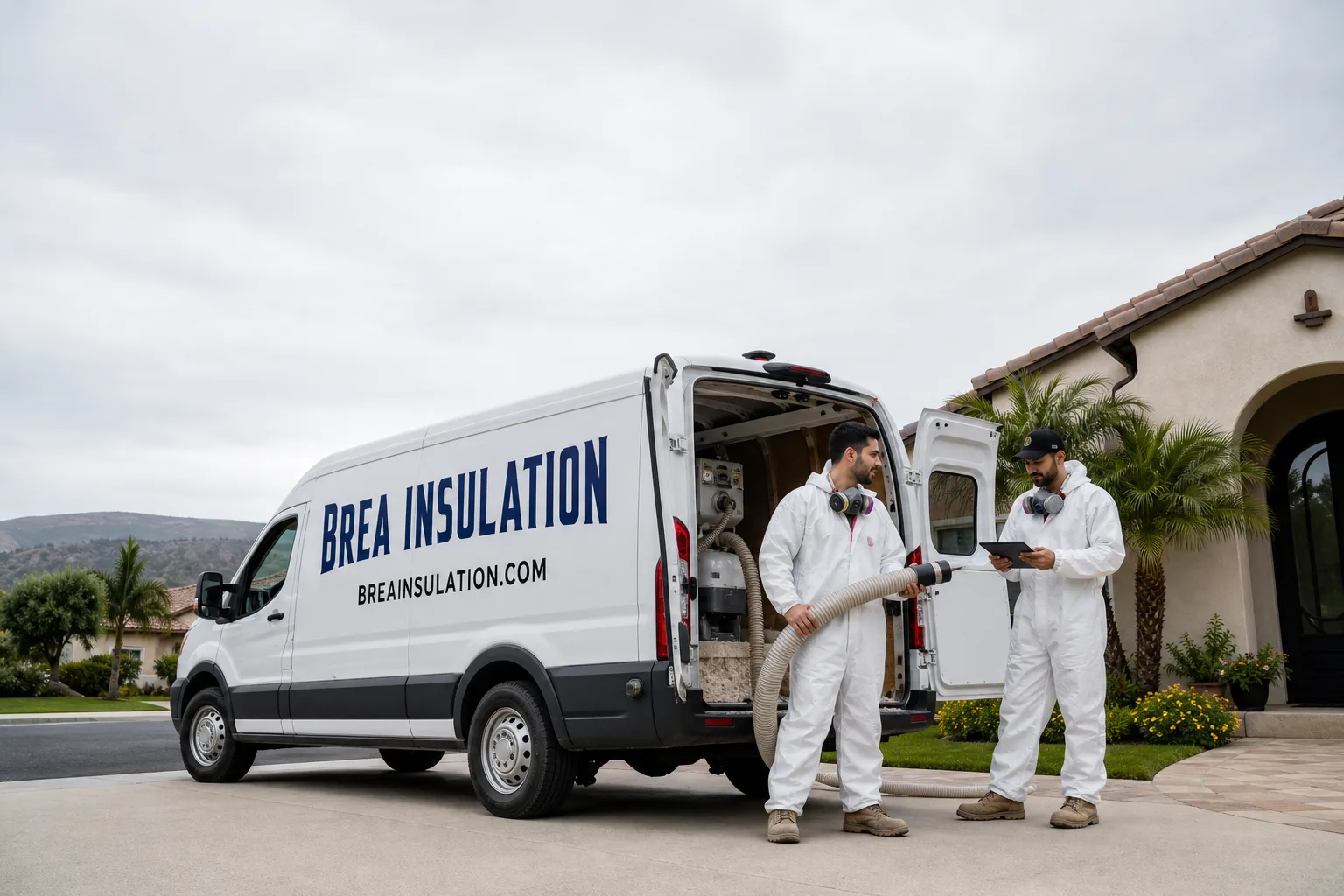
Fast, Reliable Spray Foam Insulation Across Glendale
Spray foam insulation in Glendale homes typically costs $2.50 to $6.50 per board foot installed, putting most attic or rim joist jobs in the $2,800 – $9,000 range depending on square footage and whether we’re air-sealing a hillside attic or encapsulating a canyon crawlspace. We run crews into Glendale daily from our Brea shop, and we know the pre-1960 stucco bungalows, Chevy Chase Canyon post-and-beams, and mid-century tract pockets that make this city’s insulation work different from anywhere else in the Valley. If your AC can’t keep up and your attic reads 140°F by noon, call (866) 858-4033 and we’ll give you a straight answer on what’s actually going on up there.
Brea Insulation is a dedicated Spray Foam Insulation contractor. Insulation is all we do. No roofing upsells, no HVAC add-ons, no handyman specials. That narrow focus matters when you’re retrofitting a 1948 hillside home with knob-and-tube wiring and a rodent problem in the attic – you want someone who has seen that exact scenario more than once.
Why Brea Insulation Is Glendale’s Preferred Spray Foam Insulation Company
We’ve worked enough attics in Glendale’s hillside ZIPs to know what’s waiting behind the access hatch. In 91208 and 91206 especially, the pattern is predictable: original R-11 fiberglass batts that were thin to begin with, now compressed by decades of roof-rat and feral-parrot nesting, sitting over knob-and-tube wiring that was never meant to be buried under insulation. Most companies will spray foam right over that mess. We won’t – because we know it fails, and we know what the callback looks like.
Phil Darnell built Brea Insulation around one principle: match the material to the job, not the job to whatever’s cheapest in the warehouse. That’s why we carry eight manufacturer lines – including Icynene and Demilec for spray foam – and why we’re comfortable telling a Glendale homeowner that open-cell is right for their roof deck while closed-cell is overkill. The right call isn’t always the more expensive one.
Our response time to Glendale is same-day for estimates and typically within 2 – 3 business days for installation, depending on scope. We stay close to the 134 and 2 corridors, so getting from Brea to Glendale doesn’t burn half a day. When you call, you’re talking to someone who knows the difference between a 1950s vented attic in the Verdugo foothills and a flat-ceilinged tract home near the 134 – and why that difference changes the entire spray foam approach.
Open Cell Spray Foam in Glendale
Open Cell Spray Foam in Glendale is the workhorse retrofit option for vented attics and roof decks in the city’s older wood-frame homes, running $2.50 – $4.00 per board foot installed in most Glendale attics. It’s a semi-rigid, air-permeable foam that expands to fill rafter bays, air-seals the thermal boundary, and allows moisture to move through the assembly – which matters in a climate where attic temps swing 60°F between day and night. For most Glendale bungalows and ranch homes from the 1920s through 1960s, open-cell on the roof deck is the single highest-impact upgrade you can make to cut cooling costs.
Roof Deck Application in Vented Attics
In a typical Glendale vented attic, we apply open-cell foam directly to the underside of the roof sheathing, converting the attic from a superheated dead zone into semi-conditioned space. This brings the attic temperature from 140 – 150°F down to 110 – 120°F in summer, which is the difference between your ductwork fighting 35°F heat gain or 15°F heat gain. If your ducts run through the attic, and in Glendale most of them do, this matters more than almost any other single retrofit.
When Open-Cell Beats Closed-Cell
Open-cell is the right call for Glendale roof decks because it allows moisture vapor through. In a 1957 ranch with no housewrap and old stucco, trapping moisture in the rafter bays with closed-cell can lead to sheathing rot that you won’t see until it’s structural. Open-cell air-seals without turning the roof assembly into a sealed box, which is what we want in Glendale’s dry-but-condensation-prone attics.
Spray Foam Insulation Contractors in Glendale
Spray Foam Insulation Contractors in Glendale are easy to find; ones who understand what’s actually inside Glendale’s walls are not. The work here is different because the housing stock is different. A contractor running insulation in new-build Irvine or Rancho Cucamonga is working with clean, uniform cavities and modern wiring. A Glendale contractor is opening 1940s bungalows with balloon-framed walls, knob-and-tube circuits, and attic cavities that haven’t been touched since Eisenhower was in office. That’s the difference between a foam job that performs and one that creates new problems.
Crews Who Know 1920s – 1960s Framing
Our installers know how to work around old dimensional lumber, uneven rafter spacing, and steel lath in 1950s tract homes. Foam adhesion to old, oil-soaked sheathing is not the same as adhesion to fresh OSB, and an installer who has never seen the difference will leave air pockets that condense moisture against the deck. We prep the substrate, isolate wiring, and check adhesion as we go. That’s what an insulation specialist does.
Rodent and Parrot Damage Remediation
In Glendale’s hillside ZIPs, specifically 91208 and 91206, we routinely find that roof rats and feral parrots have shredded or compressed whatever legacy insulation was there. Foam sprayed over contaminated batts compresses them further and fails to bond where it matters. We remove the soiled material first, sanitize, air-seal the penetrations the rodents used as entry, and then apply the foam. This two-step sequence is the whole game in Glendale, and generic pages never mention it.
Trusted Brands We Service in Glendale
For Glendale spray foam jobs, we lean on Icynene and Demilec open- and closed-cell products – two of the most respected names in professional polyurethane foam. Icynene’s open-cell is our default for roof decks in vented attics; Demilec’s closed-cell comes out for rim joists, crawlspace encapsulation, and anywhere we need structural rigidity plus a vapor barrier. We also stock CertainTeed and Rockwool for hybrid jobs where a Glendale homeowner wants foam air-sealing on the roof deck and mineral wool batts in the walls for fire resistance and sound control. Eight brands on the bench means we’re never forcing one product into every situation.
Common Spray Foam Insulation Problems We See in Glendale Homes
- Rodent- and parrot-soiled legacy batts under fresh foam: In the hillside ZIPs, roof rats and feral parrots nest in vented attics, shredding R-11 batts and leaving droppings that stain joists. Foam sprayed over this fails at the interface and traps the contamination. We remove and sanitize first, then foam.
- Knob-and-tube wiring in contact with foam: Pre-1960 Glendale homes frequently still have active knob-and-tube circuits in the attic. Spray foam encasing this wiring can cause it to overheat, because the foam insulates the wires from the air that used to cool them. We require rewiring or at minimum isolation of these circuits before we apply foam.
- Uneven rafter spacing on hillside steep roofs: Chevy Chase Canyon and Verdugo foothill homes were often stick-built with irregular rafter spacing and odd penetrations through the roof deck. Foam applied without addressing these irregularities leaves air pockets, which condense moisture and quietly rot the sheathing.
- Vented crawlspaces with fiber-based insulation: Many Glendale bungalows have vented crawlspaces with old fiber batts dangling under the floor, soaked with moisture from irrigation and rodent activity. Spraying closed-cell on the crawlspace walls and rim joists is the correct fix, but only after the old material is stripped and the ground is covered with a vapor barrier.
Pricing for Spray Foam Insulation in Glendale, CA
A typical open-cell roof deck job in a 1,200 – 1,600 square foot Glendale ranch runs $3,200 – $5,800 installed. Rim joist encapsulation in a crawlspace adds $1,800 – $3,400 depending on linear footage. Closed-cell jobs run higher – $4.50 – $6.50 per board foot – so a full 2,000 square foot hillside attic with closed-cell could land at $14,000 – $19,000, which is why we’re honest about when open-cell is the smarter spend. The variables that move price in Glendale specifically: rodent remediation, knob-and-tube rewiring, steep roof access, and whether old insulation needs to be removed and hauled. Call (866) 858-4033 and we’ll give you a free, line-item estimate tied to your actual attic, not a square-footage guesstimate.
We Also Serve Cities Near Glendale
Brea Insulation runs crews into Burbank, La Cañada Flintridge, Echo Park, and Silver Lake most weeks, covering the foothill corridor and the near Eastside. If you’re in one of those neighborhoods and have a question about Spray Foam Insulation in Glendale or the surrounding area, we’re happy to help with an estimate no matter which side of the 134 you’re on.
Serving Glendale, CA — Our Local Coverage Area
We’re based in the Glendale area and know this community well. Use the map below to see our service coverage — if you’re nearby, we can almost certainly help.
FAQs About Spray Foam Insulation in Glendale
Yes, if the old insulation is rodent- or parrot-soiled, compressed flat, or sitting over knob-and-tube wiring, it needs to come out before spray foam goes in. In Glendale’s hillside ZIPs (91208, 91206), we almost always remove the original R-11 batts because roof rats and feral parrots have shredded them and left droppings that would otherwise get entombed under the foam. Clean removal and air-sealing is the only way the foam bonds properly and the attic stops being a contamination zone. Call (866) 858-4033 for an attic-specific assessment.
No, spray foam should never encase active knob-and-tube wiring – the foam insulates the wires and prevents heat from dissipating, which can cause smoldering in pre-1960 Glendale homes. The wiring must be rewired, decommissioned, or isolated with an air gap before we’ll spray. We flag this on almost every 1920s – 1940s bungalow we bid in Glendale, and we’ll tell you what the rewiring scope looks like before any foam is scheduled.
Open-cell foam on the roof deck is the best fit for most Glendale homes because it air-seals effectively while allowing moisture vapor through the assembly, which prevents condensation in a climate with extreme day-night temperature swings. For wildfire smoke, we often pair open-cell roof-deck foam with Rockwool mineral wool batts in wall cavities, because Rockwool is non-combustible and adds a fire-resistant layer that foam alone doesn’t provide. Closed-cell is the right call only for rim joists, crawlspaces, and areas needing a vapor barrier or structural rigidity.
Spray foam helps in two ways: it air-seals the penetrations that rats and parrots use to enter the attic, and it eliminates the shredded batt material they love to nest in. In Chevy Chase Canyon and the Verdugo foothills, we commonly find roof-rat entry points around roof-deck penetrations, gable vents, and plumbing chases – foam closes those paths tight. Removing the soiled batts and replacing them with foam takes away the nesting substrate entirely, which is the only long-term fix that works in Glendale’s hillside neighborhoods.
Yes, but with a specific approach: strip out any old fiber-based insulation under the floor, seal the vents, and apply closed-cell foam to the rim joists and crawlspace walls rather than the floor itself. This converts the crawlspace into a semi-conditioned space, keeps humidity out of the floor system, and stops the cold-floor problem that Glendale bungalow owners complain about in winter. Our team handles this in Glendale regularly, and we’ll give you a line-item breakdown of the rim joist work before we start.
If you’re in Glendale and your attic is hot enough to bake bread, call (866) 858-4033 for a free estimate. We’ll tell you what’s up there, what it’ll take to fix it properly, and what it costs – no pressure, just straight answers from an insulation specialist.
Written by Phil Darnell, Owner at Brea Insulation, serving Glendale and the surrounding foothill communities.