
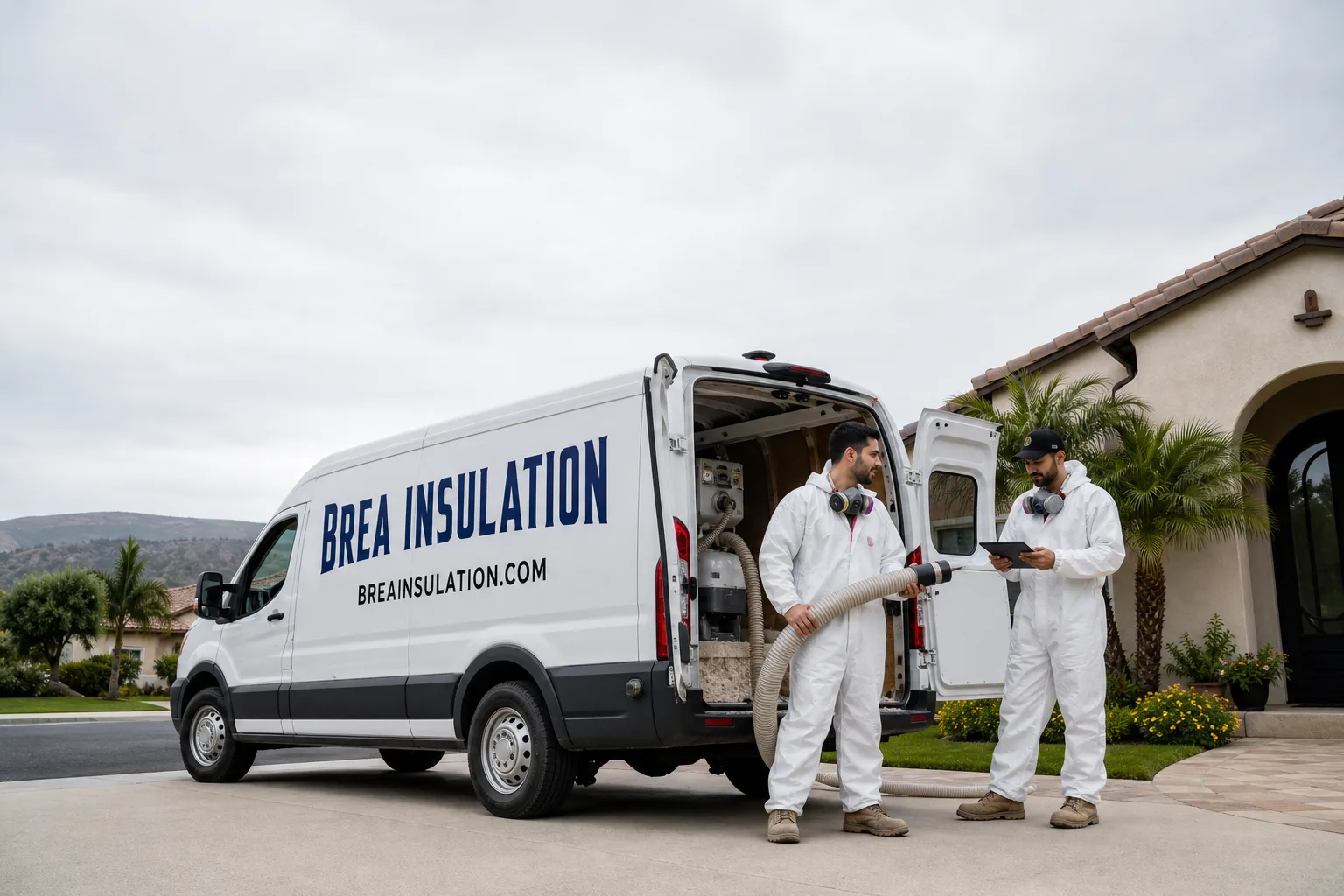
Fast, Reliable Spray Foam Insulation Across Corona
Spray foam insulation in Corona typically runs $2.50 to $6.50 per square foot installed, with closed-cell foam on the higher end and garage ceiling applications falling in the $1,800 to $4,200 range for a standard two-car garage. Most Corona jobs are completed in one day, and our crews are in Corona neighborhoods like the 92879 tract homes, the newer 92883 builds up into the Temescal Valley, and the 92881/92882 grid near Foothill Parkway every week. Homeowners in Corona deal with a specific problem: attics that bake under 100-degree summer heat and Santa Ana wind events that push temperatures far past what builder-grade insulation was ever rated to handle. Brea Insulation fixes that with spray foam that air-seals, not just insulates. Call (866) 858-4033 for a free estimate, and our Spray Foam Insulation team will give you a straight answer on what your Corona home needs.
Why Brea Insulation Is Corona’s Preferred Spray Foam Insulation Company
Insulation is the only thing we do. That focus matters in a city like Corona, where the housing stock runs heavily to 1980s and 2000s production-built tract homes that all share the same weak points. Phil Darnell built Brea Insulation around a simple principle: match the material to the job, not the other way around. We carry eight manufacturer lines including Icynene, Demilec, and Owens Corning, so when a Corona homeowner calls about a west-facing attic in 92881 or a garage ceiling over a builder-grade opener in 92879, we have the right foam for that exact condition.
Corona residents call us because we know the difference between a flatland tract house and a Temescal Valley home climbing the grades in 92883. Those aren’t the same insulation job, and a company that treats them as identical is guessing. We don’t guess. Our crews have been inside hundreds of attics across the 92882 and 92877 grid, and we can tell you what’s under your ceiling before we open it. Response to Corona is same-day for estimates and next-day for most installs. Call (866) 858-4033 and ask for Phil.
Garage Spray Foam Insulation in Corona
Garage Spray Foam Insulation in Corona is the single highest-impact fix for homes with bedrooms over the garage, which describes a large share of the 1980s and 1990s two-story tracts across 92879 and 92881. Builders put drywall on the garage ceiling and called it done. No insulation, no air sealing. During a Corona summer, that bare ceiling turns the garage into an oven that radiates heat upward into the rooms above it and sideways through the shared wall into the house. Spray foam changes that by bonding directly to the garage lid and sealing every gap.
Cost for a standard two-car garage ceiling in Corona runs $1,800 to $3,200 for closed-cell, depending on access and whether we’re also treating the knee walls. Some homeowners ask about open-cell on garage lids; we generally steer Corona garages toward closed-cell because it adds structural rigidity and acts as a vapor barrier in a space prone to humidity from parked cars.
What goes into it
We mask and protect everything, then spray the foam directly onto the ceiling, rim joists, and any knee-wall cavities facing the house. The foam expands into every crack and seam. When we’re done, the garage stays within a few degrees of ambient temperature instead of spiking 20 to 30 degrees above the outside air. Bedrooms over the garage hold temperature through the worst Santa Ana event.
When Corona homeowners need it
You notice the upstairs front bedroom never cools below 78 in July. Your garage feels like a sauna at 9 a.m. The wall between the garage and the laundry room is warm to the touch. Any of these signals means that builder-grade gap is costing you money and comfort. Garage foam is also a smart prep step if you’re considering an EV charger or converting garage space for a workshop or gym.
Closed Cell Spray Foam Insulation in Corona
Closed Cell Spray Foam Insulation in Corona is where we spend most of our days, because it’s the only product that solves the two biggest problems this city’s attics face: extreme heat and air leakage. Closed-cell foam cures at roughly 2 inches thick as an air barrier and vapor barrier, adds structural strength, and won’t sag or settle the way fiberglass batts do under decades of Corona heat cycling. It’s the product we recommend for attic decks, rim joists, and garage ceilings in nearly every Corona home built before 2010.
For a typical Corona attic deck, closed-cell runs $3.50 to $6.00 per square foot, with rim joist work often adding $800 to $1,500 depending on the home’s footprint. It’s more than batts, and it outperforms them in ways that matter here: batts don’t stop air movement, and air movement is what drives attic temperatures during a Santa Ana event. In a 2003 production-built tract off Foothill Parkway in 92881, our crew opened a west-facing attic where the original builder batts had sagged and the garage ceiling above the openers was bare drywall, letting attic heat cook the garage and the rooms above it. We ran closed-cell spray foam across the garage lid and knee walls, air-sealed the top plates and can lights, and finished with a reflective radiant barrier. The homeowner noticed the bedrooms over the garage held temperature through the next Santa Ana event instead of spiking.
Why R-value isn’t the real story
Builders talk R-value because it’s a number on a spec sheet. But a batt rated R-30 installed with gaps around can lights, top plates, and vent chases performs like R-15 or worse. Closed-cell foam is an air seal first and insulation second. In Coronas’s west-facing 92881 and 92882 tracts, that seal is the difference between an attic that behaves and one that fights your HVAC all summer.
Warranty and material choice
We install Icynene and Demilec closed-cell foams, both with manufacturer-backed warranties and decades of field performance in hot climates. If a foam isn’t matched to the attic’s exposure and the home’s elevation, it can underperform or off-gas. Corona’s combination of high heat and dry air means we specify closed-cell with a higher compressive strength for structural applications.
Trusted Brands We Service in Corona
We carry eight manufacturer lines, and we match the product to the condition, not the other way around. For Corona attics with extreme heat exposure, we lean on Icynene and Demilec closed-cell foams for their air-sealing and structural performance. For garage ceilings and rim joists, those same foams earn their keep because they handle temperature swings without degrading. Owens Corning provides our fiberglass and mineral wool options when a hybrid approach makes sense. Because we stock materials locally and run crews into Corona every week, turnaround on most jobs is next-day or better. We don’t make a Corona homeowner wait while parts come from a warehouse in another county.
Common Spray Foam Insulation Problems We See in Corona Homes
- Settled and compressed builder batts in west-facing attics. The original R-11 to R-19 fiberglass in 1980s and 2000s tract attics across 92881 and 92882 compresses under years of Santa Ana heat cycling. By the time we open the attic, the batts are often a third thinner than the manufacturer spec, leaving bare gaps that spray foam would have sealed permanently.
- Bare garage ceilings over builder-grade doors and openers. Builders consistently skip insulating the garage lid in Corona tract homes. The garage turns into a heat reservoir, and the wall between the garage and the house turns into a radiator. Closed-cell foam on the ceiling and knee walls stops that transfer dead.
- Open-cell foam applied without a radiant barrier on west-facing decks. Some contractors sell open-cell as a cheaper alternative and skip the radiant barrier. In a 92881 or 92882 west-facing attic during a Santa Ana event, the deck still spikes, and the open-cell foam’s service life shortens. Those attics need closed-cell and a reflective barrier together.
- Unsealed can lights and top plates in vaulted-ceiling tract homes. Corona’s 1980s and 1990s tracts have plenty of cathedral and vaulted ceilings with can lights and top plates that leak conditioned air straight into the attic. Foam that doesn’t air-seal those penetrations is only doing half the job.
Pricing for Spray Foam Insulation in Corona, CA
Garage ceiling spray foam in Corona runs $1,800 to $3,200 for a two-car garage. Rim joist work adds $800 to $1,500. Attic deck closed-cell runs $3.50 to $6.00 per square foot, and a typical 1,800-square-foot Corona attic falls between $5,500 and $9,500. Roof deck applications, common in vaulted-ceiling homes and garage conversions, land between $6.00 and $8.00 per square foot. The variables are access, surface prep, and whether we’re also treating knee walls, top plates, and can lights. We give a written, line-item quote before we start, and the price we quote is the price you pay. Estimates in Corona are free. Call (866) 858-4033 to book one.
We Also Serve Cities Near Corona
Our crews cover the full Corona area including Home Gardens, El Cerrito Corona, Eastvale, and Norco. If you’re in any of those neighborhoods, call (866) 858-4033 and we’ll be at your door the same week, usually sooner. Same pricing, same brands, same crew-level expertise.
Serving Corona, CA — Our Local Coverage Area
We’re based in the Corona area and know this community well. Use the map below to see our service coverage — if you’re nearby, we can almost certainly help.
FAQs About Spray Foam Insulation in Corona
Yes, and it’s one of the highest-return insulation projects we do in that era of Corona tract home. The garage ceiling was almost certainly left uninsulated by the production builder, which means the garage overheats and pushes heat into the rooms above and beside it. Closed-cell foam on the garage lid and knee walls typically costs $1,800 to $3,200 and pays back in lower cooling bills and usable garage space. Call (866) 858-4033 and we’ll quote your exact garage.
Yes. Homes climbing the Temescal Valley grades in 92883 experience wider day-night temperature swings and more wind exposure than the flatland 92879 grid, and some sit on former mine-affected ground that shifts vapor and drainage patterns. Those homes need closed-cell foam with full air-sealing and vapor detailing at top plates, knee walls, and rim joists. The builder playbook for flatland tracts skips those steps, and skipping them in 92883 shows up as condensation and musty garages. We specify per-elevation and per-exposure, not per zip code alone.
Yes, and this is a job we’d schedule quickly. West-facing attics in the 92881 and 92882 tracts hit temperatures during Santa Ana events that exceed what builder-grade R-11 to R-19 batts were rated for, and the heat cycling causes off-gassing and compression. Closed-cell spray foam air-seals the attic and stops the thermal transfer. Paired with a radiant barrier, it holds the deck temperature down and keeps the foam’s service life long. One-day attic deck jobs are common.
Directly, yes. Can lights and top plates are two of the biggest air leaks in Corona’s 1980s and 1990s tract homes, especially those with vaulted or cathedral ceilings where the framing dumps conditioned air straight into the attic. Spray foam expands into those gaps and seals them permanently. This is a standard part of our attic deck and garage ceiling work, and it’s why foam outperforms batts in these houses by a wide margin.
We install Icynene and Demilec closed-cell and open-cell foams, backed by manufacturer warranties, plus Owens Corning and other lines for hybrid applications. The brand isn’t the decision; the condition is. For a west-facing Corona attic we’d specify a closed-cell Icynene or Demilec product with the right compressive strength and air-seal rating. For a garage ceiling, the same products in a thinner application. Call (866) 858-4033 and we’ll walk you through which product fits your home and why.
Written by Phil Darnell, Owner at Brea Insulation, serving Corona since our first day in the business.