
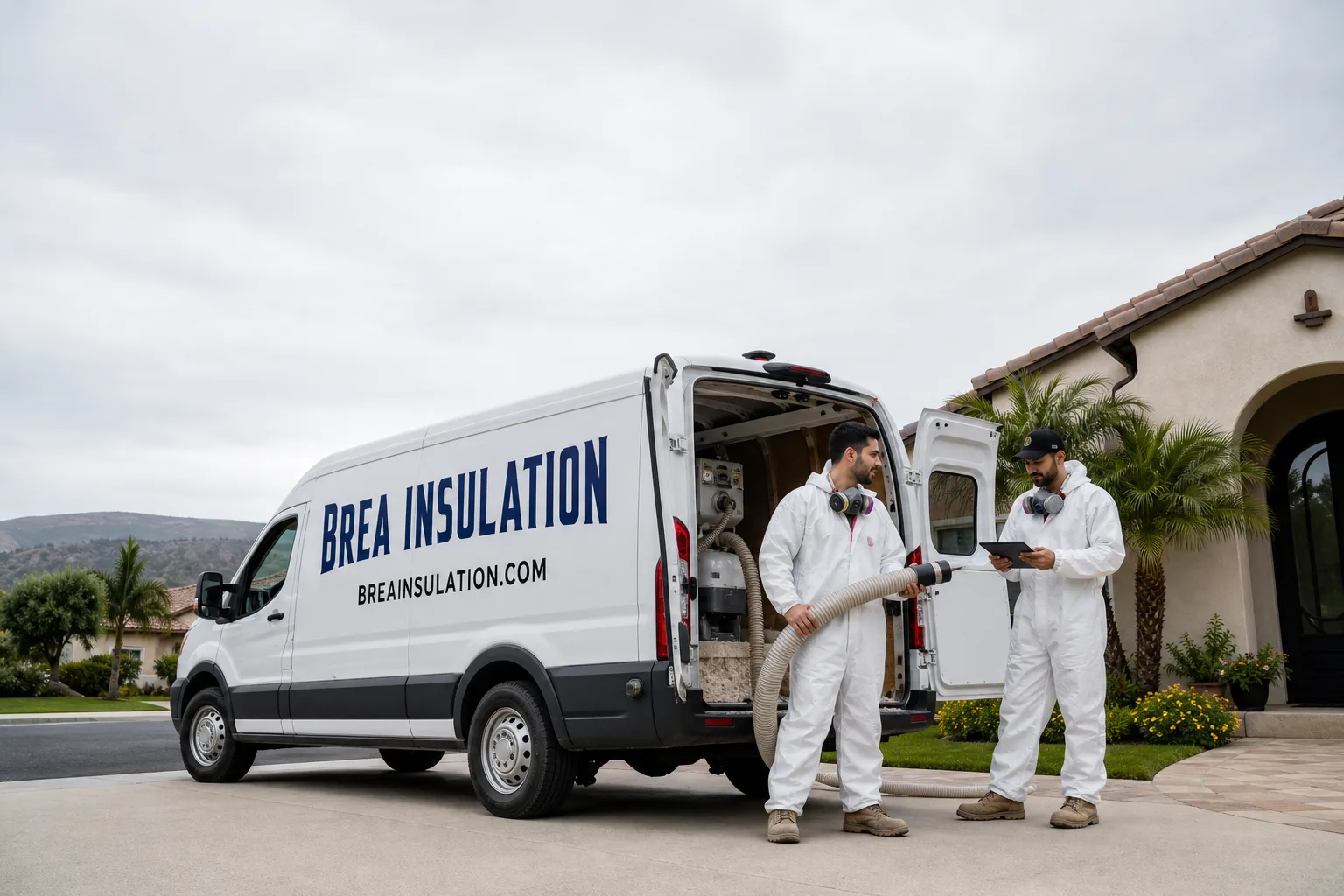
Fast, Reliable Attic Insulation Across Home Gardens
Attic insulation in Home Gardens typically costs $1.50 to $3.50 per square foot for blown-in work, with most 92879 homes running between $1,800 and $4,200 for a full top-off and air-seal job. We get calls from Home Gardens homeowners every week during the summer, usually after the third straight week of the AC running nonstop and the living room still feeling warm by 4 p.m. The fix is almost always the same: the original 1970s batts have settled to nothing, and the attic is radiating heat straight down through the ceiling. You can reach us at (866) 858-4033 for a free estimate, and we respond to Home Gardens calls fast because we’re based right up the 91 in Brea.
Why Brea Insulation Is Home Gardens’s Preferred Attic Insulation Company
Home Gardens is unincorporated Riverside County, not a city, which means homeowners here don’t get the same municipal code enforcement or energy-efficiency rebate programs that Corona or Eastvale residents do. That’s a real distinction, and it changes how we approach every 92879 job. Phil Darnell, who leads our team, has walked enough Home Gardens attics to know what the original tract builders in the 1950s through 1980s did and didn’t install. Most of these homes got the bare minimum at construction – thin fiberglass batts, no radiant barrier, no attic ventilation beyond a couple of static roof vents. Three decades of Inland Empire heat has done the rest.
Insulation is all we do. We’re not a handyman service adding insulation as a line item, and that focus shows when we’re in a Home Gardens attic diagnosing why the back bedroom won’t cool. We carry eight brands – Owens Corning, Johns Manville, Knauf, Rockwool, CertainTeed, Icynene, Demilec, and GreenFiber – so the recommendation we make is driven by what your home actually needs, not what’s cheapest on our truck. Our Attic Insulation team has handled everything from 900-square-foot ranch homes near the 91 corridor to larger stucco tracts with converted garages that have wrecked the thermal envelope. We respond to Home Gardens estimates within one business day, and in summer we prioritize attic jobs because we know what a 140°F attic feels like to a homeowner at 6 p.m.
Attic Ventilation in Home Gardens
Attic ventilation in Home Gardens is the difference between an attic that bakes at 140°F and a space that actually lets heat escape before it radiates into your living room. Most 92879 homes from the 1970s and 1980s were built with minimal static venting – typically a couple of small roof vents and maybe one gable vent. That’s nowhere near enough for the Inland Empire climate, where summer attic temperatures routinely exceed 140°F and stay there for hours. When we add proper ventilation – ridge vents, soffit vents, or powered options depending on the roof design – we give that trapped heat somewhere to go. A typical attic ventilation job in Home Gardens runs $600 to $1,400 for a single-story ranch, which includes baffles and sealing around the new vents.
Why Original 1970s Venting Fails Here
The original static roof vents on Home Gardens tract homes are small, poorly positioned, and after 40-plus years, often blocked by debris or crushed by roofing work. When we inspect attics along streets like those off Magnolia Avenue or near the 91 freeway corridor, we routinely find attic temperatures 30 to 40 degrees higher than they’d be with proper cross-ventilation. That heat load doesn’t stay in the attic – it pushes down through the ceiling and forces your AC to work harder. Ventilation is the first thing we address on any Home Gardens attic job, because insulation alone can’t fix a space that’s trapping heat.
Baffles and Soffit Prep for 92879 Homes
Before we add ventilation to a Home Gardens roof, we install baffles to keep the new airflow channel clear and prevent insulation from blocking the soffit intakes. Older stucco tract homes often have soffits that were never designed for active airflow, so we prep them properly – that means clearing, sealing, and ensuring the intake side works with the exhaust side. Without that prep, you end up with vents that don’t actually move air, which is wasted money. We include baffles and soffit prep in the ventilation estimate, so there’s no surprise line item later.
Radiant Barrier in Home Gardens
Radiant barrier in Home Gardens is one of the highest-impact upgrades you can make on a 1970s tract home that’s fighting Inland Empire heat. A radiant barrier is a reflective material – typically aluminum foil bonded to kraft paper or polypropylene – that we install on the underside of your roof deck. It reflects radiant heat back out instead of letting the roof deck absorb it and re-radiate it down into your attic and living space. In Home Gardens, where the original builders rarely installed them, a radiant barrier can drop attic temperatures by 20 to 30 degrees on a summer afternoon. A typical radiant barrier install for a Home Gardens attic runs $1.20 to $2.00 per square foot, so a 1,200-square-foot attic lands around $1,400 to $2,400.
Why 92879 Attics Need It More Than Most
The summer sun in Riverside County is relentless, and Home Gardens sits right in the hottest swath of it. Our crew measured an attic near the 91 freeway corridor at 148°F on a June afternoon – that’s common, not an outlier. With no radiant barrier, all that heat pours down into the insulation below, and once the insulation saturates with heat, it radiates into your ceiling. Reflective barriers work especially well in low-humidity climates like ours, which is why they’re standard practice in the Inland Empire but less common in coastal Orange County. If your Home Gardens home has no radiant barrier, that’s almost certainly the single biggest thermal gap in your envelope.
Pairing a Barrier With an Attic Top-Off
A radiant barrier is not a substitute for attic insulation – it’s a complement. The barrier blocks the initial radiant load, and the insulation slows whatever conductive heat gets through. In Home Gardens, where the original 1970s batts have often settled to R-11 or less, doing the barrier without topping off the insulation only solves half the problem. We recommend doing both together on any 92879 home that still has original attic insulation. The combined cost is higher, but the comfort change is dramatic – and it’s the combination that actually lets your AC cycle normally in August.
Trusted Brands We Service in Home Gardens
When we insulate a Home Gardens attic, we’re not locked into one product line. We carry and install Owens Corning and Johns Manville fiberglass, Demilec closed-cell spray foam for air-sealing and high-R-value work, and GreenFiber blown-in cellulose for top-offs over existing insulation. That matters in 92879 because different situations call for different materials. A clean attic that’s never had insulation is a good candidate for spray foam or fresh batts. A 1970s ranch with settled fiberglass is better served by blowing GreenFiber over the top – it’s faster, less disruptive, and it fills the nooks that batts never covered. We keep local stock of these materials so Home Gardens jobs don’t wait on special orders. The right insulation for your home – not just what’s easiest to install.
Common Attic Insulation Problems We See in Home Gardens Homes
- Settled 1970s fiberglass batts. The original batts in most 92879 tract homes have compressed to 2-3 inches in places, dropping the attic to roughly R-11. That’s less than a third of the R-38 to R-60 the Inland Empire climate calls for. A top-off with blown-in insulation fixes this in a single day.
- No radiant barrier at the roof deck. Home Gardens tract builders in the 1950s through 1980s skipped radiant barriers almost universally. Attic temperatures past 140°F are the direct result, and that heat radiates down through the ceiling into living space. A reflective barrier install is the standard fix.
- Converted garages and add-ons with no wall insulation. A lot of these older ranch homes had garages enclosed or rooms added later, and those additions rarely got insulated walls or attic continuity. The thermal envelope ends up uneven, so the rest of the house never feels right even after an attic top-off. We check for these gaps on every Home Gardens estimate.
- Blocked or undersized attic ventilation. The few static vents these homes were built with are often crushed, blocked, or just too small to move real air. Hot air gets trapped, the attic bakes, and insulation eventually saturates with heat. Adding ridge or soffit venting restores the airflow that insulation needs to work.
Pricing for Attic Insulation in Home Gardens, CA
Here’s what we see in the 92879 market. A blown-in attic top-off over existing insulation runs $1.50 to $2.50 per square foot, so a 1,100-square-foot Home Gardens ranch typically lands between $1,650 and $2,750. Full attic insulation replacement – remove the old settled batts, air-seal, and install new material – runs $2.50 to $3.50 per square foot, or $2,750 to $3,850 for that same home. Adding a radiant barrier runs parallel at $1.20 to $2.00 per square foot. Attic ventilation work, including baffles and new vents, adds $600 to $1,400 depending on roof configuration. Every estimate is free, and we give you a written number before any work starts. Call (866) 858-4033 and we’ll come out to Home Gardens and measure the attic properly – no guesswork, no pressure.
We Also Serve Cities Near Home Gardens
Brea Insulation covers Home Gardens and the surrounding Riverside County communities, including Corona, Eastvale, Norco, and El Cerrito Corona. If you’re right across the border in any of those areas, the same team and the same material selection applies. One call covers the whole Inland Empire corridor along the 91 and 15.
Serving Home Gardens, CA — Our Local Coverage Area
We’re based in the Home Gardens area and know this community well. Use the map below to see our service coverage — if you’re nearby, we can almost certainly help.
FAQs About Attic Insulation in Home Gardens
Most 1970s Home Gardens homes need a top-off, not a full replacement. The original fiberglass batts have settled but they’re often still functional as a base layer, so we blow GreenFiber or new fiberglass on top to reach the R-38 to R-60 level the climate demands. A full removal and replacement only makes sense if the original insulation is water-damaged, rodent-soiled, or contaminated. We’ll tell you straight which one applies after we look in the attic. Call (866) 858-4033 to schedule an inspection – estimates are free.
In July and August, a Home Gardens attic without radiant barrier routinely hits 140-150°F by mid-afternoon, and we’ve measured 148°F near the 91 freeway corridor. With no ventilation and settled insulation, that heat saturates the space and radiates down into your living areas. This is the single biggest reason AC systems in 92879 run constantly and still can’t hold temperature on peak days.
Yes, and in Home Gardens it’s often one of the best dollar-for-dollar upgrades available. The barrier blocks the initial radiant heat from the roof deck before it ever reaches your insulation, which keeps the insulation cooler and more effective. If you have R-11 to R-19 in a 92879 attic and no barrier, adding one can drop ceiling temperatures noticeably within the same day of installation. We recommend pairing it with a top-off for the full effect.
Yes, but only if we address the garage walls and the attic space above it at the same time. In Home Gardens, older converted garages almost never got wall insulation or proper attic continuity, so heat enters through three surfaces instead of one. An attic top-off that skips the garage section won’t fix the space. We’ll scope the whole envelope – garage walls, ceiling above the conversion, and any gap where the add-on meets the original roofline – and give you a price that covers all of it.
We install Owens Corning and Johns Manville fiberglass, Demilec closed-cell spray foam, and GreenFiber blown-in cellulose, among others. The material choice depends on your attic’s condition, your budget, and whether you need air-sealing in addition to insulation. For most Home Gardens top-offs, GreenFiber cellulose is the right call – it fills around existing batts, packs well, and uses recycled material. For air-sealing a drafty 1970s attic, Demilec spray foam is the more effective route. Call (866) 858-4033 and we’ll walk you through which product fits your home.
Written by Phil Darnell, Owner at Brea Insulation, serving Home Gardens and the Inland Empire since 2008.