
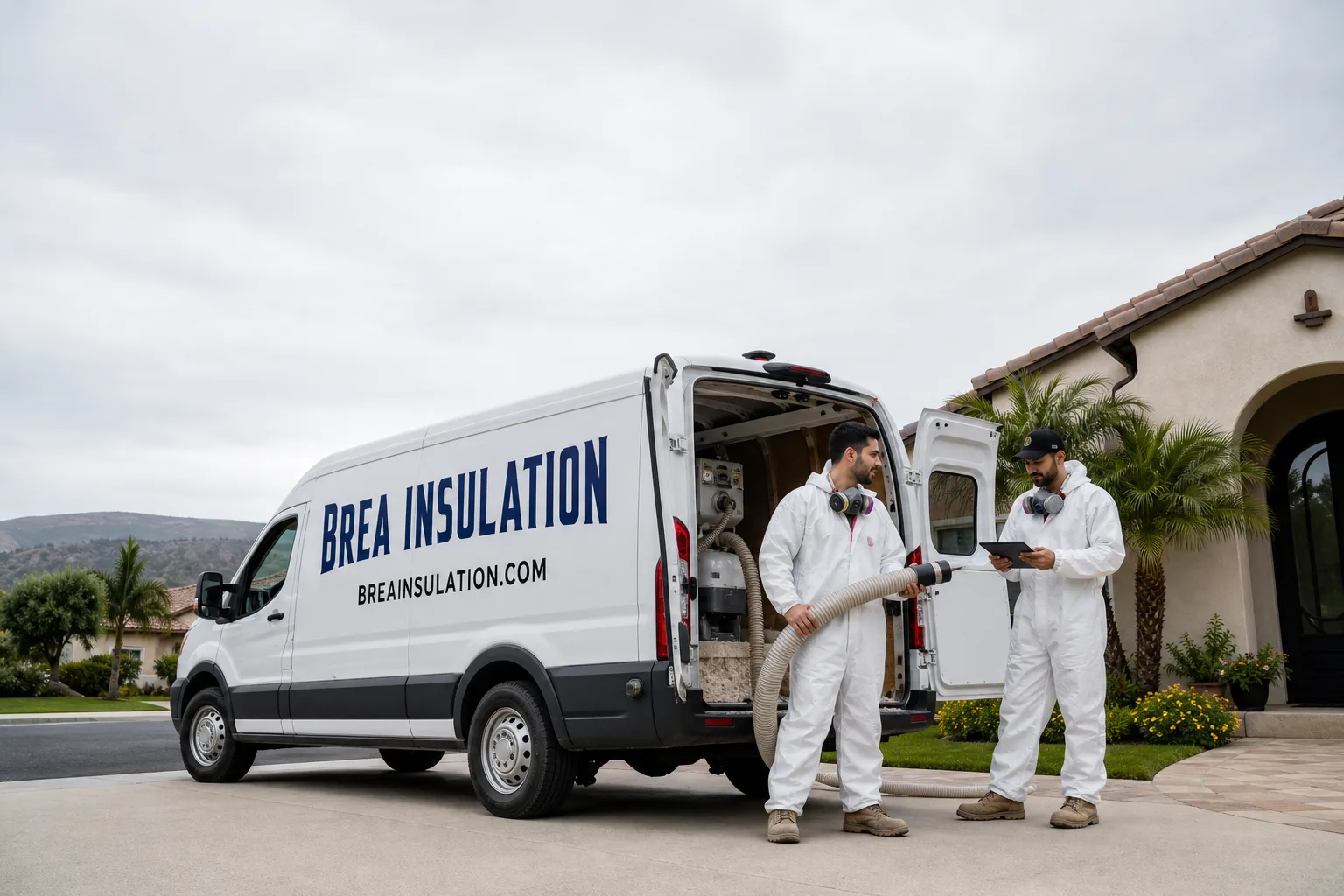
Fast, Reliable Spray Foam Insulation Across Spring Valley Lake
Spray foam insulation in Spring Valley Lake typically costs $2.50 to $6.50 per board foot installed, with most full attic retrofits running $4,800 to $9,500 depending on square footage and foam type. Our crews respond to Spring Valley Lake calls within 24 to 48 hours in most cases. That matters when your attic is baking at 140°F and your air conditioner can’t keep up. We know the homes here, we know the heat, and we know what it takes to fix an under-insulated attic in this community. Call (866) 858-4033 for a free estimate, and we’ll send a technician who knows exactly what to look for in Spring Valley Lake’s tract-era construction.
Why Brea Insulation Is Spring Valley Lake’s Preferred Spray Foam Insulation Company
Insulation is all we do. That’s not a slogan, it’s how we’re structured. We don’t install roofs, we don’t service HVAC units, and we don’t take on handyman side work. When a Spring Valley Lake homeowner calls us about a scorching second story or an attic that won’t stop radiating heat into the living space, the person who shows up spends every working day thinking about thermal envelopes, air sealing, and R-value. That narrow focus matters in a place where the difference between a properly insulated attic and a settled fiberglass batt job is a summer electric bill that’s $200 higher every month.
We carry materials from Icynene, Demilec, and Owens Corning, which means we’re not locked into one manufacturer’s product line. A 1980s stucco home near the lake needs something different than a newer golf-course-adjacent build. We match the foam to the job. Our Spring Valley Lake customers consistently tell us the same thing: the crew showed up on time, explained exactly what they found in the attic, and didn’t push a product that wasn’t right for the structure.
Spray Foam Insulation Contractors in Spring Valley Lake
Spray Foam Insulation Contractors in Spring Valley Lake do not all approach the job the same way, and the difference shows up in your energy bills for years. A proper spray foam job in this community starts with removing or addressing the settled fiberglass batt that’s been sitting in the attic since the Carter or Reagan administration. If a contractor sprays foam directly over compressed, degraded batt without air-sealing the attic floor first, they’ve locked the problem in place, not solved it. That’s a failure we see regularly when we’re called in to re-do someone else’s work. The honest approach in Spring Valley Lake: remove the old material, air-seal the plane between attic and living space, then apply closed-cell foam at the right depth for the high desert climate.
Closed-Cell vs. Open-Cell for High Desert Homes
Closed-cell spray foam is the workhorse for Spring Valley Lake attics. At roughly $3.50 to $6.50 per board foot, it costs more than open-cell, but it delivers an R-value of about R-6.5 per inch and acts as its own vapor barrier. That’s important in a climate where winter nights dip near freezing and the temperature inside the attic swings 60 degrees in a single day. Open-cell foam, typically $2.50 to $4.50 per board foot, is a good fit for interior wall cavities and sound control, but for the attic envelope in a 1970s tract home, closed-cell is usually the right call. We’ll tell you which one fits your house, not which one is easier for us to install.
Rim Joist and Garage Ceiling Work
Rim joist spray foam is one of the most overlooked upgrades in Spring Valley Lake homes. The rim joist, where the foundation meets the wood framing, is a common entry point for the dry, dusty Victor Valley air that infiltrates crawlspaces and garages. Sealing it with closed-cell foam stops air movement and cuts the dust load inside the house. Garage ceiling spray foam runs $1,800 to $4,200 for a typical two-car garage and makes a real difference when the garage shares a wall with a bedroom or living area.
Spray Foam Attic Insulation in Spring Valley Lake
Spray Foam Attic Insulation in Spring Valley Lake is the highest-impact retrofit you can make to a home built between 1970 and 1995, and that’s most of the housing stock here. The original fiberglass batt insulation in these attics was often R-11 to R-19 when it was installed, and after 40 or 50 years of settling, compression, and rodent traffic, it’s frequently performing below R-11. The high desert demands R-38 or better in the attic. Spray foam closes that gap in one application, and because it air-seals as it insulates, it addresses the under-ventilated attic problem that’s baked into these older stucco tract designs. A standard Spring Valley Lake attic retrofit, including old insulation removal, air-sealing, and closed-cell foam application, typically runs $5,500 to $9,500 for homes between 1,200 and 2,200 square feet.
What We Found in a 1980s Tract Home Near the Golf Course
We recently completed a spray foam insulation job on a 1980s stucco home near the Spring Valley Lake golf course. The homeowner complained of scorching upstairs bedrooms and high energy bills; our crew found the original R-11 batts compressed and a severely under-ventilated attic reaching 145°F. We removed the old insulation, air-sealed the attic floor with closed-cell spray foam, and applied a radiant barrier to the roof deck. The result was a 30°F drop in attic temperature and noticeably cooler rooms within a week. That’s the kind of before-and-after we see routinely in this community, where the original builder-grade insulation was never designed for a 100°F-plus summer day.
Radiant Barrier and Foam: The Combined Approach
In Spring Valley Lake, spray foam alone does not always solve the attic heat problem. The sun beats on these stucco and composition-shingle roofs all afternoon, and the roof deck itself radiates heat down into the attic space. That’s where a radiant barrier comes in. A radiant barrier installed on the underside of the roof deck reflects solar heat back out, reducing attic temperatures by 20°F to 30°F before your foam insulation even has to do its job. The combination of closed-cell foam at the attic floor and a radiant barrier at the roof deck is the most effective retrofit we know for this specific climate. Figure $1.50 to $2.50 per square foot for the radiant barrier portion, on top of the foam cost.
Trusted Brands We Service in Spring Valley Lake
We carry eight insulation brands, but the three that matter most for Spring Valley Lake spray foam work are Icynene, Demilec, and Owens Corning. Icynene is the open-cell foam we recommend for wall cavities and sound control in wood-frame construction. Demilec makes a closed-cell product that holds up well in the dry desert climate and delivers consistent R-value per inch. Owens Corning gives us access to additional attic insulation materials and air-sealing components that pair with foam applications. Carrying these brands means we’re not forcing a single product line into every job, which is what happens when a company has a financial incentive to stock one thing. For Spring Valley Lake homeowners, that means the recommendation comes from what your attic actually needs.
Common Spray Foam Insulation Problems We See in Spring Valley Lake Homes
- Foam sprayed over settled fiberglass batt without air-sealing. This is the most common failure we’re called to fix. A contractor blows foam over compressed batts, the air leaks remain, and the homeowner pays for insulation that can’t do its job. In Spring Valley Lake’s windy, dusty conditions, unsealed attic bypasses let desert air pour through the house.
- Under-ventilated attics cooking the foam and the house. Many 1970s to 1990s tract homes in Spring Valley Lake have soffit and ridge vents that were inadequate on day one. Seal the attic floor with foam without addressing ventilation at the roof deck, and attic temperatures climb even higher, degrading foam over time and radiating heat into the living space.
- Poor adhesion on stucco and wood-frame surfaces. The dry desert air in Spring Valley Lake pulls moisture out of surfaces fast. If a crew doesn’t prep the substrate properly, or applies foam to a dusty or weathered surface, the foam can delaminate and lose contact with the framing. That creates gaps and voids exactly where you don’t want them.
- Low-density foam specified where high-density belongs. Open-cell foam has a place in Spring Valley Lake, but not on an unvented attic deck. Some installers use it because it’s cheaper per board foot. What the homeowner gets is a foam that can’t handle the temperature swings and moisture conditions of an unvented high-desert attic. We specify closed-cell for these applications, period.
Pricing for Spray Foam Insulation in Spring Valley Lake, CA
Here’s what you should expect to pay for spray foam work in Spring Valley Lake. Open-cell foam runs $2.50 to $4.50 per board foot installed. Closed-cell runs $3.50 to $6.50 per board foot installed. A full attic retrofit, including removing old fiberglass batt, air-sealing, and applying closed-cell foam, runs $5,500 to $9,500 for homes between 1,200 and 2,200 square feet. Rim joist sealing alone runs $1,200 to $2,800 depending on how much perimeter access the crawlspace allows. Garage ceiling spray foam runs $1,800 to $4,200. Radiant barrier on the roof deck adds $1.50 to $2.50 per square foot. The biggest variable is access: if your attic has tight clearances or the old insulation is heavily contaminated, expect the higher end of these ranges. Call (866) 858-4033 and we’ll give you a firm quote after an attic inspection, not a guess over the phone. Estimates are free.
We Also Serve Cities Near Spring Valley Lake
Brea Insulation handles Spray Foam Insulation work throughout the Victor Valley. We run crews to Mountain View Acres, Victorville, Apple Valley, and Hesperia every week. If you live in one of those communities and need a foam attic retrofit, the same crew that works Spray Foam Insulation in Spring Valley Lake handles your job. Same pricing, same response times, same eight-brand material bench.
Serving Spring Valley Lake, CA — Our Local Coverage Area
We’re based in the Spring Valley Lake area and know this community well. Use the map below to see our service coverage — if you’re nearby, we can almost certainly help.
FAQs About Spray Foam Insulation in Spring Valley Lake
Spray foam performs better than any other insulation type in Spring Valley Lake’s 60-degree daily temperature swings because it air-seals the building envelope, not just insulates it. The dry, windy Victor Valley air moves through fiberglass batt like it’s not there. Closed-cell foam stops that air movement at the source. A properly sealed attic keeps the 100°F summer air out and the near-freezing winter air out too. Call (866) 858-4033 and we’ll show you what a sealed attic looks like in your home.
No, and any contractor who says otherwise is cutting corners at your expense. The old settled fiberglass batt in Spring Valley Lake’s 1970s to 1990s tract homes has to come out before foam goes in. If you spray over it, you trap heat and moisture, you don’t air-seal the attic floor, and the foam can’t bond properly. The right sequence is: remove, air-seal, then apply closed-cell foam at the correct depth. We handle the full removal and disposal as part of every Spring Valley Lake attic retrofit.
Aim for R-38 or higher in the attic, which for closed-cell foam means about 6 inches of application. For open-cell foam in wall cavities, target R-15 to R-21 depending on the wall depth. The original R-11 to R-19 batt in most Spring Valley Lake attics is nowhere near what the high desert climate demands. That’s why these homes bake in summer. Our sealed attic retrofits consistently bring attic temperatures down 25 to 30 degrees, and the R-value you get is what the foam actually delivers, not what a spec sheet says it might deliver after settling.
It helps by changing the strategy from venting to sealing. Many Spring Valley Lake attics don’t have enough soffit and ridge ventilation to manage the heat, and adding vents to a 1980s stucco roof isn’t always practical. The alternative is to air-seal the attic floor with closed-cell foam and add a radiant barrier to the roof deck. This keeps the superheated attic air out of the living space instead of trying to vent it away. We do this on nearly every Spring Valley Lake retrofit because the original venting is rarely adequate.
Yes, but surface preparation matters more in this climate than anywhere else we work. The dry desert air pulls moisture out of stucco and wood framing quickly, which means dust, loose material, and old paint have to be cleaned off before foam is applied. If the surface is prepped right, closed-cell foam bonds well to both stucco and wood-frame construction and adds structural rigidity to the wall assembly. We’ve done hundreds of spray foam applications on Spring Valley Lake’s stucco tract homes without a single adhesion failure, because we don’t skip the prep step.
Get Your Spring Valley Lake Attic Inspected
If your Spring Valley Lake home was built before 1995 and still has its original attic insulation, you’re paying for it every month. The fix starts with an attic inspection. We’ll climb up, measure what’s there, check the ventilation, and give you a written quote with the exact materials we’d use and the total installed price. No pressure, no vague estimates. Call (866) 858-4033 to schedule your free inspection, or ask for Phil Darnell directly if you want to talk through the technical details before we send a crew out.
Written by Phil Darnell, Owner at Brea Insulation, serving Spring Valley Lake and the surrounding Victor Valley.