
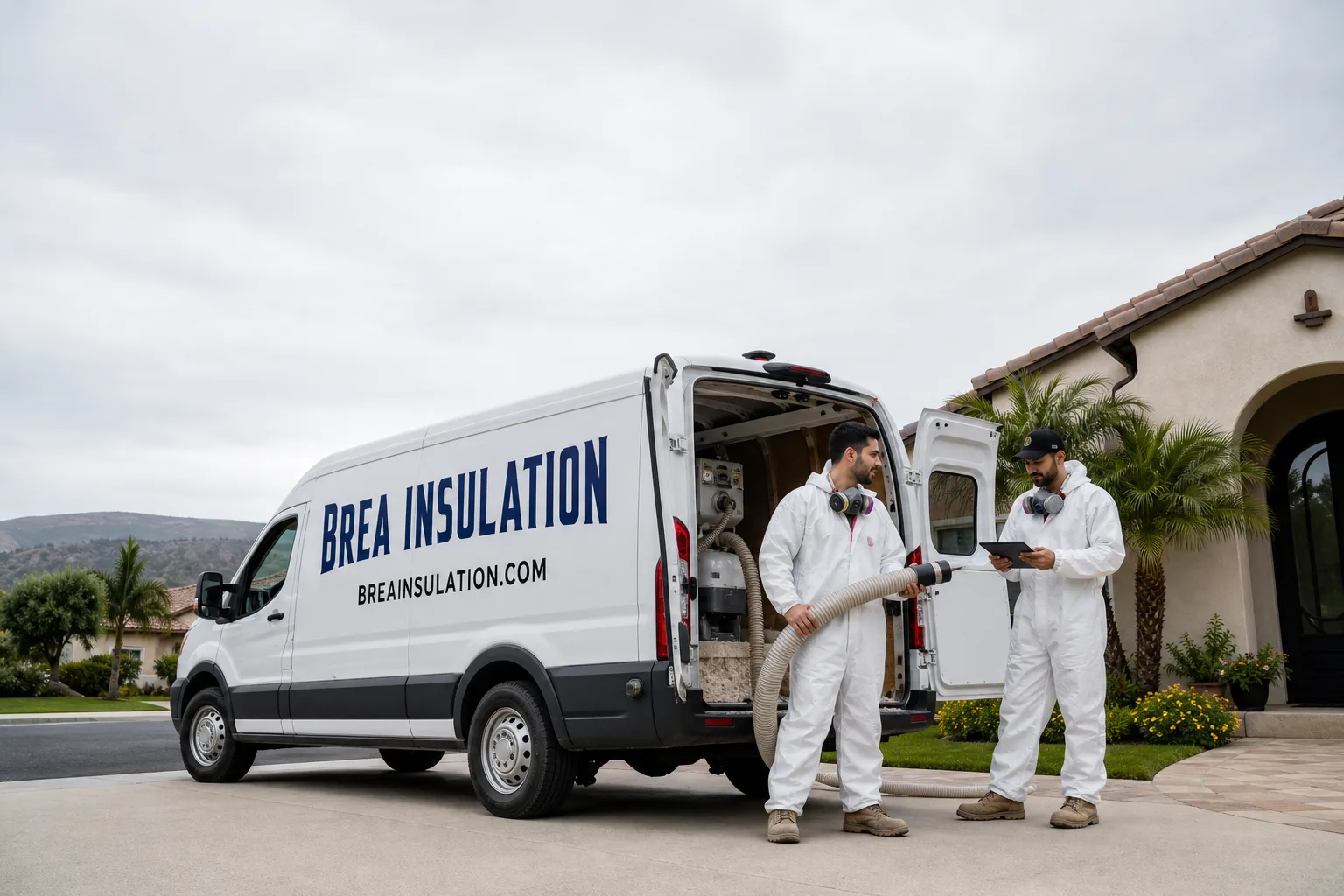
Fast, Reliable Spray Foam Insulation Across Lakeview
Lakeview sits in the Perris Valley, where summer temperatures routinely push past 100°F and the inland wind through the San Jacinto foothills turns attics into ovens by mid-morning. That heat is the real enemy here, not winter cold. Spray foam insulation in Lakeview works because it seals the attic air leaks that let superheated outside air pour into your living space while adding R-value to the roofline itself. Our spray foam crews know the 92567 ZIP and the older rural homes scattered across it, and we respond fast to Lakeview calls, usually within a day or two depending on the season. If you’re fighting a hot second story or cooling bills that spike every July, call Phil Darnell’s team at Brea Insulation at (866) 858-4033 and we’ll give you a straight answer about what your attic actually needs.
Why Brea Insulation Is Lakeview’s Preferred Spray Foam Insulation Company
Lakeview homeowners call us because we’re insulation specialists, not a handyman outfit that adds foam work as a side line. Every crew member works with spray foam, attic insulation, or blown-in on a daily basis. That’s the whole job. Our Spray Foam Insulation team has opened attics in Lakeview’s older rural homes and the newer tract subdivisions alike, so we know what a 1920s farmhouse attic looks like versus a 1990s subdivision attic, and we know what each one needs. Local homeowners tell us they appreciate that we don’t have to flip through a manual to recognize settled fiberglass or a roof deck that’s been baking for 40 summers. When we quote a Lakeview job, the price reflects the actual condition of the home, not a generic square-footage chart. Phil Darnell built Brea Insulation around a simple idea: carry enough material options to match the product to the house, not the other way around. We carry eight manufacturer brands in our lineup, including Demilec, Icynene, Owens Corning, and GreenFiber, so when one foam isn’t right for a job, we have alternatives ready on our truck rather than excuses.
Rim Joist Spray Foam in Lakeview
Rim joist spray foam in Lakeview addresses a problem most attic-focused insulation companies skip entirely: the band board where your floor framing meets the foundation wall, which lets outside air pour into the house and the garage. In Lakeview’s dry inland climate, the rim joist area often looks bone dry, so homeowners assume it’s fine. But the dry air masks slow moisture intrusion from condensation and even minor plumbing leaks, and we’ve opened garages in 92567 where the rim joist timber was already softened before anyone noticed. Spraying closed-cell foam along the rim joist seals the air leaks and creates a moisture barrier that protects the framing. A typical rim joist spray foam job in Lakeview runs $1,600 to $3,400 depending on linear footage, access, and whether we’re treating a crawl space, a garage, or both. We usually remove any old fiberglass stuffed along the rim first, because leaving it in place just creates a thermal void.
Garage Rim Joists and Air Leakage
Attached garages in Lakeview leak air into the house through the shared wall and the rim joist, and most garage ceilings have zero insulation at all. We spray the rim joist from inside the garage where possible, using a closed-cell foam that stops the air movement that drags heat into the home in summer. If the garage ceiling is open to the attic, we’ll often quote a garage ceiling spray foam job at the same time, since combining the two is more cost-effective than doing them separately.
Settled Moisture and Rim Joist Degradation
The Perris Valley’s occasional winter rains and the dry summer heat cycle the soil moisture around foundations, and rim joists absorb that cycling over time. We’ve found the worst degradation in older rural homes built before perimeter drainage was standard. Spray foam locks out the air that carries the moisture, and it stiffens the rim joist, which is a real benefit in older Lakeview homes where the framing has dried and shrunk over the decades.
Crawl Space Spray Foam Insulation in Lakeview
Crawl space spray foam insulation in Lakeview is something we recommend more than homeowners expect, because the low-humidity inland air fools people into thinking crawl spaces here stay dry. In reality, the temperature swings between hot days and cool desert nights create condensation on the underside of floor joists, and that moisture sits on the wood all summer. Older homes in the 92567 ZIP, especially those dating to the early-to-mid 1900s, often have dirt or thin gravel crawl spaces with zero thermal protection between the ground and the living space. Spraying closed-cell foam on the crawl space walls and rim joist creates an air and moisture barrier that stops that condensation cycle and cuts the stack effect, where hot outside air pulls up through the floor and pushes conditioned air out of the attic. A crawl space spray foam job in Lakeview typically runs $2,800 to $6,500 for the full perimeter, depending on crawl space size, access height, and whether we’re also encapsulating the floor. We quote it honestly after we’ve looked at what’s under your home, not before.
Encapsulated Crawl Space Walls vs. Floor Insulation
For most Lakeview homes, spraying the crawl space walls and rim joist does more than insulating between floor joists ever could. Wall foam seals the crawl space from the dirt below, which cuts both the moisture and the heat that rises through the floor. In homes with ductwork running through the crawl space, which is common in older Lakeview houses, wall foam also keeps the ducts inside a semi-conditioned space, so your cooled air isn’t fighting 130°F crawl space air all afternoon.
Dry Climate, Hidden Moisture
You’d think a dry inland valley means dry crawl spaces, and usually there’s no standing water. But the real problem is humidity from the soil and the condensation cycle. Closed-cell foam cuts the vapor drive through the foundation vents and walls, which protects wood joists from slow rot and also keeps out the rodents and insects that colonize unsealed crawl spaces in rural Lakeview properties.
Trusted Brands We Service in Lakeview
Brea Insulation carries eight brands in our material bench: Demilec, Icynene, Owens Corning, Johns Manville, Knauf, Rockwool, CertainTeed, and GreenFiber. For Lakeview’s spray foam jobs, we most often reach for Icynene and Demilec closed-cell products on roofs and rims, because those two lines cure reliably in the low-humidity heat that defines the Perris Valley. Owens Corning and Rockwool show up more often on the batting and blown-in side of our work. We keep enough material on hand for a full day’s Lakeview install, so we aren’t running back to a supplier mid-job. That matters in summer, when a half-finished roof deck gets hot enough to burn and the crew has to keep moving. And because Lakeview is a small community, parts and materials are a real logistics question. We plan around it.
Common Spray Foam Insulation Problems We See in Lakeview Homes
- Spraying foam over settled fiberglass: Decades of 100°F-plus valley heat leave old fiberglass batts brittle, compressed, and slumping away from the roof deck. Foam sprayed over that mess traps air pockets that limit R-value, which is why we pull the old material first on most Lakeview attic retrofits.
- Untreated rim joists in attached garages: Homeowners focus on the attic ceiling and never look at the rim joist in the garage or crawl space. But that band board moves air all year, and in Lakeview’s dry heat the moisture signature hides until the wood is already compromised.
- Open-cell foam applied too thick on a hot roof deck: Low-humidity valleys like Lakeview let open-cell foam cure with a crust on the surface while the cells underneath stay uncured. We adjust our lift thickness on hot days and use closed-cell on roof decks where the heat demands it.
- Thin factory insulation in manufactured and mobile homes: Many of Lakeview’s manufactured and mobile homes from the 1970s through 1990s came with minimal factory insulation. Roof cavities are thin, and summer heat pours through the ceiling. We often quote a roof deck spray foam combined with a radiant barrier in these homes.
Pricing for Spray Foam Insulation in Lakeview, CA
We Also Serve Cities Near Lakeview
Brea Insulation works across the Perris Valley and into the surrounding Inland Empire communities. Homeowners in Nuevo, Romoland, Good Hope, and Perris call us for the same spray foam work we do in Lakeview, and we keep response times tight across the whole area. If you’re just outside the 92567 ZIP, we’ll still come out.
Serving Lakeview, CA — Our Local Coverage Area
We’re based in the Lakeview area and know this community well. Use the map below to see our service coverage — if you’re nearby, we can almost certainly help.
FAQs About Spray Foam Insulation in Lakeview
My Lakeview attic has old fiberglass batts that look crushed and are pulling away from the roof deck – can you spray foam right over them?
No. We pull them out first. Lakeview’s decades of 100°F-plus summers bake fiberglass until it turns brittle, compresses, and slumps away from the deck, and spraying foam over that traps air pockets that cut your R-value and can cause the foam to slump later. Pulling the old batts adds labor, but leaving them in place wastes the foam. Call (866) 858-4033 and we’ll tell you what’s actually up there before we quote.
Does spray foam make sense in the crawl space of a 1920s Lakeview home, or is that overkill for this dry climate?
It makes sense precisely because the climate is dry, not despite it. The dry air hides the condensation that forms on floor joists when hot days and cool nights cycle moisture through the crawl space. Older Lakeview homes often have dirt crawl spaces with zero thermal barrier, and spraying closed-cell foam on the walls and rim joist stops that cycle and protects the old framing. Overkill would be doing nothing and waiting for the joists to soften.
How hot does a Lakeview attic actually get, and does that change what foam you recommend?
A Lakeview attic in July and August routinely hits 140°F to 160°F by mid-afternoon, and it radiates that heat down into the house for hours after sunset. That heat load is why we lean toward closed-cell foam on roof decks in the 92567 ZIP. Closed-cell cures hard and bonds tight even in high heat, and it adds structural strength to older roofs. Open-cell has its place on interior walls and some crawl spaces, but on a Lakeview roof deck that bakes every summer, closed-cell is usually the right call.
Can you spray the rim joist in my attached garage without moving everything out of the attic?
Yes. The rim joist is sprayed from inside the garage or crawl space, not from the attic. We work along the band board where the garage wall meets the foundation, and we don’t need access to the attic at all for that job. You don’t have to move attic contents, and most garage work can be done in a single day. If we’re also doing the garage ceiling, that involves the attic space above the garage, but the rim joist itself is a separate access point.
You service Icynene and Demilec – which one fits a Lakeview attic that bakes all summer?
For a Lakeview attic that bakes all summer, we usually recommend Demilec closed-cell or Icynene closed-cell, depending on the roof assembly and your budget. Demilec’s closed-cell line cures board-hard and bonds tight to the decking even in extreme heat. Icynene’s closed-cell offers excellent adhesion and air sealing, and it’s a strong match for roof decks that need the highest R-value per inch. We’ll talk through both when we walk your attic, and we’ll quote you the one that suits your roofline and your budget. Call (866) 858-4033 and Phil Darnell’s team will give you an honest answer.
Written by Phil Darnell, Owner at Brea Insulation, serving Lakeview and the Perris Valley.