
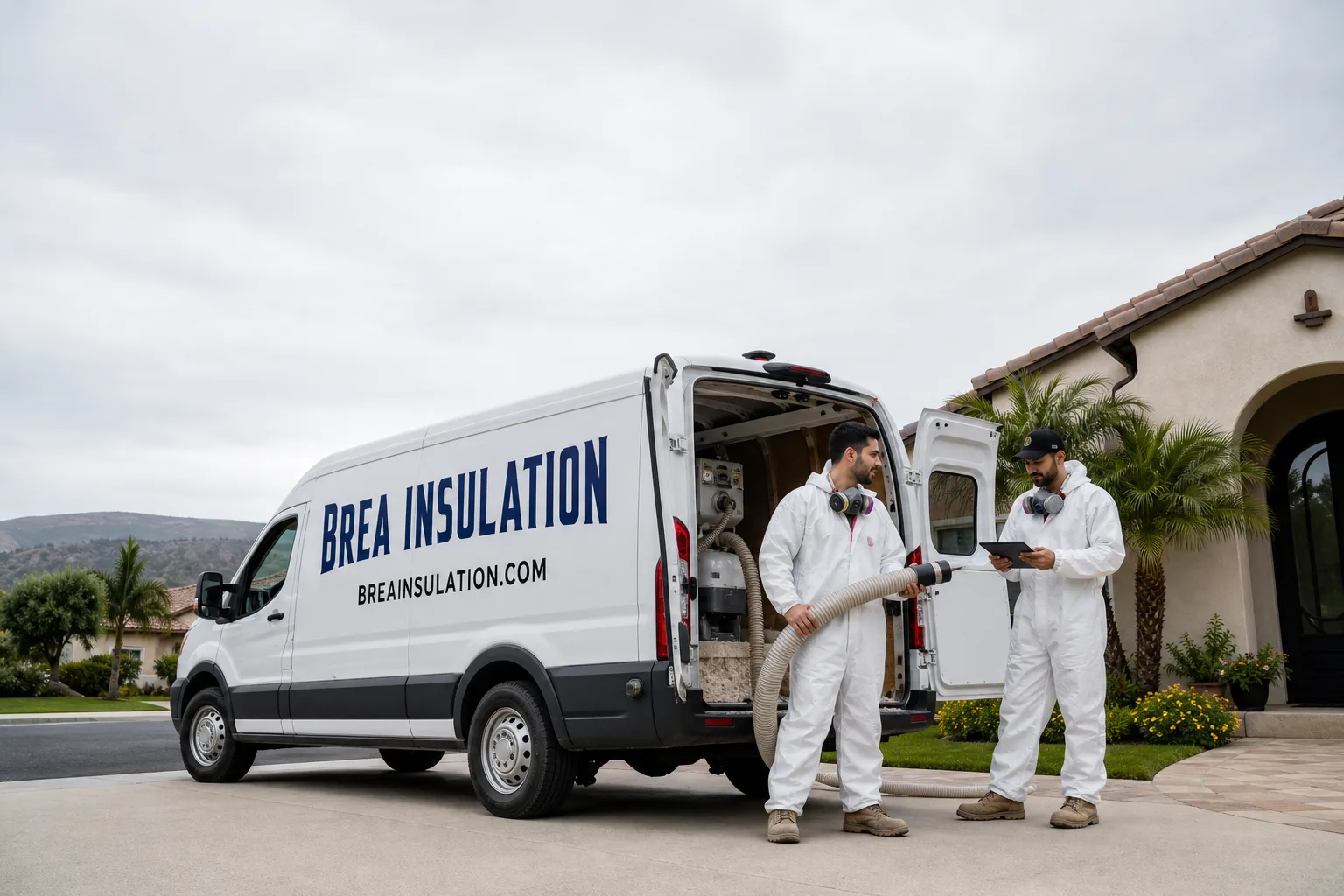
Spray Foam Insulation in Del Aire: What It Costs and Why It Matters Here
Spray foam insulation in Del Aire typically costs $2,800 – $7,200 for a full attic application in a standard 1,100 – 1,400 sq ft ranch, with wall cavity injections running $1,900 – $4,600 depending on stud bay accessibility. Most Del Aire jobs are completed in one to two days, and the work addresses a problem unique to this pocket of Los Angeles: marine-layer humidity that attacks both your insulation’s performance and the metal hardware in attached garages. If you’re dealing with drafty rooms, high summer attic heat, or a garage that feels damp, call Brea Insulation at (866) 858-4033 for a free on-site assessment. We’re a dedicated insulation contractor led by Phil Darnell, and we work in Del Aire every week.
Fast, Reliable Spray Foam Insulation Across Del Aire
Del Aire’s original 1940s and 50s tract homes were built when insulation was an afterthought. Many still have thin fiberglass batts that have settled to half their original thickness, or nothing in the walls at all. That’s a problem here because the coastal air off the Pacific doesn’t just cool things down; it carries salt and moisture that creep into open attics, around unsealed hatch openings, and through attached garage walls. Our Spray Foam Insulation team knows the specific failure patterns in this neighborhood because we’ve worked on dozens of homes between Aviation Boulevard and Isis Avenue. We’re typically on site in Del Aire within 24 to 48 hours of your call. Phil Darnell set up Brea Insulation as a single-trade company for exactly this reason: insulation is all we do, and specialized crews diagnose faster than generalists who’re splitting time across three different trades. Reach us directly at (866) 858-4033.
Why Brea Insulation Is Del Aire’s Preferred Spray Foam Insulation Company
Homeowners here tend to be research-driven. They’ve already looked into R-values, open-cell versus closed-cell, and Title 24 requirements before they pick up the phone. That’s the customer we’re built for. Phil Darnell’s team carries eight manufacturer lines, including Icynene and Demilec for spray foam, plus GreenFiber and Owens Corning for complementary cavity and attic work. We don’t push one product because it’s what we happen to stock. We match the material to the moisture load, the framing pattern, and the specific air-sealing goal in your home.
Del Aire customers regularly tell us two things: the estimate was more detailed than they expected, and the crew respected the fact that these older ranch homes have quirks. Raised foundations mean crawl-space air migrates up through wall cavities. Open attics with minimal soffit venting create stack effect that pulls garage air into living space. We account for all of that before we ever mix foam. Response time matters here too. Because Del Aire sits in a tight service radius off the 405 and 105, we can schedule most jobs within two business days and finish standard attic applications in a single visit.
Spray Foam Attic Insulation in Del Aire
Spray foam attic insulation in Del Aire is the single highest-impact upgrade you can make to a 1940s or 50s ranch, because the marine-layer air that rolls in every evening enters through the attic first. Applying closed-cell foam to the roofline deck creates an air and moisture barrier that keeps damp coastal air out of the insulation layer entirely. A typical open-attic retrofit in Del Aire’s 90251 zip code runs $3,100 – $6,800 for closed-cell on an 1,100 – 1,400 sq ft footprint, depending on rafter depth and whether we’re also sealing the hatch and any can-light penetrations.
Roof Deck Applications for Coastal Humidity
When we spray directly to the roof deck rather than the attic floor, the attic becomes conditioned space. That matters in Del Aire because unconditioned attics here collect marine moisture on cool nights, and that moisture settles into fiberglass batts, reducing their R-value and inviting mildew. Closed-cell foam at 2 – 3 inches on the deck cuts that cycle off completely.
Attic Hatch and Penetration Sealing
The single most common leak point we find in Del Aire attics is the access hatch, usually a drywall panel resting on a wooden frame with no gasket. Add the fact that many of these homes route HVAC ducts through the attic, and you have a steady draw of humid air moving past the hatch edge into the home. We foam-seal the hatch frame and around every plumbing vent, electrical chase, and recessed can before or during the attic application. This step alone changes how the attic feels within a day.
Spray Foam Wall Insulation in Del Aire
Spray foam wall insulation in Del Aire usually means injecting open-cell or closed-cell foam into existing wood-framed cavities from the interior or exterior, and it’s the only reliable way to address the uninsulated walls common to this neighborhood’s post-WWII housing stock. Most homes here have lath-and-plaster or drywall over 2×4 framing with no sheathing barrier, which lets marine-layer air move straight through the assembly. Wall cavity injection typically runs $2,200 – $5,400 for a full exterior wall set, and the work takes one to two days depending on whether we access from inside, outside, or both.
Closed-Cell for Exterior Wall Cavities
For Del Aire’s conditions, we recommend closed-cell in exterior walls because it acts as a vapor retarder as well as an insulator. When the coastal fog settles in overnight, that exterior wall surface cools and draws interior moisture toward it. Closed-cell’s resistance to moisture passage keeps that boundary working correctly. In most of these homes, we drill small access holes from the exterior and inject the foam at low pressure to fill the cavity without stressing old plaster.
Garage Adjoining Walls and Rim Joists
This is a Del Aire-specific issue we don’t see as much inland. Attached garages here were often built with no wall insulation and minimal air sealing, and the rim joist where the wall meets the raised foundation is wide open to crawl-space air. We seal the rim joist with closed-cell foam and insulate the adjoining wall, which stops the garage from pulling in damp air and delivering it to the living space.
Trusted Brands We Service in Del Aire
We install and service spray foam systems from Icynene and Demilec, two manufacturers whose chemistries we know in detail. That matters in Del Aire’s humid coastal air because not all foams behave the same way at varying humidity and substrate temperature. For customers who want a lower-cost cavity dense-pack or attic top-up alongside a foam application, we draw on Owens Corning and GreenFiber materials. Because we stock and order directly from these manufacturers, we can get the right kit scheduled for Del Aire jobs quickly, no waiting on a distributor’s backorder. If you’re already living in Del Aire and want to know what’s currently in your walls, we’ll tell you straight.
Common Spray Foam Insulation Problems We See in Del Aire Homes
- Marine-layer moisture compromising garage hardware before insulation. The same coastal humidity that shortens the life of garage-door springs and hinges also pushes moisture through unsealed attic hatches and adjoining walls. Our crews regularly find that a corroding garage door is the canary in the coal mine for a poorly sealed thermal envelope.
- Settled 1940s – 50s batt insulation leaving hidden gaps. Original fiberglass batts in these tract homes compress over time, especially in sloped ceiling sections. Spray foam must bridge those gaps, but if we don’t fix the air-sealing first, the foam can adhere poorly to damp or dusty framing.
- Converted garages pulling damp air into the home. Many Del Aire garages were enclosed decades ago without a proper air or moisture barrier. That creates a steady path for marine air to migrate through the rim joist and into wall cavities where it condenses, which undermines existing insulation.
- Unsealed attic hatches and can lights acting as chimneys. The stack effect in these single-story houses is strong on warm afternoons. Warm attic air pushes out through can lights and hatch gaps, and the negative pressure pulls damp coastal air back in through the foundation. Without addressing these penetrations first, even good spray foam struggles to perform.
Why Garage-Door Rust Matters for Del Aire Insulation Jobs
Here’s the specific thing about Del Aire that most insulation pages won’t tell you: salt-air corrosion on garage-door springs and hinges runs roughly twice as fast here as it does ten miles inland. The marine layer hangs low over these neighborhoods, and the combination of salt, fog, and cool metal surfaces creates exactly the conditions for rust to seize up torsion springs and weld hinge pins in place. Why does that matter for insulation? Because when those springs bind, the opener strains harder, the door doesn’t seal tight against the opening, and the entire garage becomes a leak point for the attic and wall cavities you’re trying to seal with foam. We’ve learned to check garage-door hardware during every spray foam estimate in Del Aire. If the springs are rusted or the hinges are spalling, we flag it before we ever open a foam kit. The right order is important: handle Reflectix repair in Del Aire and the garage seal, then insulate the envelope.
On a 1950s ranch off Isis Avenue, our crew found the original garage-door springs nearly seized with rust and the attic hatch unsealed, pulling damp marine air into the wall cavities. We installed closed-cell spray foam from Icynene at the attic roofline and inside the wall cavities, then replaced the corroded springs with galvanized units and stainless hinges. The homeowner reported the garage felt drier and the opener ran quieter within a week. That’s the kind of sequencing job we do routinely in Del Aire, and it’s why foam work here requires a contractor who understands the mechanical enclosure, not just the insulation.
Pricing for Spray Foam Insulation in Del Aire, CA
Spray foam pricing in Del Aire lands in these ranges for the typical 1,000 – 1,400 sq ft ranch: attic roofline, $3,100 – $6,800; full wall-cavity injection, $2,200 – $5,400; rim joist sealing, $800 – $1,600; garage ceiling and adjoining wall, $1,100 – $2,800. What moves the number is access, foam type (open-cell runs lower than closed-cell), and how much prep sealing we need to do first on hatches, can lights, and rim joists. A home with a converted garage and no existing air barrier will always cost more than a straightforward open-attic application. We give free estimates with no obligation, and every quote from Phil Darnell’s team is itemized so you can see exactly which line items drive cost. Call (866) 858-4033 and we’ll have someone out to measure within two business days.
We Also Serve Cities Near Del Aire
Brea Insulation covers the entire South Bay pocket around Del Aire, including Spray Foam Insulation in Del Aire plus Hawthorne, Inglewood, Lennox, and Lawndale. Same crew, same brands, same attention to coastal moisture and older construction. Call (866) 858-4033 to schedule a site visit wherever you are in this corridor.
Serving Del Aire, CA — Our Local Coverage Area
We’re based in the Del Aire area and know this community well. Use the map below to see our service coverage — if you’re nearby, we can almost certainly help.
FAQs About Spray Foam Insulation in Del Aire
They rust faster because Del Aire sits directly under the nightly marine layer that carries salt and fog off the Pacific, and that moisture condenses on cool metal surfaces like torsion springs and hinge pins. The corrosion rate here is roughly double what you’d see in the San Gabriel Valley or other inland areas. If your door opener has started to strain or the springs look rusty, get the hardware replaced before insulating the garage or adjacent spaces. Call (866) 858-4033 and we’ll inspect both the door hardware and the thermal envelope in one visit.
Yes, when it’s done correctly. Closed-cell spray foam installed on the garage ceiling and the wall shared with the house creates an air and moisture barrier that stops marine-layer humidity from migrating into living spaces. The prep matters: we seal the rim joist, replace any corroded door hardware that prevents a tight door seal, and check for standing moisture before applying foam. Call us for a free assessment of your converted garage.
Closed-cell spray foam, typically from Icynene or Demilec, is our default recommendation in Del Aire because it doubles as a vapor retarder and has the structural rigidity to handle the moisture cycle these older wood-frame homes experience. Open-cell has its place in interior sound control or certain attic floor applications, but for exterior walls and rooflines near the coast, closed-cell wins on performance.
In Del Aire’s salt-air microclimate, we recommend a visual check every six months, especially on the torsion springs, hinge pins, and bottom brackets. If you see flaking rust or hear the opener working harder than it used to, the hardware is failing and the door seal is likely compromised. That makes every insulation job downstream less effective. We check this as part of our free spray foam estimates.
Yes, and it’s a two-part prep. First we fix the air-sealing issues: the attic hatch, can lights, rim joists, and any garage hardware that prevents a tight envelope. Then we address substrate moisture, because applying foam to damp framing will cause adhesion failure down the road. Most Del Aire ranches need both steps, and we account for them in the estimate so you’re not surprised mid-job. Call (866) 858-4033 for a quote that includes the prep, not just the foam.
Written by Phil Darnell, Owner at Brea Insulation, serving Del Aire and the surrounding South Bay communities with dedicated spray foam and insulation expertise.