
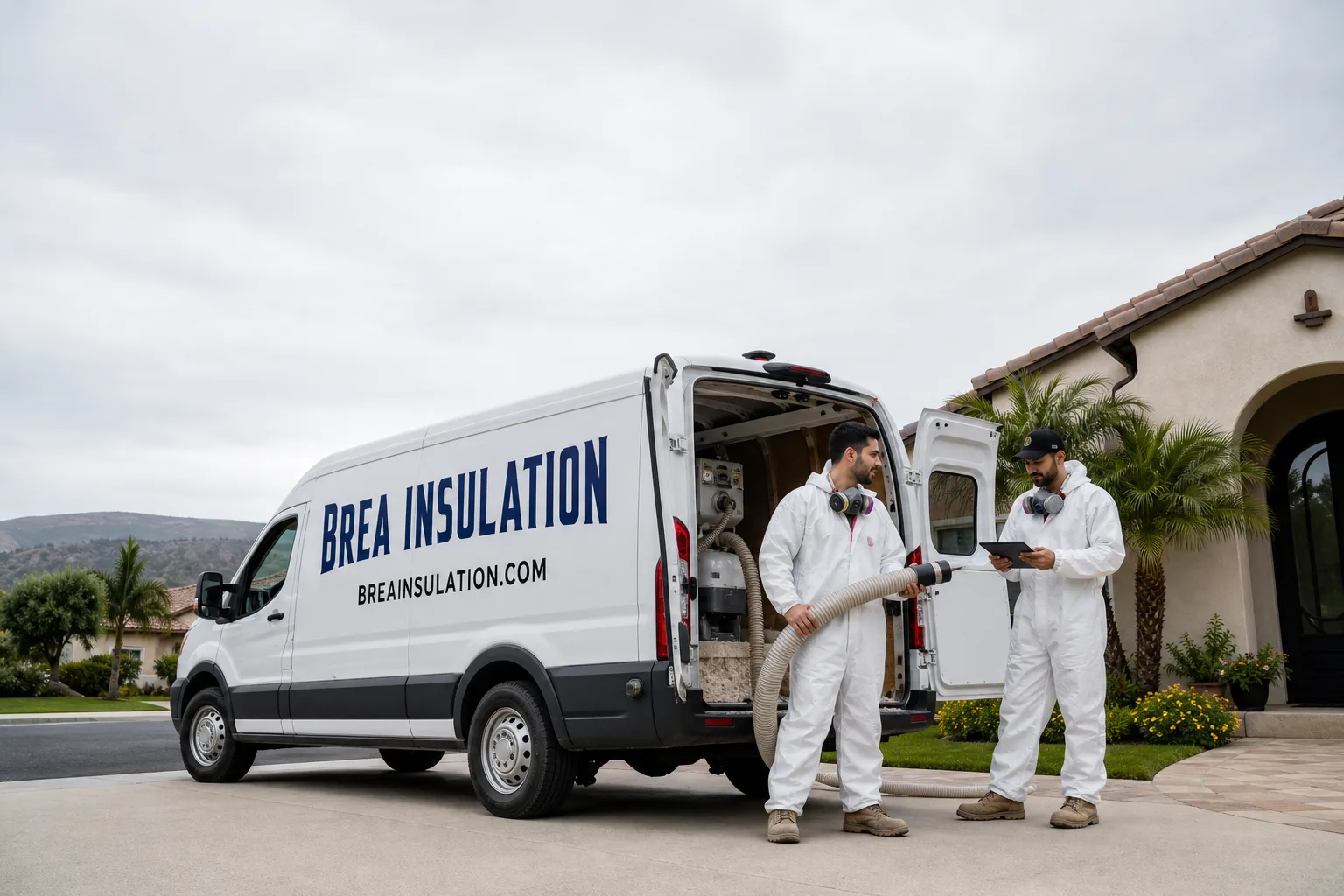
Fast, Reliable Attic Insulation Across Venice
Attic insulation in Venice typically costs $1,800 – $4,200 for a full removal-and-replacement job on a 1,000 – 1,500 sq ft bungalow, with most projects completed in one to two days. Brea Insulation responds to Venice calls within 24 – 48 hours for estimates, and we stock the materials this neighborhood actually needs: vapor-retarding batts, GreenFiber cellulose, and closed-cell spray foam for the dampest canal-side attics. If you’re noticing musty odors upstairs or condensation stains on ceiling drywall, call (866) 858-4033 for a free estimate. We know 90291 and 90294 block by block, from the walk streets to the canals.
Why Brea Insulation Is Venice’s Preferred Attic Insulation Company
Insulation is all we do, and that narrow focus matters in a neighborhood like Venice where the wrong material choice turns into mold within two fog seasons. Phil Darnell built Brea Insulation around a simple principle: carry eight brands so we can match the product to the house, not force the house to fit whatever’s on the truck. For Reflectix repair in Venice, we apply the same principle. For a 1920s wood-frame bungalow near the canals, that might mean Rockwool batts with a vapor retarder. For a newer infill build off Abbot Kinney, open-cell Icynene makes more sense. Same crew, same week, different answers because different houses.
Venice homeowners call us because the marine layer doesn’t care what the R-value is on paper. We’ve pulled damp, sagging fiberglass out of attics where the roof had no leak at all, just years of fog-fed condensation soaking through unvented decking. That’s not generic attic work. That’s Venice attic work. Our Attic Insulation team handles removal, mold remediation, air sealing, and new installation under one roof, so you’re not juggling three contractors when the humidity has already done its damage.
We’ve been serving Venice long enough to know which blocks have original 1910s framing and which have retrofitted additions with bypass gaps that let damp air pour into the attic. That local pattern recognition means we arrive with the right venting plan, the right insulation density, and the right moisture control strategy on day one.
Attic Mold Removal in Venice
Attic mold removal in Venice runs $900 – $2,800 depending on how far the fog-fed condensation has spread across the roof sheathing, and in canal-side bungalows we’re usually treating the deck, not just the insulation. The marine layer keeps nighttime humidity above 85% for months at a stretch. Add a poorly vented attic with old batts pressed against the deck, and the sheathing becomes a condensation plate. Mold follows within a season or two. We see it on walk-street bungalows off Dell Avenue, on canal-front properties east of Pacific, and in the flatland cottages between Lincoln and the beach.
Condensation-Driven Mold on Roof Sheathing
This is the Venice signature problem: black staining and fuzzy growth on the underside of plywood decking with no active roof leak. The moisture comes from fog-laden air entering through soffit gaps or leaking interior air through unsealed top plates. Treatment includes drying the deck, applying an antimicrobial treatment, then adding baffle vents and a sealed vapor retarder so the dew point stays out of the sheathing.
Insulation Contamination and Replacement
When original batt insulation has soaked up years of marine-layer moisture, mold is usually present in the fiberglass or cellulose itself. We remove the contaminated material under containment, treat the deck and framing, and replace with moisture-resistant material suited to the coastal microclimate. GreenFiber cellulose with a borate treatment is a common choice, as is Rockwool batting which doesn’t hold water.
Attic Insulation Removal in Venice
Attic insulation removal in Venice costs $700 – $1,900 for a typical 1,200 sq ft bungalow attic, and it’s not a job you want to rush. We see original 1930s rock wool batts that have compacted to half their original thickness, soaked through with salt-laden condensation, and sometimes housing rodent activity from the pier-and-beam crawlspace below. Pulling that material out properly means containment, negative-pressure dust control, and careful disposal so the living space doesn’t get a face full of decades-old fiberglass dust.
Full Removal for Moisture-Damaged Batts
In walk-street bungalows with irregular framing and retrofitted additions, the old batts rarely sit flush anymore. Gaps open at eaves and top plates, letting damp air bypass the insulation entirely. Full removal lets us see the deck, fix bypasses, install baffles, and start clean.
Selective Removal for Contaminated Sections
Not every attic needs full removal. If mold or rodent damage is confined to one corner, we can remove the affected section, treat the deck, and match the surrounding insulation without disturbing the intact areas. This keeps costs down while still addressing the actual failure mode.
Trusted Brands We Service in Venice
We carry eight manufacturers so we can match the material to Venice’s specific damp-air conditions, not to what’s easiest to stock. For canal-side attics prone to condensation, Rockwool and CertainTeed batts handle moisture without collapsing. For air-sealing retrofits in tight walk-street bungalows, Icynene and Demilec closed-cell foam seal the top plate bypasses that fog exploits. For blown-in top-ups over sealed decks, GreenFiber cellulose holds its R-value and offers a recycled-material option. Having the full bench matters here because coastal moisture punishes the wrong product choice within a single wet season.
Common Attic Insulation Problems We See in Venice Homes
- Sagging original batts in 1910s – 1940s bungalows. The marine layer keeps attic humidity high enough that fiberglass loses its loft and compresses over decades. The top plate and eaves end up uninsulated, which is exactly where condensation forms.
- Fog-fed condensation staining without a roof leak. Ventilation gaps in old soffits let fog drift into the attic and condense on the deck. Homeowners often think they have a leak when the deck is actually sweating moisture from the inside.
- Bypass gaps in retrofitted walk-street additions. Venice’s older bungalows rarely got framed as a single airtight envelope. Retrofitted additions create seams and gaps that let interior air bypass the insulation layer entirely, dragging moisture into the attic.
- Pier-and-beam crawlspace damp migrating upward. Canal-side homes sit close to water, and the raised crawlspaces breathe ground moisture. Without underfloor insulation and vapor control, that damp air rises through wall cavities and condenses on the attic deck.
Pricing for Attic Insulation in Venice, CA
Here’s what Venice homeowners should expect to pay. Blown-in attic insulation runs $1,200 – $2,200 for a standard 1,000 – 1,200 sq ft bungalow. Batt insulation replacement lands at $1,800 – $3,400. Attic insulation top-ups over existing material cost $600 – $1,500 depending on depth needed. Full removal with mold treatment and replacement runs $2,500 – $4,200 for the typical canal-side or walk-street house. Spray foam air sealing adds $1,500 – $3,800 depending on roofline complexity and deck condition. Call (866) 858-4033 for an exact quote, estimates are free and we’ll give you the number before we leave the driveway.
We Also Serve Cities Near Venice
Brea Insulation works throughout the westside. Beyond Venice, we cover Santa Monica, Culver City, Ladera Heights, and Century City, with the same moisture-aware approach we bring to the 90291 and 90294 flatlands. Coastal fog respects no city lines, so neither do we.
Serving Venice, CA — Our Local Coverage Area
We’re based in the Venice area and know this community well. Use the map below to see our service coverage — if you’re nearby, we can almost certainly help.
FAQs About Attic Insulation in Venice
Because Venice is not dry. The marine layer holds nighttime humidity above 80% for much of the year, and fog rolls through attic vents and settles on cool sheathing. A vapor retarder on the warm side of the assembly stops interior moisture from reaching the dew point inside the insulation. In a canal-side bungalow, a properly installed vapor retarder is often more important than adding R-value. Call (866) 858-4033 and we’ll explain how it applies to your specific framing.
No, not in most cases. The old batts are usually damp and compressed, and blowing over them traps moisture and hides bypass gaps that need sealing. We remove the failed material, check the deck for condensation staining, then blow in GreenFiber cellulose over a sealed vapor retarder. It’s the only way to get a clean, dry assembly in a Venice-era bungalow.
First we contain the attic, dry the deck, and treat the affected sheathing with an antimicrobial. Then we fix the ventilation so fog can’t get trapped, install baffles, and replace the insulation with a moisture-resistant material. In canal-side homes we always inspect the pier-and-beam crawlspace too, because ground moisture feeding up through the walls is often the root cause. Call us for a free inspection at (866) 858-4033.
Rockwool and CertainTeed batts for moisture resistance, Icynene or Demilec closed-cell foam for air sealing and condensation control on the deck, and GreenFiber cellulose for blown-in top-ups over a sealed assembly. We carry all of them, so the choice comes down to your attic’s actual condition, not what we happen to stock.
Often they need it first. Raised foundations breathe ground moisture upward through wall cavities, and that damp air condenses on the attic deck. Insulating and vapor-sealing the crawlspace stops the moisture at the source, which makes the attic insulation work and keeps working. We check both ends of the stack on every Venice job.
If you’re in Venice and your attic smells musty in the morning, or the upstairs ceiling shows condensation staining, the marine layer is already working against your house. Brea Insulation specializes in attic insulation, removal, and mold remediation for Venice’s older beach bungalows and canal-side homes. Call (866) 858-4033 for a free estimate, and we’ll give you a straight answer on what your attic needs and what it’ll cost.
Written by Phil Darnell, Owner at Brea Insulation, serving Venice since our first canal-side bungalow job.