
Fast, Reliable Attic Insulation Across Redondo Beach
Attic insulation in Redondo Beach usually costs between $1,800 and $4,600 for a full removal-and-reinstall on a typical 1,200 to 1,800 sq ft home, with top-ups running $900 to $1,800. Most Redondo Beach jobs are done in one day, and our crews hit the road for Redondo Beach daily, not once a week. We know the 90277 flats and the 90278 hillsides, we know the marine-layer moisture problem, and we know why “just add more fiberglass” is the wrong answer for so many of these homes. Call (866) 858-4033 and we’ll give you a straight answer about what your attic actually needs.
Why Brea Insulation Is Redondo Beach’s Preferred Attic Insulation Company
We’re a dedicated insulation contractor, not a general contractor with an insulation sideline. That’s not a marketing line; it’s the reason we can identify a vapor-control problem in a 1955 bungalow before we quote it. Insulation is all we do, and that single-trade focus means our crews have seen every attic configuration Redondo Beach’s post-war housing stock can throw at them: flat ceilings with shallow rafter bays, scissor trusses over 1980s additions, vented and unvented hip roofs, you name it.
Phil Darnell runs Brea Insulation, and he built the company around one principle: carry more materials than the average installer, so the right product goes into the right home instead of whatever’s on the truck. We’re not local to Redondo Beach in the sense of having an office on Artesia Boulevard, but we’re local in the way that matters: we’re in Redondo Beach every single week, we know what the salt air does to batts and sheathing, and our recommendations are built for this climate, not for a generic Southern California zip code.
Every attic insulation project in Redondo Beach gets the same treatment: an actual inspection of what’s up there now, an honest conversation about whether it needs removal or just a top-up, and a quote that doesn’t change after we open the access hatch. Call (866) 858-4033 and you’ll talk to someone who can tell you the difference between Owens Corning and Rockwool without reading a product sheet.
Attic Mold Removal in Redondo Beach
Attic mold removal in Redondo Beach is a job we do more often than almost any other coastal city we serve, because the marine layer keeps attic sheathing damp for months at a time and mold takes hold fast once it starts. In the 90277 flats west of Pacific Coast Highway, we routinely find salt-laden, moisture-darkened wood that’s been quietly failing for years. The work involves removing contaminated insulation, treating the affected framing and sheathing, correcting the ventilation problem that caused it, and reinstalling insulation that won’t trap moisture. You can’t just kill the mold and walk away; the conditions that fed it have to change.
For a standard 1,000 to 1,500 sq ft attic in Redondo Beach, mold removal combined with insulation replacement typically runs $2,200 to $5,000 depending on how far the growth has spread and whether any sheathing needs replacement. If the mold is isolated to one corner near a bathroom exhaust vent, it’s on the lower end. If it’s across the entire north-facing roof plane, expect the upper end. We quote it firm after inspection, and the price we give is the price you pay.
Source Elimination Before Treatment
Mold in a Redondo Beach attic almost always traces back to one of three things: a bathroom fan venting into the attic instead of through the roof, insulation blocking the soffit vents, or a roof leak that’s been slow-dripping for months. If we treat the mold but leave the fan venting into the attic, it comes back. We find the source first, then treat the surface.
What Happens to Contaminated Insulation
Fiberglass batts with mold growth can’t be cleaned; they get bagged and removed. Blown-in cellulose with surface mold on the top layer sometimes can be, but if it’s been wet it compacts and loses R-value anyway. In most Redondo Beach mold jobs, the right call is full removal, treatment, and new installation, not spot cleaning.
Attic Insulation Removal in Redondo Beach
Attic insulation removal in Redondo Beach is often the correct first step before any upgrade, especially in the 1950s bungalows that dominate the area around Knob Hill and the Avenues. Old fiberglass batts from that era sag, compress, and absorb moisture from the marine air, leaving gaps at the edges and dark, crusty sheathing underneath. On a 1952 stucco bungalow near Knob Hill, we pulled out collapsed, moisture-heavy fiberglass batts from the attic and found dark, salt-crusted sheathing. We installed Rockwool batts with a breathable vapor retarder and added baffles for ventilation, solving the condensation issue without trapping moisture. The homeowner noticed warmer floors and no more musty odors.
Full attic insulation removal in Redondo Beach typically runs $1.20 to $2.50 per square foot of attic floor, so a 1,200 sq ft attic lands between $1,440 and $3,000 for removal and disposal alone. That’s a real cost, and we won’t hide it. But adding new insulation on top of failed insulation is spending money to make the problem worse. If the existing material is wet, moldy, compressed, or infested, removal is the only honest starting point.
When Removal Is Mandatory
Never bury a problem. If the existing attic insulation is damp to the touch, shows visible mold, has rodent droppings throughout, or has compressed to less than half its original thickness, it’s coming out. Salt air accelerates corrosion on wiring and fasteners when insulation traps moisture against them, so a wet attic in Redondo Beach is also a longevity problem for the house itself.
Removal Without the Dust Cloud
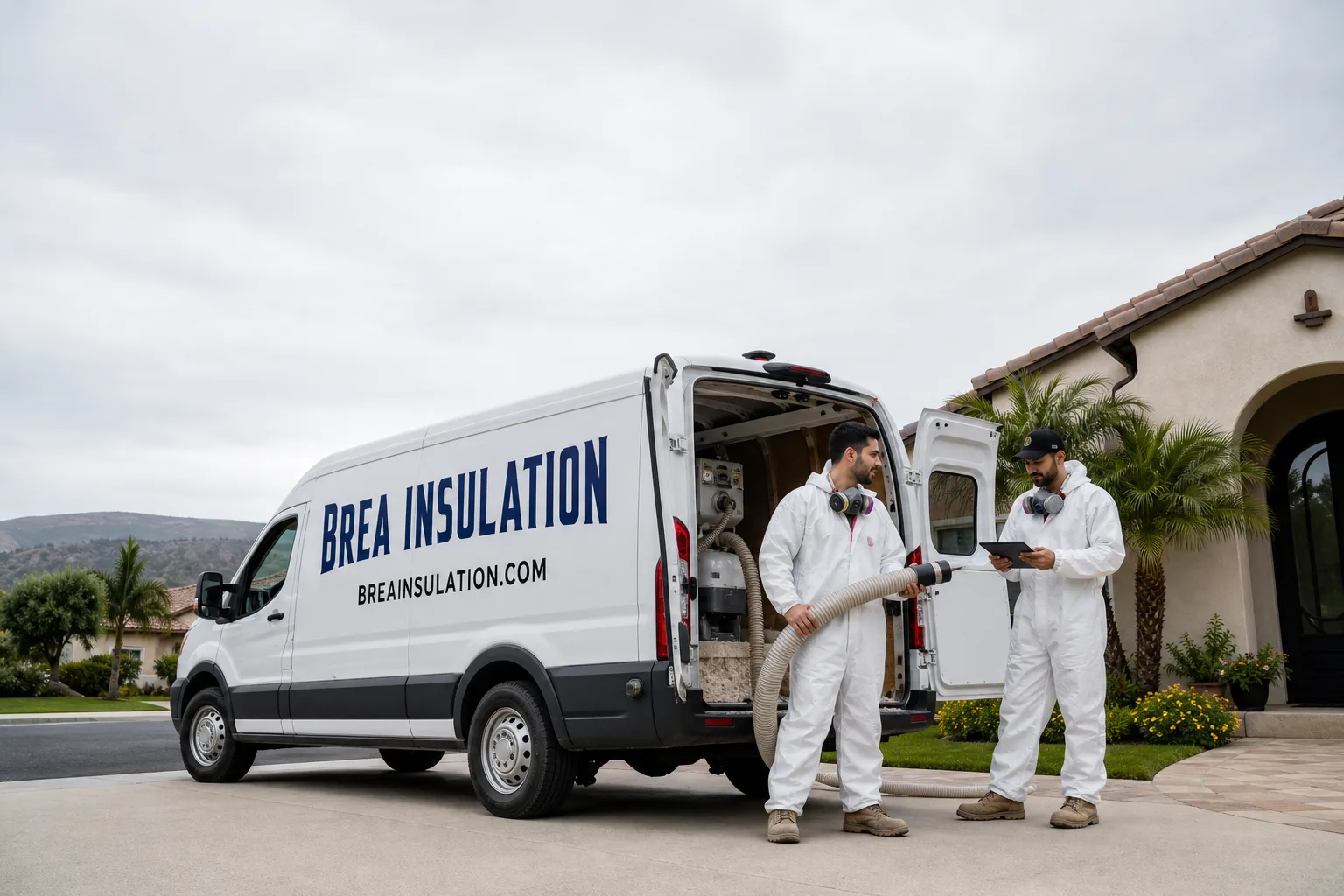
We use commercial HEPA-filtered vacuums and contain the work area so old fiberglass and cellulose don’t end up raining through your can lights and hallway. The access point gets sealed, the attic gets vacuumed to the deck, and we inspect the sheathing before anything new goes in. Most removals take three to five hours, and the new installation usually happens the same day.
Trusted Brands We Service in Redondo Beach
Brea Insulation carries an eight-brand material roster because no single product is right for every Redondo Beach attic. Owens Corning and Johns Manville batts are workhorses for standard vented attics. Icynene and Demilec spray foam come out when a 1970s two-story needs air sealing as much as insulation. Rockwool stone wool handles the moisture-smart retrofit role in those 90277 bungalows, and GreenFiber cellulose gives us a high-coverage blown-in option for top-ups. We carry materials from CertainTeed as well, particularly for batt and blown applications. Most of these products are stocked or available same-week for Redondo Beach jobs, so we’re not quoting you a two-week lead time on a brand we actually know cold.
Common Attic Insulation Problems We See in Redondo Beach Homes
- Vapor traps in unvented attics. Faced batts or poly sheeting installed in attics without proper ventilation create condensation on cool sheathing. In Redondo’s humid marine layer, that trapped moisture becomes mold and rot within a few seasons. We correct it by pulling the vapor barrier and installing breathable assemblies with proper baffles.
- Compression and settling in 1950s bungalows. Original fiberglass batts in the old 90277 tract homes have been walked on, pushed aside, and flattened by decades of storage. A 6-inch batt compressed to 2 inches loses most of its R-value, and the gaps let salt-laden air circulate against wiring and fasteners, which is a corrosion concern.
- Roof deck moisture from blocked soffit vents. Insulation installed without baffles pushes into the eaves and chokes off airflow. The sheathing stays damp, darkens, and the insulation itself loses performance as moisture content rises. We see this constantly in Redondo Beach attics with blown-in fiberglass from the 1990s.
- No insulation at all. In the flats west of Pacific Coast Highway, it’s still common to open an attic hatch and find nothing but bare lath or drywall. Some of these 1950s bungalows were never insulated because the original owners thought the ocean climate made it unnecessary. That’s half true; the bigger problem is condensation, not heat loss, but uninsulated attics still transfer moisture and make rooms clammy year-round.
Pricing for Attic Insulation in Redondo Beach, CA
Here’s what we’re quoting in Redondo Beach right now. Attic insulation top-up with blown-in cellulose runs $900 to $1,800 for a typical 1,000 to 1,500 sq ft attic. Full removal and replacement with fiberglass batts lands at $1,800 to $3,800. Spray foam varies the most; open-cell foam on a standard attic starts around $2,800 and can exceed $6,000 on a big 1970s two-story. The material you choose, the condition of what’s already up there, and whether we’re dealing with mold or moisture remediation all move the number. What doesn’t change: the estimate is free, and it’s firm. Call (866) 858-4033 and Phil Darnell’s team will schedule a time to look, measure, and quote. No pressure, no surprises.
We Also Serve Cities Near Redondo Beach
Our Attic Insulation crews cover Redondo Beach and the surrounding beach cities weekly, including Hermosa Beach, Palos Verdes Estates, Manhattan Beach, and Marina del Rey. If you’re in Redondo Beach or one of these neighboring communities and your attic needs a real inspection, the same crew and the same eight-brand material bench are available. Call (866) 858-4033 to schedule.
Serving Redondo Beach, CA — Our Local Coverage Area
We’re based in the Redondo Beach area and know this community well. Use the map below to see our service coverage — if you’re nearby, we can almost certainly help.
FAQs About Attic Insulation in Redondo Beach
Redondo Beach’s marine layer drives the difference. Inland cities insulate primarily to block heat in summer and hold heat in winter; Redondo Beach attics fail from moisture, not temperature. Salt-laden, humid air moves through attic framing for months at a time, so the material choice and ventilation design have to account for condensation control first. A vapor-correct, breathable assembly with mineral wool or properly vented fiberglass beats maximum R-value in this climate.
Yes, the attic is the right place to start for a Redondo Beach bungalow. Heat rises, so an uninsulated attic lets more conditioned air escape than uninsulated walls do. More importantly, an uninsulated attic in 90277 is often damp and mold-prone, which affects the whole house. Addressing the attic first corrects the biggest energy and moisture problem, and it’s the least invasive job compared to opening up stucco-over-wood-frame walls. Call (866) 858-4033 and we’ll explain what an attic-first plan looks like for your specific bungalow.
If you open the attic hatch and smell must, see dark stains on the sheathing, find insulation that’s damp or compressed flat, or spot rodent droppings or ant trails in the existing material, you need removal before you add anything. Burying wet or compromised insulation under new material makes the problem invisible and worse. In Redondo Beach specifically, salt crust on the underside of the roof deck is a tell-tale sign that the existing insulation has been trapping moisture for years and needs to come out.
Salt air in Redondo Beach does not degrade fiberglass or mineral wool directly, but it accelerates corrosion on metal fasteners, wiring connections, and any exposed HVAC ductwork in the attic. When insulation is damp or trapping moisture against these surfaces, the salt-laden air makes the corrosion move faster. Insulation that stays dry and allows sheathing to breathe is what prevents this; insulation that holds moisture makes it worse.
Yes. Most 1970s two-story rebuilds in Redondo Beach have accessible attics with adequate clearance for either blown-in or batt installation from the hatch side. The only challenge is if the attic is tight or fully packed with old framing and ductwork, in which case blown-in cellulose or low-pressure spray foam handles the job without opening walls or ceilings. We assess access during the free inspection and tell you exactly what’s feasible before any work starts. Call (866) 858-4033 to schedule.
Written by Phil Darnell, Owner at Brea Insulation, serving Redondo Beach and the surrounding beach cities.