Fast, Reliable Attic Insulation Across March Air Force Base
Attic insulation in March Air Force Base costs $1,800 – $4,200 for a full removal-and-reinstall on the base’s typical wood-frame military housing, while a simple top-up over existing material runs $900 – $1,800. Most jobs on base finish in a single day. If your home was built between WWII and the 1960s, that original attic insulation is almost certainly underperforming by a wide margin. Call Brea Insulation at (866) 858-4033 and we’ll tell you exactly what’s in your attic and what it needs.
We know this housing stock. March Air Force Base is not Moreno Valley tract homes from the 1990s or Perris new-builds. It’s wood-frame barracks and duplexes assembled at wartime speed, with shallow 2×4 wall cavities and attics that were never designed for modern R-value targets. We measure what’s actually there before we recommend anything.
Why Brea Insulation Is March Air Force Base’s Preferred Attic Insulation Company
Insulation is the only thing we do. No roofing, no HVAC, no handyman add-ons. That narrow focus is why our Attic Insulation team can tell you whether an open-cell Icynene air seal makes more sense than a GreenFiber cellulose top-up, and why, before we even quote. Property managers on base keep calling us back because we don’t treat every structure the same.
We work directly in March Air Force Base and the surrounding Riverside County area, and we’re familiar with the quirks of military-era construction: original rock wool that has settled to R-7 or worse, low-pitch roofs with barely enough headroom to crawl, unsealed top plates that dump heat into the house. When a homeowner on base calls, we’re not learning their housing type from scratch. Our material bench includes Owens Corning, Icynene, Demilec, and GreenFiber, which means we can match a fix to what the structure actually needs, not what’s easiest to grab off the shelf.
The right insulation for your home, not just what’s easiest to install. That’s the Brea Insulation position, and it matters more in March Air Force Base than almost anywhere else in Riverside County.
Attic Insulation Removal in March Air Force Base
Attic Insulation Removal in March Air Force Base is the process of vacuuming out old, compressed, or contaminated insulation before installing new material, and it’s the single most common job we perform on the base’s older housing stock. When rock wool batts from 1943 settle to R-7 and get packed with dust, rodent droppings, and decades of debris, adding new insulation on top doesn’t fix the problem. The old layer has to come out first, the attic cavity needs to be cleaned, and only then can we assess what the rafter depth will actually support.
Full Removal and Air Sealing
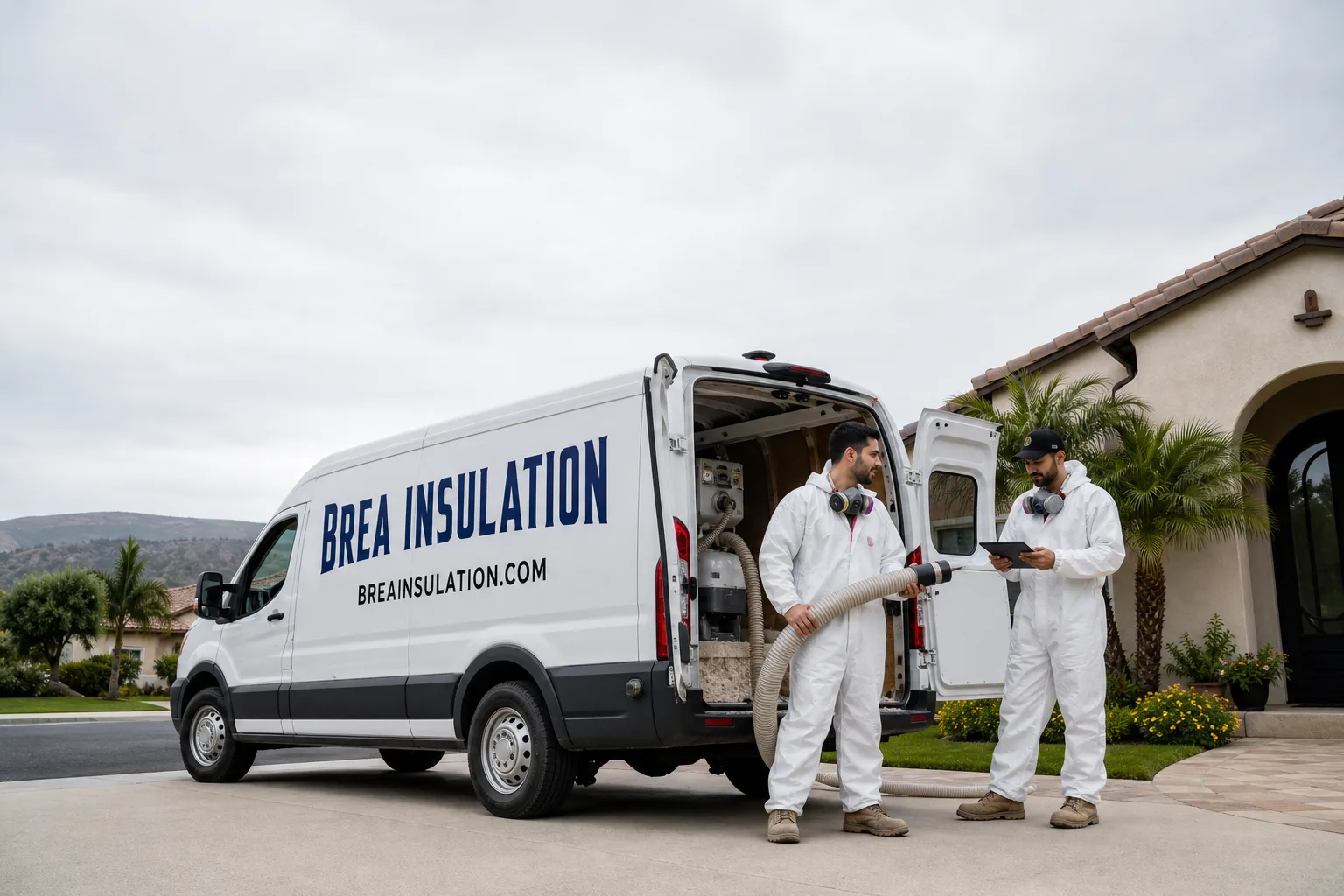
We run commercial vacuum equipment through the attic, removing every bit of degraded fiberglass, rock wool, or cellulose down to the ceiling deck. Once the cavity is empty, we inspect the top plates, wiring penetrations, and plumbing chases. Air sealing happens before any new insulation goes in. A full removal and air seal on a 1,200-square-foot base duplex typically runs $1,500 – $2,800 in March Air Force Base, depending on hatch access and how much contamination we’re dealing with.
Contaminated or Rodent-Damaged Attics
A lot of the original housing on March Air Force Base has never had a rodent-proof attic. Old vent screens rust out, gaps open where gable ends meet the roof deck, and squirrels or rats get in. If we find droppings, nesting material, or chewed insulation, the old material has to go. Disposal fees and the extra labor of working around contaminated zones add to the bill, but leaving it in place creates health and fire risks. Call (866) 858-4033 if you suspect your attic has been a rodent highway.
Insulation Contractors in March Air Force Base
Insulation Contractors in March Air Force Base fall into two camps, and we’re the one that specializes exclusively in the thermal envelope. General contractors sub out insulation to whoever is cheap and available. We carry eight brands, run all three installation methods, and every crew member on site is trained on insulation specifically. For base housing with shallow attics and older framing, that difference shows up in the final R-value and how well the job actually holds up through a July heat wave. A typical attic insulation job in March Air Force Base runs $1,800 – $4,200, with full removal on the higher end and a simple top-up on the lower end.
Title 24 Compliance for Retrofit Work
When you add insulation to an existing home in March Air Force Base, the work needs to meet current California energy code requirements for the attic assembly. We check the target R-value against what your rafter depth can physically accommodate. On shallow-pitch military attics, that often means dense-pack or batt-stack methods instead of standard loose-fill. We don’t cut corners and we don’t pretend a shallow cavity can hold a code-depth blanket of blown fiberglass.
Same-Day Assessments for Active-Duty Families
Moving to or from March Air Force Base usually comes with a deadline: a PCS date, a rental turnover, a property sale. We keep assessment slots open for base-adjacent calls and can often inspect an attic the same day you call. The inspection tells us what’s up there, what it’ll take to fix, and what it’ll cost. No obligation, no pressure. Call (866) 858-4033 and ask for Phil Darnell’s team.
Trusted Brands We Service in March Air Force Base
We’re not tied to one manufacturer’s product line, and that matters when you’re dealing with attics that can’t accept a standard installation. On March Air Force Base jobs, we’re most often installing Owens Corning high-density blown fiberglass, Icynene open-cell spray foam for air sealing, and GreenFiber cellulose when a homeowner wants a recycled-content material. Our shop keeps a deep stock of these product lines, so most jobs on base don’t wait on a special order. If a specific insulation brand is specified by your property manager or housing office, we’ll match it.
Common Attic Insulation Problems We See in March Air Force Base Homes
- Settled rock wool in original 1940s and 1950s barracks. The original rock wool batts compress to R-7 or less over decades, leaving the ceiling deck as the only barrier between living space and a 140°F attic. We remove and replace, not just top up.
- Blocked eave vents from past blown-in jobs. Low-pitch roofs have roughly a 2-inch gap at the soffit. A previous contractor with basic equipment buries that gap in loose fill, the attic stops ventilating, and moisture condenses on the underside of the roof deck.
- Uninsulated legacy attic hatches and knee-wall doors. A single unsealed hatch can leak 25% of the conditioned air in a room. On base housing with hallway hatches, that’s a constant heat draw all summer.
- Duct insulation decay in vented attics. The dry heat doesn’t rot things the way a humid climate does, but it bakes the jacket off older duct insulation. Exposed ducts in a 120°F attic lose a measurable amount of cooling before conditioned air ever reaches a register.
Pricing for Attic Insulation in March Air Force Base, CA
Plan on $1,800 – $4,200 for a full attic insulation job on March Air Force Base, with most single-family military-era homes landing around $2,400 – $3,200. A straight top-up over existing insulation runs $900 – $1,800. Full removal and air sealing is typically $1,500 – $2,800 before new material goes in. The biggest cost drivers in this area are attic access (knee-wall attics and tight hatches slow us down), contamination removal (rodent or pest damage), and how much air sealing the top plates need. We offer free estimates with no obligation. Call (866) 858-4033 and we’ll give you a line-item quote for your specific attic.
We Also Serve Cities Near March Air Force Base
Brea Insulation does most of its work within a 30-minute drive of March Air Force Base, so if you’re in Moreno Valley, Woodcrest, Perris, or Good Hope, you’re in our normal service area. The same crew, the same brand bench, and the same calibration-free quote process. If you’re just outside base boundaries, call (866) 858-4033 and we’ll confirm coverage for your street.
Serving March Air Force Base, CA — Our Local Coverage Area
We’re based in the March Air Force Base area and know this community well. Use the map below to see our service coverage — if you’re nearby, we can almost certainly help.
FAQs About Attic Insulation in March Air Force Base
No, not at standard depth. The low-pitch attic in most March Air Force Base military housing leaves roughly 6 to 8 inches of usable clearance at the eave line. Standard blown-in to R-38 needs 10 to 12 inches, which would bury the eave vents and stop all airflow. We use high-density blown fiberglass or batt-stacking techniques to reach target R-values within the space available. Call (866) 858-4033 and we’ll assess your specific rafter depth.
R-38 is the current Title 24 target for attic insulation in this climate zone, but many March Air Force Base attics can only accommodate R-30 without modifications. The dry heat means radiant barrier performance matters as much as the R-number, and air sealing the top plates often improves comfort more than bumping from R-30 to R-38. We’ll tell you what’s realistic for your structure after measuring it.
Yes, whenever the existing material has settled below R-10, absorbed moisture, or been contaminated by rodents, we remove it completely before installing new insulation. Adding new material over compressed rock wool doesn’t restore lost R-value and can trap contaminants against the ceiling deck. Full removal is standard on most March Air Force Base homes built before 1960.
Leaky or uninsulated ducts in a vented attic can waste 20 – 30% of the conditioned air your HVAC system produces, and the problem is worse in March Air Force Base’s triple-digit summers. We inspect ducts as part of every attic job, even though we don’t replace them. When we find gaps, we’ll flag them and can recommend the right fix before you shell out for attic insulation that won’t solve the real problem.
Yes, we handle knee-wall attics and tight access hatches regularly on March Air Force Base. These jobs require more labor because we’re working in constrained spaces and often have to hand-carry material through narrow openings. The cost runs slightly higher than a standard walk-in attic. Call (866) 858-4033 and we’ll give you a price based on your actual access points.
Written by Phil Darnell, Owner at Brea Insulation, serving March Air Force Base and surrounding Riverside County communities.