
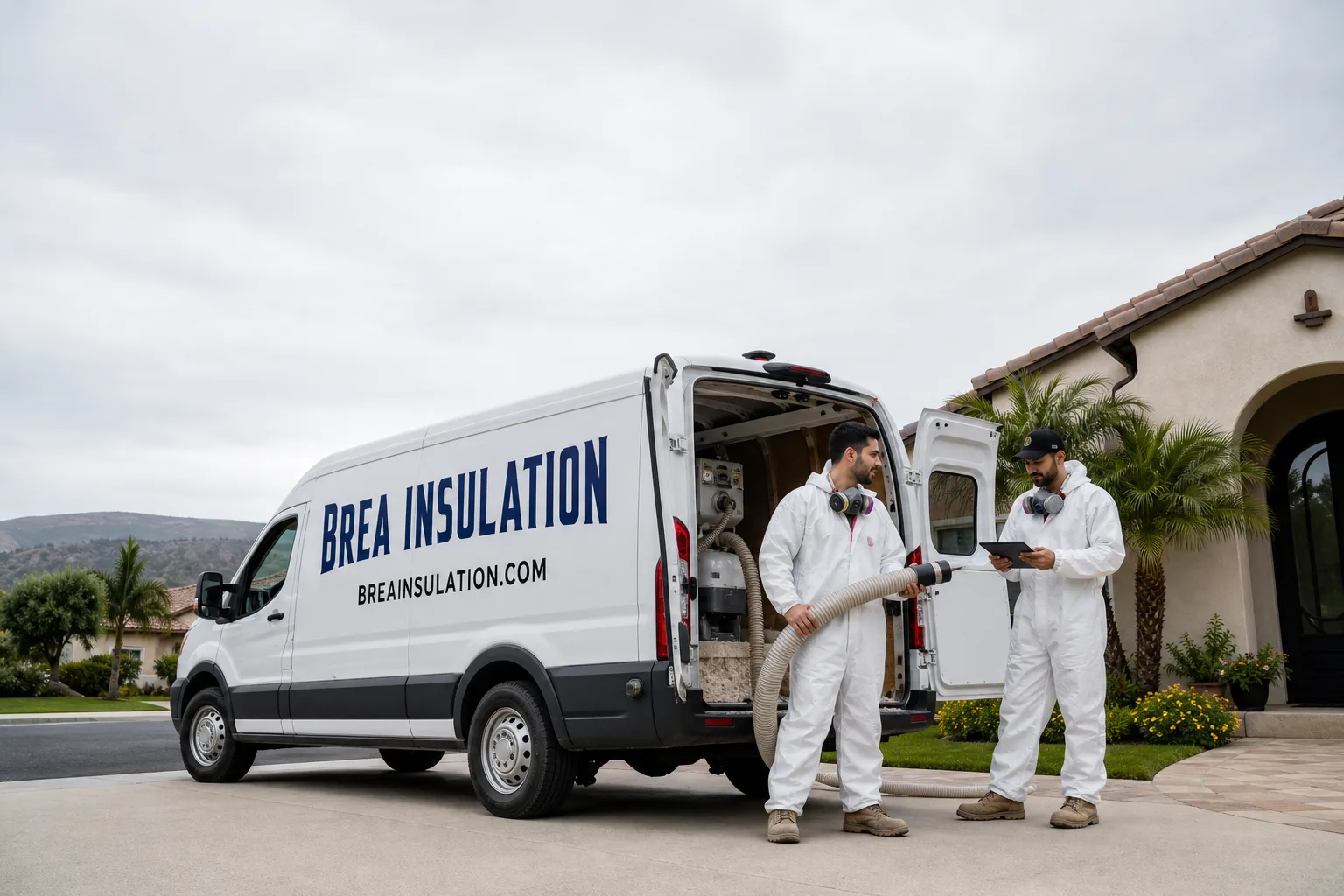
Fast, Reliable Attic Insulation Across Indian Wells
Attic insulation in Indian Wells isn’t a one-size-fits-all job, and any contractor who treats it that way is doing your home a disservice. Most homes here were built between the 1960s and 2000s with flat or low-pitch roofs, and the attic spaces above them routinely hit 160°F in summer. That kind of heat wrecks standard fiberglass faster than most homeowners realize. Our crews know the housing stock in Indian Wells, from the mid-century ranches off Highway 111 to the custom estates in the gated communities, and we bring the right material to each job instead of whatever’s cheapest to stock. If you’re tired of rooms that never cool down evenly or energy bills that climb every July, call (866) 858-4033 for a free assessment.
Why Brea Insulation Is Indian Wells’s Preferred Attic Insulation Company
Insulation is the only trade on our menu. That narrow focus matters in a city like Indian Wells, where HOA architectural review boards are strict and the housing stock demands more than a generic blown-in top-up. We’re not a handyman service adding insulation as a side line. Every crew member works with insulation daily, across all three installation methods: attic insulation, spray foam, and blown-in. That means when we walk into a 1970s stucco ranch with a flat roof and a 140°F attic, we already know what we’re likely to find before we open the hatch.
Phil Darnell leads the company with a straightforward approach: diagnose the real problem, match the material to the home, and document everything. Indian Wells homeowners appreciate that level of rigor, especially when a retrofit needs to pass an HOA architectural review. We carry an eight-brand material bench so we can specify Owens Corning loose-fill on one job, Icynene open-cell foam on another, and GreenFiber cellulose on a third. The recommendation comes from the house, not from our inventory. That’s the difference between a specialist and a generalist, and it shows up in every install we complete across the 92210 zip code.
Attic Mold Removal in Indian Wells
Attic mold removal in Indian Wells is a job we handle more often than people expect, and it usually traces back to one of two causes: a ventilation system that was never adequate for a flat-roof desert home, or a bathroom exhaust fan venting directly into the attic instead of through the roof. When daytime attic temperatures hit 160°F and nighttime lows drop into the 50s, condensation forms inside the attic cavity. That moisture feeds mold on plywood sheathing and framing, and the problem compounds fast in homes that sit unoccupied for weeks at a time during the summer months.
A typical attic mold removal job in Indian Wells runs $800 – $1,800 depending on the size of the attic and the extent of the growth. The work involves removing contaminated insulation, treating the affected framing and sheathing with an EPA-registered antimicrobial, and addressing the root cause so the mold doesn’t return. We always inspect ventilation and air-sealing as part of the job. Removing mold without fixing the moisture source is a waste of money.
What We Check During Mold Removal
Our crew looks at how the current baffles are installed, whether the soffit vents are actually open, and whether the roof has any signs of leakage around penetrations. In Indian Wells, we frequently find that original baffles from the 1970s and 1980s have collapsed or been pushed aside during previous insulation work. That blocks airflow and turns the attic into a sauna. We document all of it with photos so you can see exactly what we found and what we fixed.
When Indian Wells Homeowners Should Act
If you smell a musty odor inside the home that gets stronger when the AC kicks on, or if you see dark staining on the underside of the roof sheathing, get it checked. Second-home owners in Indian Wells should have an attic inspection done at least once every two years, even if the home is only occupied seasonally. Mold spreads quietly in an empty house, and by the time it’s visible, the remediation cost has usually climbed.
Attic Insulation Removal in Indian Wells
Attic insulation removal in Indian Wells is often the first step in a larger retrofit, and it’s not a job to rush. The original fiberglass batts in many of these homes have been cooking under a flat roof for 30 or 40 years. That means sagging, compaction, and R-values that have quietly fallen below what the label claims. We remove the failed material, inspect the attic deck for signs of water damage, old electrical issues, or pest activity, and then prep the space for fresh insulation that actually performs in this climate.
A full attic insulation removal in Indian Wells typically runs $1.50 – $2.50 per square foot, which puts most homes in the $2,000 – $4,500 range depending on attic access, depth of existing material, and whether mold remediation is part of the scope. The price includes bagging, removal, and disposal of the old material. We don’t leave anything behind, and we don’t blow new insulation over the top of failing batts just to make a job easier.
Why Removal Matters Before a Top-Up
Blowing fresh insulation over degraded batts traps heat and moisture below the new layer. That’s how mold problems start, and it’s how HOAs end up flagging a project that should have been straightforward. In Indian Wells, where many attics are accessed through a narrow interior hatch or a small exterior scuttle, the temptation to skip removal is real. We recommend removal whenever the existing material is heat-degraded, moisture-damaged, or contaminated with pest droppings.
Flat-Roof Access Challenges
Low-pitch and flat roofs on Indian Wells homes create tight attic cavities that make removal physically demanding. There’s often less than three feet of clearance at the peak, and the heat inside an unventilated attic during a summer removal is brutal. Our crews schedule early-morning starts, work in rotations, and use powered extraction equipment so the job gets done safely and thoroughly without cutting corners.
Trusted Brands We Service in Indian Wells
We carry eight manufacturer lines so we can match the material to the home rather than forcing one product onto every job. For Indian Wells attics, that includes CertainTeed fiberglass for straightforward batt replacements, Icynene open-cell spray foam when air sealing and thermal performance are both priorities, and GreenFiber blown-in cellulose for homeowners who want a recycled, eco-conscious option with excellent coverage in hard-to-reach flat-roof cavities. The right product depends on your roof configuration, your HOA’s requirements, and how long you plan to own the home. We keep relationships direct with manufacturers, which means faster order turnaround for Indian Wells customers and no mystery about what’s going into your attic.
Common Attic Insulation Problems We See in Indian Wells Homes
- Heat-degraded fiberglass batts in flat-roof attics. When attic temps stay above 150°F for weeks on end, standard batts lose loft and sag away from the framing. That creates thermal gaps that quietly erase R-value long before the material looks visibly failed. We see this constantly in homes built before the mid-1990s along Indian Wells Lane and in the older sections off Highway 111.
- HOA compliance issues with visible roof penetrations. Indian Wells HOAs are strict about anything that alters a roofline or exterior appearance. Adding a roof-mounted attic fan or changing venting without architectural review approval can generate a violation notice fast. We document every retrofit so the association’s file shows no unapproved exterior changes.
- Pest intrusion through existing attic vents. Desert rodents and birds find their way into attics through gaps in older vent screens and around HVAC penetrations. Once inside, they shred insulation for nesting material and leave droppings that make replacement mandatory. Sealing entry points is part of every removal and replacement we do in the 92210 zip code.
- Inadequate radiant control on west- and south-facing exposures. Many Indian Wells homes sit on large lots with significant western and southern wall exposure. The solar gain on those walls transfers heat into the attic through framing members, and standard insulation alone can’t stop it. Radiant barrier film or reflective sheathing makes a measurable difference on these exposures.
Pricing for Attic Insulation in Indian Wells, CA
Blown-in attic insulation for an average Indian Wells home, roughly 1,800 to 2,500 square feet, runs $1,800 – $3,800 depending on the target R-value and the material selected. Attic batt insulation replacement typically lands between $1.50 and $3.00 per square foot installed. A top-up over existing, still-viable insulation runs $800 – $1,500 for most homes. Full removal and replacement, which we recommend for heat-degraded or pest-contaminated attics, runs $2,000 – $5,000 depending on access and scope. Radiant barrier installation adds $0.75 – $1.25 per square foot. These are Indian Wells market numbers, not national averages. Call (866) 858-4033 for a free on-site estimate and we’ll give you exact figures for your attic.
We Also Serve Cities Near Indian Wells
Brea Insulation works across the Coachella Valley, including Palm Desert, La Quinta, Bermuda Dunes, and Rancho Mirage. If you’re in any of those communities, the same crew and the same eight-brand material bench apply. For more detail on our full service area, see our Attic Insulation page or our dedicated Attic Insulation in Indian Wells overview.
Serving Indian Wells, CA — Our Local Coverage Area
We’re based in the Indian Wells area and know this community well. Use the map below to see our service coverage — if you’re nearby, we can almost certainly help.
FAQs About Attic Insulation in Indian Wells
Yes, in most Indian Wells communities you’ll need architectural review approval if the project changes any visible roofline, venting, or exterior finish. Interior-only work like replacing attic insulation with no new roof penetrations typically doesn’t require HOA sign-off, but we always recommend checking your community’s specific CC&Rs. We document every job with before-and-after photos so you have a clean paper trail if the association asks questions. Call (866) 858-4033 and we’ll walk you through what your particular HOA is likely to require.
Yes, full removal of heat-degraded fiberglass is a core part of what we do in Indian Wells, and it’s often the right move before installing new insulation. The process includes bagging and removing the failed material, inspecting the attic deck for damage, air-sealing top plates and penetrations, and then installing fresh material matched to your roof configuration. We schedule early-morning starts during summer months so crews work before attic temps become unsafe. Call (866) 858-4033 for a removal and replacement estimate.
Flat and low-pitch roofs create tight, hot attic cavities that trap heat and accelerate breakdown of standard fiberglass. They also leave little room for ventilation corrections, which is why Indian Wells retrofits often lean on spray foam or dense-pack cellulose rather than standard batts. The material has to work within a smaller cavity while still hitting target R-values and code requirements. We assess the actual roof structure before recommending a system, because flat-roof retrofits fail when spec’d like a standard pitched-roof job.
If your HOA flags the project, we provide documentation showing that no visible roofline or exterior changes were made, along with photos of the attic before, during, and after the work. Most violations stem from unapproved venting or roof penetrations, not from interior insulation replacement. If exterior venting changes are required for proper thermal performance, we’ll help you prepare the architectural review submittal so the association sees a compliant plan from the start. Call (866) 858-4033 if you’re facing a violation notice and need documentation fast.
For homes with significant west- or south-facing roof exposure, the answer is usually yes. Radiant barrier film installed on the underside of the roof deck reflects a large share of solar heat before it can radiate into the attic, which is a big deal when summer roof surfaces approach 160°F. It’s not a substitute for insulation, but it works alongside it to cut cooling loads and protect the insulation from extreme heat degradation. We offer radiant barrier as part of new insulation installs throughout Indian Wells. Call (866) 858-4033 to see if your roof orientation makes it worthwhile.
Written by Phil Darnell, Owner at Brea Insulation, serving Indian Wells and the Coachella Valley.