
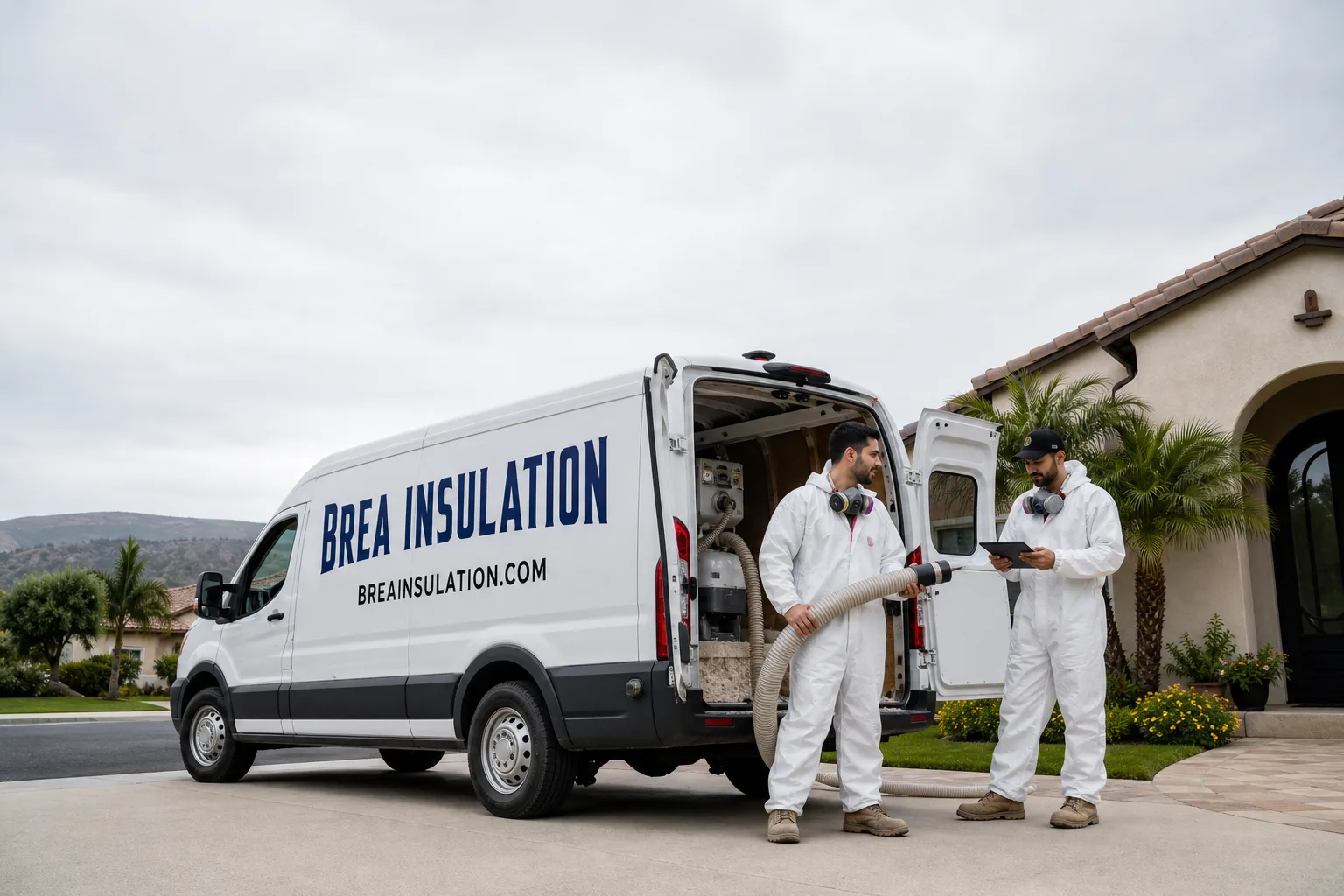
Fast, Reliable Attic Insulation Across Highgrove
Attic insulation in Highgrove runs $1,800 to $4,600 for a typical 1,200 to 1,800 square foot ranch home, with blown-in cellulose or fiberglass making up most of the work. Most jobs are completed in a single day. The bigger issue here isn’t cost, it’s what’s already in your attic. Highgrove’s housing stock is overwhelmingly mid-century, and those original batts are almost always dead. We’re Brea Insulation, a dedicated insulation contractor out of Brea, and we’re in Highgrove weekly. Call (866) 858-4033 for a free estimate that actually measures your existing R-value, not just a ballpark guess.
Why Brea Insulation Is Highgrove’s Preferred Attic Insulation Company
Insulation is the only thing we do. That matters in Highgrove because the diagnosis here is different from coastal Orange County homes. We’re not looking at moisture problems or winter cold. We’re looking at radiant heat gain through a roof deck that hits 140°F plus by mid-afternoon. A generalist contractor might send a tech who installs whatever batt is on the truck. Our team arrives with eight manufacturer lines to choose from, so the material gets matched to the house.
Phil Darnell built Brea Insulation on one principle: carry the full bench of materials and know each one cold. That means Owens Corning fiberglass, Icynene open-cell foam, Rockwool mineral wool, Demilec closed-cell, and GreenFiber recycled cellulose are all options on any Highgrove job. No other insulation contractor serving the 92313 zip code routinely specifies from that many product lines. When you see our truck on Center Street or down near the old packing house district, it’s a crew that only does attics.
Response time to Highgrove is typically same-day for estimates and within 48 hours for installation, depending on attic accessibility and whether ventilation repairs are part of the scope. We keep a full schedule in this corridor because Grand Terrace, Colton, Loma Linda, and Rubidoux all share the same aging housing stock. That means our crews know exactly what a 1960s ranch attic looks like before they even open the hatch. Our Attic Insulation estimates include an attic probe of your existing batt depth and R-value at no charge.
Attic Ventilation in Highgrove
Attic Ventilation work in Highgrove is often the difference between an insulation upgrade that works and one that doesn’t, because low-pitch roofs on 1950s and 60s tract homes frequently have undersized ridge and soffit vents that trap 140°F air and cook even new insulation. When the roof deck can’t shed heat, insulation degrades faster and the ceiling plane stays warm well after sunset. A ventilation correction, whether adding ridge vents, enlarging soffit intakes, or installing baffles, typically runs $450 to $1,200 depending on the roof’s configuration and access.
When Baffles Are Mandatory
On Highgrove ranches with shallow eave overhangs, we often find original cellulose or batt material pushed tight against the roof sheathing, blocking airflow from the soffits. The fix is installing extruded or foam baffles to keep an air channel open before new insulation goes down. On a typical 1,500 square foot home, expect 18 to 24 baffles installed for $6 to $9 per baffle, labor included, as part of a larger attic job.
Ventilation Before Insulation
Adding R-38 blown-in insulation over an attic with poor venting is like putting a thicker blanket in an oven and expecting the room below to cool. It doesn’t. We measure attic temperature during our estimate. If it’s running 160°F or higher by 2 p.m. in July, we’ll flag ventilation as a required part of the scope, not an add-on. Highgrove attics with corrected airflow regularly show 15 to 25 degree drops on the ceiling plane.
Radiant Barrier in Highgrove
Radiant Barrier installation in Highgrove is the single most effective defensive measure against the Inland Empire sun, and it runs $1,200 to $2,800 for a typical ranch attic, depending on whether you choose a foil-faced decking staple-up or a retrofitted foil product over existing batt. Radiant barriers work by reflecting radiant heat rather than absorbing it, which matters when your roof deck is absorbing 140°F plus by noon. They don’t replace insulation R-value; they reduce the heat load that insulation has to resist.
Over Old Insulation
A common move in Highgrove is stapling foil radiant barrier directly over old, dusty batts without air-sealing first. That’s a mistake. The barrier reflects some heat but air bypasses it through gaps at the top plates and can lights, trapping heat at the ceiling. We air-seal first, then install the barrier over clean insulation. The combination matters more than either component alone.
Decking vs. Attic Floor
For Highgrove homes with no attic floor and exposed trusses, we recommend stapling a foil-faced radiant barrier to the underside of the roof decking. For homes with plywood decking already in place, a foil laminate over the existing insulation surface is the practical retrofit. The decking method is more effective but costs more in labor. Either way, expect a mid-summer attic temperature reduction of 20 to 30 degrees when installed correctly with proper venting.
Trusted Brands We Service in Highgrove
Our material bench means Highgrove homeowners aren’t stuck with whatever one brand happens to be on sale that week. We carry Icynene and Demilec for spray foam work, GreenFiber for recycled blown-in cellulose, and Owens Corning for batt and blown-in fiberglass. Because we stock materials for the 92313 corridor, turnaround on replacements and top-ups is fast, often same-week. When a Highgrove attic has original Johns Manville batts from the 1970s, we know exactly what’s coming out and what’s going in. That’s not guesswork. It’s just repetition on the same housing stock, every week.
Common Attic Insulation Problems We See in Highgrove Homes
- Compressed original batts reading R-4 instead of R-11. Decades of 140°F attic heat flatten fiberglass and break down its air pockets. A visual inspection looks fine. A probe tells the truth. We find this on nearly every 1960s and 70s ranch we open in Highgrove.
- Radiant barrier installed over unsealed top plates. Hot air bypasses the barrier entirely and still finds the ceiling. This is the most common retrofit mistake we correct in the area. Air-sealing first is non-negotiable.
- Low-pitch roofs with blocked soffit vents. Older Highgrove homes often have soffits that were never vented or have been painted over. Attic temperatures spike to 160°F and insulation degrades faster. Ventilation correction belongs in the scope before adding R-value.
- Recessed can lights leaking air into the attic. Non-IC-rated cans from the original build act as chimneys. We seal and box them before blowing in cellulose. This one detail can account for a measurable chunk of heat transfer into the living space.
Pricing for Attic Insulation in Highgrove, CA
A standard attic top-up with blown-in cellulose to R-38 in Highgrove runs $1,800 to $2,900 for a typical ranch footprint. Full removal of degraded batts, air-sealing, and new blown-in insulation to R-38 goes $3,200 to $4,600 depending on attic access and square footage. Batt replacement with Owens Corning fiberglass runs $2,400 to $3,800. Adding a radiant barrier is $1,200 to $2,800 on top. Ventilation correction, when required, adds $450 to $1,200. These are real numbers from jobs we’ve completed in the 92313 zip code this year. Every estimate includes an attic probe and a written scope, and it’s free. Call (866) 858-4033 and Phil or one of our lead techs will schedule a walkthrough.
We Also Serve Cities Near Highgrove
Our crews cover Attic Insulation in Highgrove and the surrounding Inland Empire corridor, including Grand Terrace, Colton, Loma Linda, and Rubidoux. The housing stock is similar across these cities, which means our material bench and local experience transfer directly. If you’re in any of these areas, the same free estimate and same-day response apply.
Serving Highgrove, CA — Our Local Coverage Area
We’re based in the Highgrove area and know this community well. Use the map below to see our service coverage — if you’re nearby, we can almost certainly help.
FAQs About Attic Insulation in Highgrove
You can, but you shouldn’t, and here’s why: the original batts are almost certainly compressed to R-4 or R-5, and laying new batts over degraded material leaves an uneven thermal barrier and trapped dust. The air-sealing value of removing everything first is significant. We recommend removal, air-sealing top plates and can lights, then blowing in cellulose to R-38. The cost difference is modest, and the performance difference is dramatic in a 140°F attic. Call (866) 858-4033 and we’ll probe your existing insulation during a free estimate.
Most Highgrove ranchers pay between $1,800 and $4,600, with the low end being a straightforward blown-in top-up and the high end being a full removal, air-seal, and R-38 replacement with ventilation corrections. A radiant barrier adds $1,200 to $2,800 if you go that route. Square footage, attic accessibility, and whether your soffit vents are still functional push the number one way or the other. The estimate is free and includes an actual R-value measurement, not a guess.
Not necessarily, but on a Highgrove ranch with a low-pitch roof and direct afternoon sun, it’s the single highest-impact upgrade you can make after air-sealing. Blown-in insulation resists conductive heat; a radiant barrier reflects the radiant heat before it reaches the insulation. The combination lowers ceiling plane temperatures measurably. We’ve seen 8 to 10 degree drops in living space after adding a barrier to a properly sealed attic. Whether it’s worth it depends on your attic temperature profile, which we measure during the estimate.
Yes, but we schedule Highgrove work for early morning and we don’t send crews into 150°F attics in the middle of a July afternoon. The heat is a safety issue and it also affects materials; blown-in cellulose can be installed in the morning with no problem, and spray foam should not be applied to an overheated deck. If your attic is running that hot, you likely have a ventilation problem that needs correcting first anyway. We’ll flag that in the estimate.
For most 1950s Highgrove ranches, the answer is blown-in GreenFiber cellulose to R-38 after air-sealing, with a radiant barrier on the roof deck if the attic space allows access. Cellulose settles into the odd cavities and shallow truss spaces of low-pitch roofs better than batts. Mineral wool from Rockwool is a strong alternative if fire resistance is a priority. Spray foam is overkill for most of these attics unless you’re converting the space. Tell us your roof pitch and attic access and we’ll match the material to the house, not the other way around.
If your Highgrove attic still has its original insulation, it’s not doing what the label says. The sun out here punishes old fiberglass. Call (866) 858-4033 or use the form on this page to schedule a free attic inspection and written estimate. We’ll tell you exactly what’s up there, what it’s really rated, and what it’ll cost to fix it right.
Written by Phil Darnell, Owner at Brea Insulation, serving Highgrove and the Inland Empire with dedicated attic insulation, spray foam, and blown-in services.