
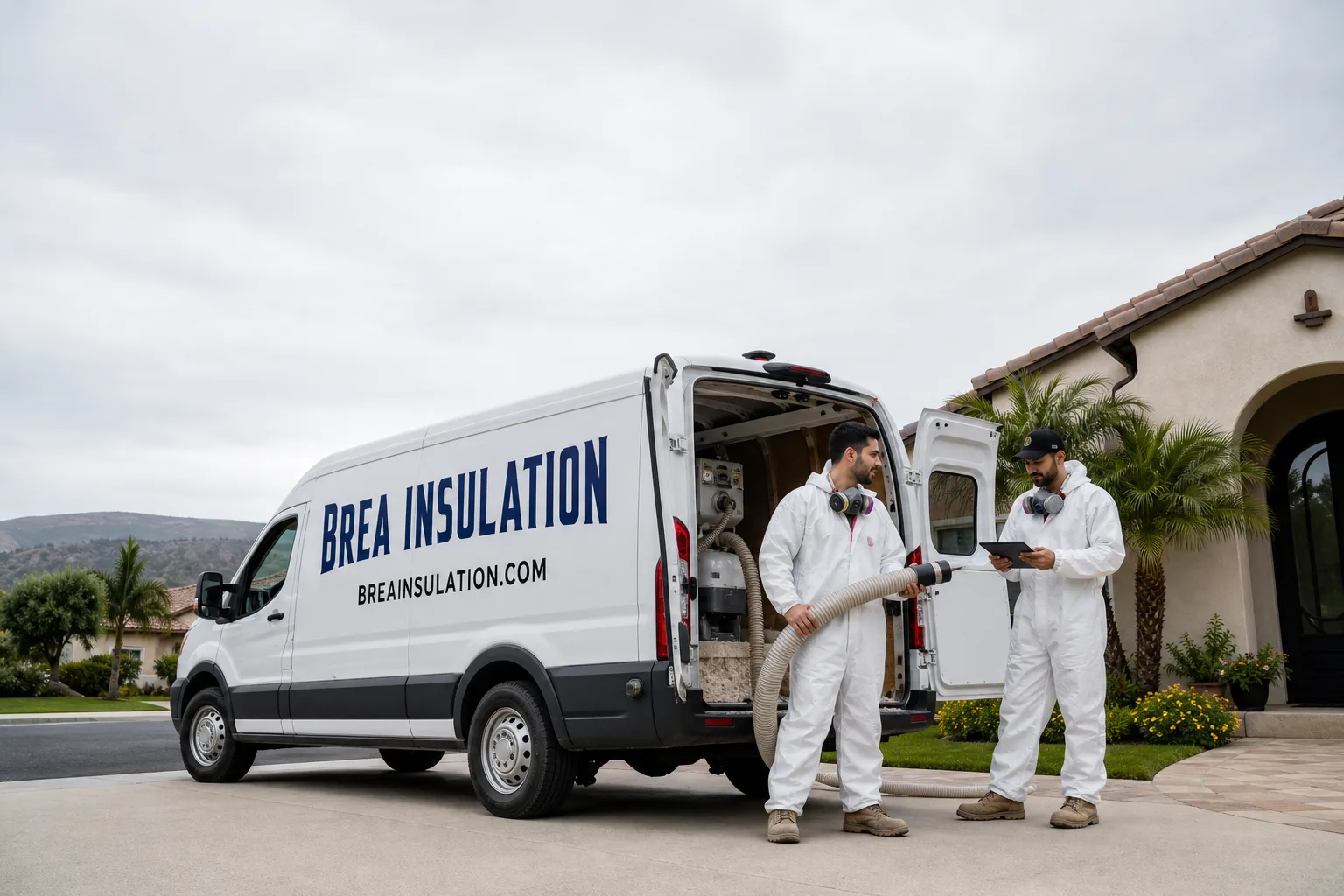
Attic Insulation in Duarte: What It Costs and Why Heat Is the Real Enemy
Attic insulation in Duarte typically runs $1.80 to $4.50 per square foot installed, depending on whether you’re topping up existing material, removing old batts, or starting fresh with spray foam. Most homes in the 91010 flats fall in the $1,500 to $3,800 range for a full attic top-up with blown-in fiberglass or cellulose. The bigger question for Duarte homeowners isn’t just R-value. It’s whether your attic can hold back 95°F-plus San Gabriel Valley afternoons and still let the cool canyon air coming down from the San Gabriels do its work at night.
We’re Brea Insulation, and insulation is the only thing we do. Call (866) 858-4033 for a free estimate on any attic insulation job in Duarte, from a quick blow-in top-up in the 91010 flats to a full air-seal and radiant barrier retrofit above the 210.
Why Duarte Homes Need a Different Approach to Attic Insulation
Duarte sits at the base of the San Gabriel Mountains, and that location creates a thermal cycle most San Gabriel Valley cities don’t experience the same way. During the day, attics over Duarte homes bake under direct foothill sun, with south-facing roof decks absorbing heat for hours. At night, cool catabatic air drains down the side canyons and flows across the city, dropping attic temperatures fast. That daily swing, often 35 to 40 degrees, puts real stress on insulation that was never designed for it.
In the foothill blocks above the 210, especially around Fish Canyon and the Mt. Olive area, our crews see a failure pattern that doesn’t show up down on the valley floor. Blown-in insulation gets scoured by wind moving downslope. Fiberglass or cellulose drifts away from the downslope side of the attic floor and piles up against the upslope side. The result is a thermal cap that’s thick on one half and nearly bare on the other. A quick depth check near the attic hatch can look perfectly fine while half your ceiling is effectively uninsulated. That’s the kind of thing you only catch when you inspect the full attic, not just a sample point.
Phil Darnell, who leads our team at Brea Insulation, has walked enough Duarte attics to know that a single-spot measurement isn’t enough here. Our approach starts with a full attic inspection, not a guess. Call (866) 858-4033 and we’ll check what’s actually happening across the entire attic floor, not just near the access point.
Attic Ventilation in Duarte
Attic Ventilation in Duarte is about managing the heat that doesn’t care how much R-value you have. When the sun hits a Duarte roof deck all afternoon, the attic air temperature can climb past 140°F. Ventilation moves that superheated air out so your insulation only has to fight the radiant heat coming through the roof deck, not a trapped pocket of oven air. In Duarte’s foothill homes, where cool canyon air already moves through at night, proper ventilation helps pull that cooler air through the attic and release the day’s stored heat.
What does a ventilation job involve? We inspect your existing vents, check for blocked soffit channels, and calculate the right intake-to-exhaust ratio for your roof geometry. Most Duarte homes we see are under-ventilated, especially mid-century ranches that were built with minimal gable vents and no ridge vent. For a typical Duarte home, adding or upgrading attic ventilation runs $450 to $1,400, depending on whether you need new vents cut, baffles installed, or a powered exhaust fan.
Baffles and Soffit Prep Before Insulation
Before blown-in insulation goes down, soffit baffles have to be right. If insulation covers the soffit vents, airflow stops and you’re back to a baked attic. In Duarte’s older homes, we often find the original baffles are missing entirely or crushed flat by a previous blow-in job. We install new baffles at every rafter bay and prep the soffit channels before any new insulation goes in.
Ridge and Gable Vent Upgrades for Foothill Roofs
Foothill roofs above the 210 see more wind than valley roofs, which means passive ventilation actually moves more air here, if the vents are placed right. A new ridge vent paired with clean soffit intake creates a natural convection loop that’s especially effective in Duarte’s climate. We’ve seen attic temperatures drop 20 to 30 degrees with proper ridge venting alone, before a single bag of insulation goes down.
Radiant Barrier in Duarte
Radiant Barrier in Duarte is the difference between an attic that’s merely insulated and one that’s actually cool. A radiant barrier is a reflective layer—similar to what you’d see with Reflectix repair in Duarte—installed under the roof deck that bounces radiant heat back toward the roof instead of letting it radiate down into your insulation. In Duarte, where south-facing roof decks take full sun for eight to ten hours a day, a radiant barrier cuts the heat load reaching your insulation drastically. It’s not a substitute for R-value, it works alongside it, and it’s one of the highest-impact upgrades for foothill homes on Duarte’s sun-baked slopes.
We install radiant barrier as a foil laminate stapled to the underside of the rafters, with a small air gap between the foil and the roof deck. That gap is what makes it work, and it’s one of the details we see botched by less experienced installers. For a typical Duarte attic, radiant barrier installation runs $1.10 to $2.25 per square foot of attic floor area. Most Duarte homes fall between $1,200 and $2,800 total.
South Slope Priority
In Duarte, the south-facing roof slope is the one that matters most. East and west slopes catch morning and late-afternoon sun, but the south slope absorbs the full midday load. We often recommend focusing radiant barrier on the south roof deck first, especially if your home sits on a hillside where that slope has no shade from neighboring trees or structures.
Combining Radiant Barrier with a Top-Up
The most effective Duarte attic is one that pairs air sealing, adequate R-value, ventilation, and a radiant barrier. If you’re topping up blown-in insulation anyway, adding radiant barrier at the same time is cheaper than doing it as a standalone job because we’re already in the attic with the crew and equipment. In the 91010 flats, where single-story ranches have large attic footprints, this combination is the most common request we get from homeowners tired of rooms that won’t hold temperature.
Trusted Brands We Service in Duarte
Brea Insulation carries materials from eight manufacturers so we can match the product to the home’s needs, not the other way around. For Duarte homeowners, that means if you want Owens Corning blown-in fiberglass, we stock it. If you’d rather use GreenFiber recycled cellulose for its density and eco profile, that’s on our truck too. Icynene open-cell spray foam is available for Duarte homes that need air sealing as much as insulation, especially in older attics with can lights and top plates leaking air. We know each product cold because insulation is all we do, and we’re not guessing at what’s on the shelf. Call (866) 858-4033 to talk through which material fits your Duarte attic.
Common Attic Insulation Problems We See in Duarte Homes
- Wind-scoured blown-in insulation above the 210. In foothill blocks near Fish Canyon and Mt. Olive, blown-in materials drift away from the downslope side of the attic floor, leaving bare drywall in one half and a deep pile in the other. A visual check from the attic hatch often misses it entirely.
- Compressed 1950s and 1960s batts in the 91010 flats. Original fiberglass batts in mid-century Duarte ranches are often crushed to two inches or less after decades of foot traffic, storage, and heat cycling. They provide almost no thermal performance and no air sealing at top plates and can housings.
- No air sealing at recessed can lights and wall top plates. Duarte’s older homes leak conditioned air into the attic around every ceiling penetration. You can have R-38 overhead and still feel drafts because the air you paid to cool is escaping through unsealed gaps.
- Missing or failed radiant barrier under south-facing roof decks. Foothill homes in the 91008 hills and upper Duarte slopes catch full sun with no reflective layer, so afternoon radiant heat pours through the roof deck into the attic regardless of R-value. Adding one is the single biggest leap in comfort for these homes.
Pricing for Attic Insulation in Duarte, CA
What you’ll pay for Attic Insulation in Duarte depends on what’s already in the attic, what condition it’s in, and whether you’re doing a simple top-up or a full retrofit with air sealing and radiant barrier. Here are the ranges we see most often for Duarte homes:
- Blown-in top-up (fiberglass or cellulose): $1,500 to $3,800 for a typical 1,200 to 1,800 sq ft attic.
- Full batts removal and replacement: $2,800 to $5,500, depending on attic size and access difficulty in older Duarte ranches.
- Attic baffles and ventilation prep: $450 to $1,400, often included in a larger insulation job.
- Radiant barrier installation: $1,200 to $2,800 for most Duarte attic footprints.
- Spray foam (Icynene or Demilec): $3.50 to $6.50 per square foot of roof deck, best for full air-sealing retrofits in hillside homes.
These are real numbers from jobs we’ve done throughout Duarte, from the 91010 flats to the upper 91008 neighborhoods. Every estimate is free, and we walk the attic with you before we quote. Call (866) 858-4033 and we’ll give you an exact number for your specific roof.
We Also Serve Cities Near Duarte
Brea Insulation works throughout the San Gabriel Valley foothills. Along with Duarte, we regularly serve Attic Insulation in Duarte‘s neighboring communities: Bradbury to the east, Monrovia to the west, Baldwin Park to the south, and Mayflower Village just across the 210. If you’re in one of those areas and dealing with a hot attic, wind-drifted insulation, or original 1960s batts, the same crew and the same eight-brand material bench is available to you.
Serving Duarte, CA — Our Local Coverage Area
We’re based in the Duarte area and know this community well. Use the map below to see our service coverage — if you’re nearby, we can almost certainly help.
FAQs About Attic Insulation in Duarte
The wind-scour pattern above the 210 is the usual culprit. Night air draining down the side canyons pushes blown-in insulation away from the downslope side of the attic and stacks it against the upslope side. In foothill Duarte homes, this means half your ceiling has near-zero insulation while the other half is overfilled. We fix it by inspecting the entire attic floor, redistributing where possible, then topping up to an even depth across the whole space. Call (866) 858-4033 and we’ll check the full span, not just one spot.
For most Duarte homes with a south-facing roof slope, you need both. R-value slows conductive heat transfer, but radiant heat from a sun-baked roof deck bypasses insulation almost entirely. A radiant barrier reflects that heat before it reaches your insulation, and in Duarte’s foothill climate it’s often the single most effective comfort upgrade we install. If your home sits on an unshaded slope above the 210, radiant barrier belongs on the south roof deck before you spend more on extra inches of blown-in material.
Replace them, and add air sealing while you’re at it. Original batts in Duarte’s mid-century ranches are almost always compressed, dusty, and doing little for you. The bigger problem is that those 1950s attics were never air sealed at the top plates, can lights, and plumbing penetrations. A proper retrofit means removing the old material, sealing the ceiling plane, installing baffles, and then blowing in fresh insulation to the right depth. It’s more work than a simple top-up, but it’s the job that actually fixes the heat problem. Call (866) 858-4033 for a free attic walkthrough and we’ll tell you honestly whether your existing batts are worth keeping.
Yes. We carry Owens Corning, Rockwool, GreenFiber, Icynene, Demilec, and more, because Duarte homes have different needs and no single product fits every attic. If you want Owens Corning blown-in fiberglass for a top-up, we’ll quote it. If fire-resistant Rockwool batts make sense for a specific wall or ceiling cavity, we’ll bring that instead. The recommendation is driven by your home’s construction and your goals, not by whatever’s cheapest to stock. Phil Darnell and the team at Brea Insulation will walk you through the options before any material goes down.
Yes, and in many Duarte homes ventilation is the missing piece even when insulation depth looks fine on paper. Insulation slows heat transfer, but it does nothing about trapped attic air that reaches 140°F on summer afternoons. That stored heat radiates down into the living space all evening. Proper ventilation flushes that hot air out and draws cooler canyon air in, reducing the total heat load on the entire ceiling assembly. If your attic feels like a sauna even with R-38 overhead, the problem is ventilation, not R-value. Call (866) 858-4033 for a free attic inspection and we’ll show you exactly where airflow is being choked off.
Get a Free Attic Insulation Estimate in Duarte
If your Duarte attic is baking all day, your upstairs rooms won’t hold temperature, or you suspect the wind has scoured your blown-in insulation into a lopsided mess, call Brea Insulation. We’ll inspect the full attic, show you what’s actually happening, and give you a written estimate with the material and method that fits your home. No pressure, no guesswork. Call (866) 858-4033 today to schedule your free estimate in Duarte, from the 91010 flats to the 91008 foothills.
Written by Phil Darnell, Owner at Brea Insulation, serving Duarte and the San Gabriel Valley.