
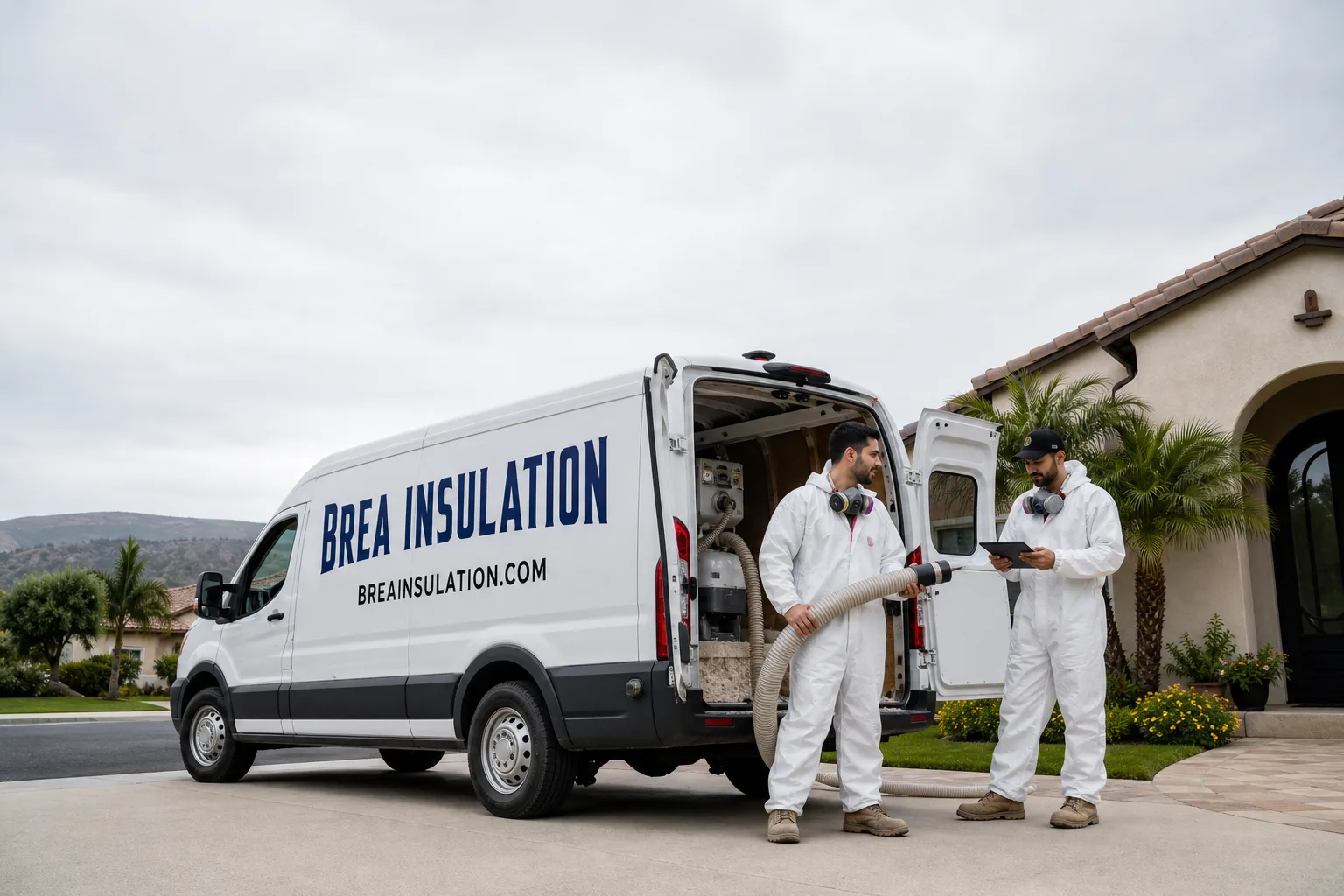
Fast, Reliable Attic Insulation Across Cypress
Attic insulation in Cypress typically runs $1.50 to $3.50 per square foot for blown-in fiberglass, with most mid-century tract homes landing between $1,800 and $4,200 for a full attic top-up to R-38. If you’re in a 1950s-60s Cypress house, your attic is probably under-insulated right now and you’re paying for it every month. We work in Cypress weekly and know these homes inside and out, from the tight attic access hatches in the Los Alamitos tract to the low-pitched rooflines along Cerritos Avenue. Call (866) 858-4033 for a free estimate with real numbers, not ballpark guesses.
Why Brea Insulation Is Cypress’s Preferred Attic Insulation Company
We’re a dedicated insulation contractor, not a generalist handyman adding insulation as a line item. That single-trade focus matters in Cypress because the homes here demand retrofit expertise, not a one-size-fits-all approach. When we pull up to a Cypress tract home, we already know the roof pitch is shallow, the attic access will be awkward, and the original insulation is likely either compressed or missing entirely. That familiarity means we diagnose faster and quote accurately.
Phil Darnell built this company around one principle: carry enough material brands to match the product to the house, not force the house to fit whatever’s on the truck. We stock eight manufacturer lines including Owens Corning, Johns Manville, Demilec, and GreenFiber, so a Cypress homeowner facing salt-air vent corrosion gets a different recommendation than someone in La Palma with a newer build.
Our Attic Insulation team handles everything from blown-in top-ups to full replacement with air sealing. In Cypress, we’re usually on-site within 24 to 48 hours of your call, and most attic retrofits wrap up in a single day. You don’t have to wonder if we understand your house. We’ve been in dozens of identical ones on your block.
Attic Ventilation in Cypress
Attic Ventilation in Cypress homes is the single biggest overlooked factor in insulation performance, because this city’s coastal-influenced air carries salt that inland Orange County neighborhoods simply don’t deal with. The job involves assessing static vents, ridge vents, and soffit screens, then calculating whether your attic is moving enough air to prevent heat and moisture buildup. Cypress homeowners need this when their attic runs hot in August, when insulation looks damp or matted, or when AC bills creep up despite a relatively mild climate. Expect to pay $350 to $900 for a full ventilation correction on a typical single-story Cypress tract home, depending on how many vents need replacing and whether new soffit screens are required.
Corrosion-Ready Vent Replacement
We replace corroded static vents with corrosion-resistant models, typically powder-coated aluminum or stainless, and we install new soffit screens where salt buildup has choked off intake airflow. In Cypress, we see effective attic airflow drop 30 to 40 percent within a decade from salt accumulation alone. That’s not a guess; it’s what we measure when we pull old vents off homes near the Los Alamitos tract and compare them to inland properties.
Balanced Airflow for Low-Pitched Roofs
Low-pitched roofs don’t leave much vertical space for natural convection, so Cypress attics need balanced intake and exhaust to function at all. We size vents based on attic square footage and roof geometry, not a generic formula. If your soffit screens are clogged and your ridge vent is corroded shut, your attic becomes a heat trap no amount of insulation can fix on its own.
Radiant Barrier in Cypress
Radiant Barrier installation in Cypress targets the exact failure mode these mid-century homes are known for: summer attic temperatures spiking above 140°F, which pushes heat down through your ceiling plane and forces AC systems to work overtime. A radiant barrier is a reflective foil layer, typically stapled to the underside of roof rafters, that bounces radiant heat back out before it can soak into your insulation. In Cypress’s low-pitched attic cavities, it’s one of the highest-impact additions you can make because the roof deck sits so close to the living space. A typical radiant barrier install for a Cypress tract home runs $900 to $2,000 depending on attic square footage and accessibility.
Foil Decking Over Corroded Fasteners
We don’t staple radiant barrier to compromised wood or corroded fasteners. On Cypress jobs where salt air has degraded rafters, we assess and replace fasteners before installing the foil. That step gets skipped by installers unfamiliar with coastal conditions, and it’s why barriers fail prematurely.
Pairing Radiant Barrier with Blown-In Top-Up
Most Cypress homeowners get the best result when radiant barrier goes in alongside a blown-in insulation top-up. The barrier reduces radiant heat gain, and the fresh insulation slows conductive heat transfer through the ceiling. Together, they address both paths heat takes into your home. We price this as a combined package and usually complete both in one day.
Trusted Brands We Service in Cypress
We carry Owens Corning, Johns Manville, Demilec, and GreenFiber on our material bench, and we service all of them for Cypress customers. That means when your existing batt insulation is Owens Corning and you need a top-up, we’re not ripping it out to install something else just because that’s what we happen to stock. We match what’s already in your attic when it makes sense, and we recommend a different material only when the house actually calls for it. For Cypress homes dealing with salt-air moisture, we frequently spec Johns Manville fiberglass with its moisture-resistant properties, and GreenFiber cellulose is a solid choice for homeowners prioritizing recycled content. We keep common retrofit materials staged for fast turnaround to Cypress, so you’re not waiting on a special order.
Common Attic Insulation Problems We See in Cypress Homes
- Salt-corroded attic vents. Salt-laden air from the coast accelerates corrosion on static vents, ridge vents, and soffit screens, choking airflow and making attics overheat. We find this on nearly every Cypress house built before 1970.
- Compressed or missing original batts. The 1950s-60s fiberglass batts installed when these tracts were built are often matted down to less than 2 inches of effective depth, especially near the eaves. That’s an R-value drop from R-11 or R-13 to roughly R-5 to R-6.
- Shallow attic cavities with poor access. Low-pitched roofs leave tight work areas, and many Cypress attic hatches are small and awkwardly placed. DIY retrofits here usually leave gaps and uneven coverage, which is why blown-in installation from a professional makes more sense than rolling out batts yourself.
- Overheated attics triggering cluster upgrades. In many Cypress tracts, one neighbor discovers their attic is hitting 140°F in August, mentions it over a fence, and suddenly half the block is calling for insulation assessments. The houses share construction era and failure modes, so problems show up almost identically house to house.
Pricing for Attic Insulation in Cypress, CA
Blown-in attic insulation to R-38 in Cypress typically runs $1,800 to $4,200 for a 1,200 to 1,800 square foot home, at $1.50 to $3.50 per square foot of attic floor. Attic batt insulation replacement lands in the $2,200 to $5,000 range depending on whether old batts need removal first. An insulation top-up, which is common when existing material is still functional but thin, runs $1,200 to $2,800. Attic baffles and ventilation prep add $300 to $700 to the job, and radiant barrier runs $900 to $2,000 as noted above. The biggest cost factors are attic accessibility, whether old insulation requires removal, and how many vents need replacing. Every estimate is free, on-site, and includes a written breakdown. Call (866) 858-4033 to book one.
We Also Serve Cities Near Cypress
Our Attic Insulation in Cypress service area extends to La Palma, Los Alamitos, Rossmoor, and Hawaiian Gardens. If you’re just over the city line and dealing with the same mid-century tract home issues, the same crew and the same material bench apply. We know these neighborhoods as well as Cypress itself because they share construction eras, roof pitches, and salt-air exposure.
Serving Cypress, CA — Our Local Coverage Area
We’re based in the Cypress area and know this community well. Use the map below to see our service coverage — if you’re nearby, we can almost certainly help.
FAQs About Attic Insulation in Cypress
Cypress sits close enough to the coast that salt-laden marine air reaches the city regularly, and that salt deposits itself on metal vent screens, fasteners, and flashing, accelerating corrosion to rates we don’t see in inland cities like Fullerton or Anaheim. Within a decade, a standard galvanized vent in Cypress can lose 30 to 40 percent of its airflow capacity. The fix is corrosion-resistant aluminum or stainless vents, which we stock and install as standard on Cypress jobs. Call (866) 858-4033 for a vent assessment.
Check your attic insulation depth: if you can see the tops of your ceiling joists, you’re under-insulated, and in Cypress homes from the 1950s-60s, the original batts are often compressed to a fraction of their original thickness. Other signs include upstairs rooms that run 5 to 10 degrees warmer than downstairs in summer, AC runtime that climbs every August, and insulation that looks damp or matted near the eaves. If you’re not comfortable climbing into a hot attic, we inspect it for free.
Blown-in fiberglass or cellulose works best for Cypress’s shallow attic cavities because it conforms to irregular spaces and fills gaps that batts can’t reach in tight, low-clearance areas. We use Owens Corning blown-in fiberglass most often on these tract homes because it settles predictably and resists moisture. The key is getting to R-38, which in Cypress’s climate keeps attic heat from radiating down into living spaces during August heat spikes.
You don’t need one, but it’s often worth adding if your attic is already insulated to R-38 and you’re still seeing high cooling bills. Radiant barrier addresses a different heat path than insulation: it reflects radiant heat from the roof deck before it can soak into your insulation and ceiling plane. In Cypress, where attics regularly top 140°F in late summer, the combination is what delivers the most noticeable AC runtime reduction.
Salt air doesn’t directly degrade fiberglass or cellulose insulation, but it corrodes the venting that keeps your attic dry and cool, which leads to trapped heat and moisture that mats down insulation over time and cuts its R-value. When your attic can’t exhaust heat and humidity, insulative material loses loft, and compressed insulation conducts heat rather than resisting it. In Cypress, ventilation correction and insulation top-up usually go hand in hand for this reason. Call (866) 858-4033 for a free assessment of both.
Written by Phil Darnell, Owner at Brea Insulation, serving Cypress and the surrounding Orange County area.