
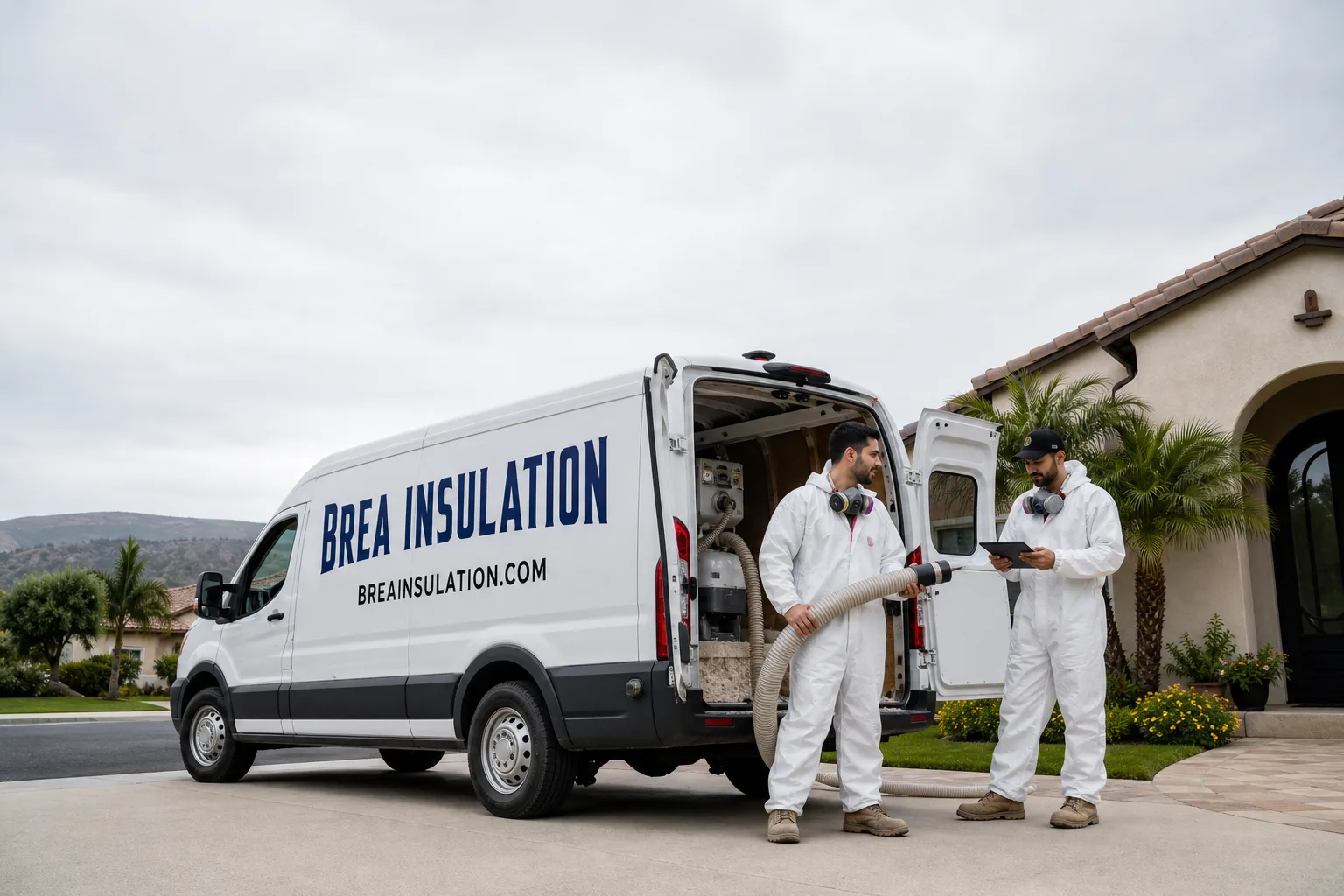
Fast, Reliable Spray Foam Insulation Across West Puente Valley
Spray foam insulation in West Puente Valley handles the specific problem your house was built with: brutal San Gabriel Valley heat pouring through attics and walls that were under-insulated from day one. If you live in the 91746 corridor, odds are your single-story stucco tract home still carries its original batts, compressed to nothing, while the knee-walls and garage ceilings never got insulated at all. We’re Brea Insulation, and we’ve worked these exact houses for years. Call (866) 858-4033 for a free estimate, and we’ll get a crew to your West Puente Valley home fast, often within the same week.
Why Brea Insulation Is West Puente Valley’s Preferred Spray Foam Insulation Company
Insulation is all we do. That narrow focus means our crews know the difference between open-cell and closed-cell foam cold, and they don’t split time across roofing, HVAC, or whatever else got scheduled that morning. West Puente Valley homeowners call us because their neighbor already did. Word travels block by block in these tight 1950s and 60s tracts, and when one house on Valinda Avenue gets its attic sprayed, three more calls follow.
We carry eight manufacturer lines, including Icynene and Demilec for professional spray polyurethane foam, plus Owens Corning, Johns Manville, Knauf, Rockwool, CertainTeed, and GreenFiber for everything from mineral wool to recycled cellulose. That eight-brand bench means the material gets matched to the job, not the other way around. For West Puente Valley’s low-pitch roofs and hot attics, for example, we often spec closed-cell Icynene rather than whatever’s cheapest on the truck. Phil Darnell, who runs Brea Insulation, built the company on that exact principle: the right insulation for your home, not just what’s easiest to install.
Crawl Space Spray Foam Insulation in West Puente Valley
Crawl Space Spray Foam Insulation in West Puente Valley addresses a problem many homeowners don’t realize they have: the space under a raised-floor addition or older home letting heat, moisture, and sometimes rodents into the envelope. In the 91746 corridor, some of the original post-war houses got crawl spaces when the land sloped, and those spaces were rarely insulated or air-sealed at construction. What that means today: hot summer air migrates up through the floor, making rooms feel ten degrees warmer than the thermostat claims.
A standard crawl space spray foam job in West Puente Valley runs $2,800 to $6,500, depending on square footage, access height, and whether we’re sealing the rim joists, the subfloor, or the full crawl walls with closed-cell foam. For most 91746 homes, rim joist sealing plus subfloor foam delivers the best heat-gain reduction for the money. We use Demilec closed-cell for these jobs because its vapor resistance handles the soil moisture common under San Gabriel Valley slab-adjacent crawl spaces.
Rim Joist Sealing for Older Crawls
Rim joists in these older homes were usually just bare wood with a little fiberglass stuffed between floor joists. Spray foam seals those joist bays completely, cutting both air leaks and the thermal bridge along the foundation line. Homeowners notice the difference in the room directly above the crawl first: it stops feeling like there’s a radiant heater under the floorboards.
Subfloor Foam in High-Heat Months
Closed-cell foam on the crawl space ceiling acts as both insulation and air barrier. In West Puente Valley’s long summer, that matters more than most people expect, because the ground under the house absorbs heat all day and releases it into the floor assembly at night. Sealing that path keeps evening cool-down from being undone by rising heat from below.
Garage Spray Foam Insulation in West Puente Valley
Garage Spray Foam Insulation in West Puente Valley often delivers the single biggest comfort win in these tract homes, because the attached garage is a giant uninsulated box baked by afternoon sun. In the 1950s and 60s houses that dominate the 91746 corridor, garage ceilings were left open to the roof deck and the shared wall between garage and living space was rarely insulated. That garage hits 130 or 140 degrees by 3 PM, and all that heat bleeds through the wall into the kitchen or bedroom behind it.
Spraying the garage ceiling and the shared wall with closed-cell foam in West Puente Valley typically runs $1,900 to $4,400, depending on garage size and whether we also do the garage door panels. For many homeowners, that single job drops the adjacent room’s temperature by 5 to 8 degrees on a 100-degree afternoon. We spray Demilec or Icynene closed-cell here, not open-cell, because closed-cell adds structural rigidity to older garage framing and acts as a vapor barrier against morning marine-layer humidity.
Shared-Wall Sealing Between Garage and Living Space
The wall between your garage and your house is a heat-transfer highway in August. We remove any thin, sagging original batts, then spray the stud cavities full of closed-cell foam. The difference is immediate and measurable with an infrared thermometer.
Garage Ceiling Foam to Cut Radiant Load
Spray foam on the garage ceiling underside turns an unvented, superheated air cavity into a sealed, cooled-down buffer zone. It also quiets the garage door opener and any workshop noise, which matters in these dense tract lots where garages sit close to bedrooms.
Trusted Brands We Service in West Puente Valley
We don’t stock one brand because we don’t believe one brand fits every house. Our crews install and service spray foam from Icynene and Demilec, the two names professional spray-foam contractors trust most, and we keep inventory on hand in our Brea shop so West Puente Valley jobs don’t stall waiting on shipment. Owens Corning batt and blown-in products round out the attic retrofits we do alongside spray foam work. When a 91746 home needs the old rodent-soiled batts pulled and replaced with properly air-sealed spray foam, we have the material on the truck before we knock on the door.
Common Spray Foam Insulation Problems We See in West Puente Valley Homes
- Compressed, rodent-soiled original batts in the attic. In 1960s tract homes along 91746, original fiberglass batts are often flattened to under an inch, soaked with dust, and chewed through by roof rats that thrive in the San Gabriel Valley. Spraying foam over that mess traps odors and gives you uneven R-value, so removal comes first.
- Knee-wall voids that were never insulated at all. Post-war builders in West Puente Valley frequently skipped insulation in knee-walls behind closets and hallway bends. Those hidden cavities act like open windows in summer, dumping heat into the core of the house while the attic floor looks fine.
- Attached-garage ceilings left open to the roof deck. On many original 1950s and 60s garages in 91746, there’s nothing between the garage ceiling and the roof sheathing but air. Garage ceiling spray foam closes that gap and cuts the heat bleeding through the shared house wall.
- Low-pitch and flat-ish roofs with poor attic access. Many West Puente Valley stucco tract houses have nearly flat roofs with tiny scuttle holes. Closed-cell foam has to be specified carefully on these homes to avoid trapping moisture in the roof deck, and our crews know which formulation fits which roof design.
Pricing for Spray Foam Insulation in West Puente Valley, CA
We Also Serve Cities Near West Puente Valley
Besides West Puente Valley, our crews cover Avocado Heights, La Puente, Valinda, and El Monte. If you’re just over the line in a 1950s tract home in any of those neighborhoods, we’re already working your block. The housing stock is nearly identical to West Puente Valley’s, and so are the insulation problems. Our Spray Foam Insulation team handles the whole San Gabriel Valley corridor from the same Brea shop, so scheduling stays fast.
Serving West Puente Valley, CA — Our Local Coverage Area
We’re based in the West Puente Valley area and know this community well. Use the map below to see our service coverage — if you’re nearby, we can almost certainly help.
FAQs About Spray Foam Insulation in West Puente Valley
Why does my 1960s West Puente Valley house feel hotter than my neighbor’s newer home even with the AC running?
Newer homes were built with minimum attic insulation standards that didn’t exist in the 1950s and 60s, and they often include air-sealed building envelopes. Your West Puente Valley tract house likely still has its original compressed batts, plus knee-wall and garage-ceiling voids that were never insulated at all. That lets radiant attic heat pour into living spaces faster than the AC can pull it out. Sealing and spraying those hidden cavities usually changes the equation within a day. Call (866) 858-4033 for a free attic assessment.
Can you spray foam over the old batt insulation in my West Puente Valley attic, or does it have to be removed?
You can technically spray over old batts, but you shouldn’t, especially in 91746 houses where the original fiberglass is almost always compressed, rodent-soiled, or both. Spraying foam over degraded batts traps the odor and creates uneven R-value with cold seams. We remove the old material, sanitize the deck, seal the top plates, then spray fresh Icynene or Demilec closed-cell foam. The removal adds labor cost, but it’s the difference between a permanent fix and a problem you’ll smell every August.
My West Puente Valley house has a low-pitch roof and a tiny attic access – can you still spray foam the attic floor and knee walls?
Yes. These low-pitch and nearly flat roofs are common on West Puente Valley stucco tract houses, and we’ve sprayed dozens of 91746 attics through scuttle holes barely big enough for a ladder. Our techs are experienced working in tight, hot attic spaces, and we sometimes use smaller spray rigs for low-clearance jobs. The knee-wall voids behind closets and hallway bends are often accessible from inside the house, so we can spray those without even opening the attic. The limiting factor is heat, not access; on 100°F+ days we schedule early starts and use ventilation fans.
Is crawl space spray foam worth it in West Puente Valley, or is attic insulation enough?
Attic insulation tackles the biggest heat source, but crawl space foam handles a different problem entirely: heat and moisture rising from the ground beneath raised floors. In West Puente Valley, where summer soil temperatures under the house can stay elevated all night, the crawl space acts as a heat reservoir that re-warms your floors after sunset. If your rooms stay hot even after the attic is insulated, the crawl is the next thing to seal. Rim joist sealing alone usually pays for itself within two to three summers.
How much cooler will my West Puente Valley attic be after spray foam on a 100°F+ summer day?
Our field measurements on a 1962 stucco tract house off Valinda Avenue in 91746 showed an attic drop from 142°F to 118°F on a 104°F afternoon, after removing degraded batts and spraying two inches of Icynene closed-cell foam across the attic floor and knee-wall void. That 24-degree drop is typical for these older tract homes when the foam is applied correctly. The living-space temperature change varies by house, but the attic stops acting as a radiant oven pressing down through the ceiling. For exact numbers on your house, call (866) 858-4033 and we’ll run an infrared scan and show you the hot spots before we quote anything.
Call Brea Insulation for Spray Foam Insulation in West Puente Valley
If your 91746 house still fights the San Gabriel Valley sun every afternoon, the problem isn’t your AC. It’s the uninsulated knee-walls, the open garage ceiling, and the compressed original batts your tract home has been carrying since the Eisenhower administration. We’ll diagnose exactly where your heat gain lives, match the right foam from Icynene or Demilec to the job, and install it so it holds for decades. Call (866) 858-4033 today for a free, no-pressure estimate. Serving all of West Puente Valley, including homes off Valinda Avenue, Amar Road, and throughout the 91746 corridor.
Written by Phil Darnell, Owner at Brea Insulation, serving West Puente Valley and the San Gabriel Valley.