
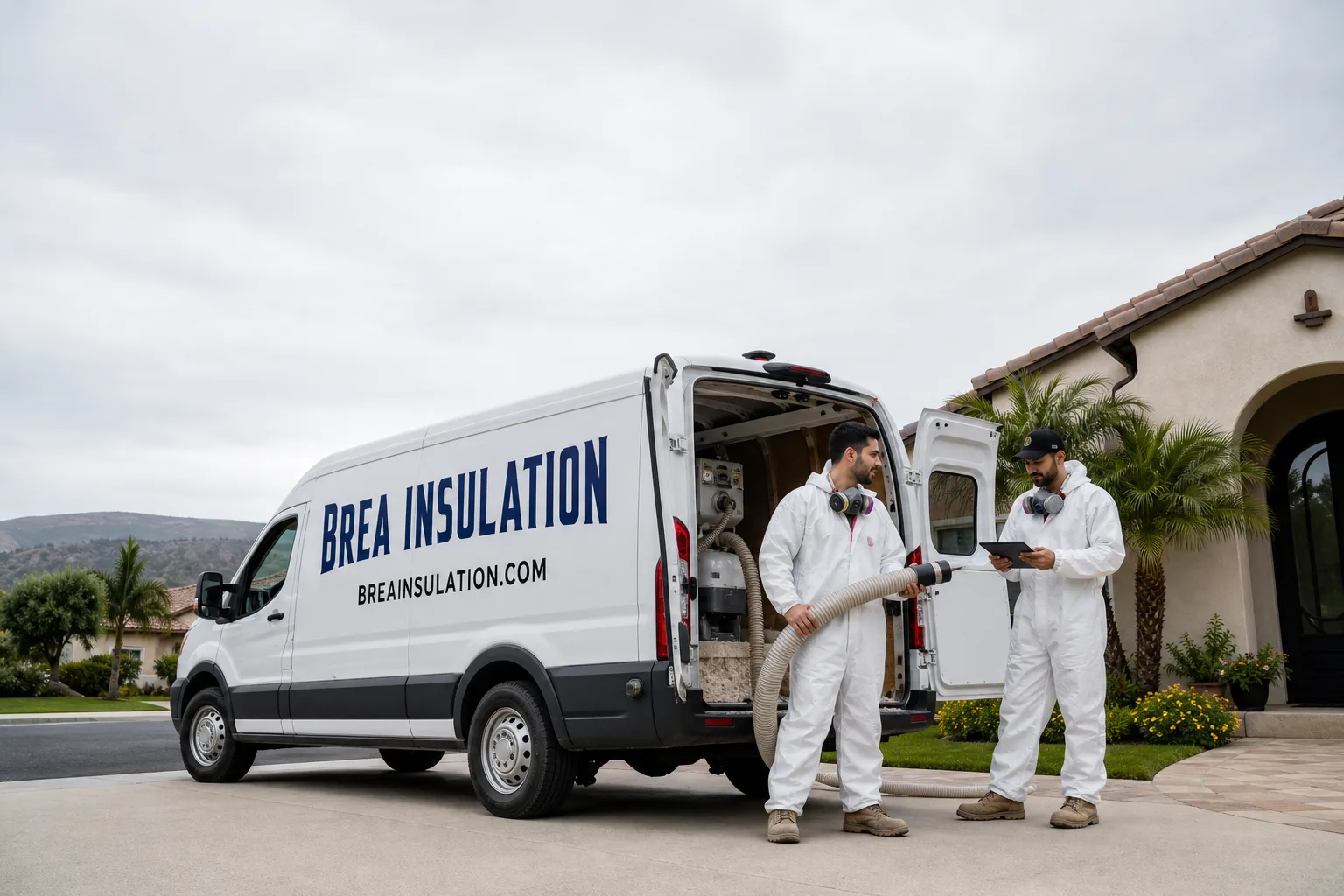
Fast, Reliable Spray Foam Insulation Across Shadow Hills
Spray foam insulation in Shadow Hills typically runs $4.50 – $9.75 per square foot installed, depending on whether you choose open-cell or closed-cell and whether the crew is sealing one attic or several separate structures on the same parcel. Most Shadow Hills jobs take one to two days, and on this side of the Verdugo foothills, the real question isn’t whether foam works; it’s whether the scope has been mapped structure by structure. That’s the reality of large-lot equestrian property, and it’s what makes this area different from tract neighborhoods down in Sunland or Burbank. Phil Darnell and the Brea Insulation crew have spent enough time on Shadow Hills parcels to know that a “standard attic job” is rare here. Call (866) 858-4033 and we’ll scope it properly.
Key Takeaways:
- Most Shadow Hills spray foam projects span multiple structures: main house, guest house, studio, barn.
- Closed-cell foam is usually the right call for unvented cathedral ceilings common in custom great rooms.
- Local foothill heat means radiant control matters more than winter retention.
- Free estimates for Shadow Hills homeowners: (866) 858-4033.
Why Brea Insulation Is Shadow Hills’s Preferred Spray Foam Insulation Company
Insulation is the only thing we do. That narrow focus matters more in Shadow Hills than almost anywhere else we work, because the housing stock here rarely fits a template. A custom ranch built in 1962 with a later great-room addition, a detached studio, and a six-stall barn is not the same job as a 1990s production build in Sunland. We carry eight manufacturer brands, including Icynene and Demilec for spray foam, so the material recommendation follows the structure, not our warehouse. When Phil’s crew arrives on Sunland Boulevard, the first hour is usually spent walking the lot and identifying every building envelope that needs attention, not just the one the homeowner called about.
Shadow Hills homeowners tend to do their research. They know an unvented cathedral ceiling with a thin open-cell pass will still cook in August. They ask about ember-aware detailing and fire-resistant mineral wool because the Sayre Fire scar is part of this community’s memory. We get those questions weekly, and we answer them with product-level specifics, because that’s what a specialist should do.
Garage Spray Foam Insulation in Shadow Hills
Garage Spray Foam Insulation in Shadow Hills almost always involves an attached garage under a room addition or a detached garage doubling as a workshop or tack room, and the work usually runs $2,800 – $6,400 for a full ceiling-and-wall scope on a standard two-car bay. Many Shadow Hills garages were built with zero cavity insulation and an uninsulated roof deck, which turns them into ovens by 10 a.m. in summer. A closed-cell foam pass on the underside of the roof deck changes that immediately.
Ceiling and Roof Deck Treatment
In Shadow Hills, the garage roof deck is often the bigger heat problem than the walls. Closed-cell foam at two to three inches on the underside of the deck blocks radiant gain and cuts the stack effect that pulls hot air into the house above the garage. When the garage sits under a bonus room or primary suite, this one change is usually the fastest way to fix an overheated upstairs space.
Detached Workshops and Tack Rooms
Detached garages on equestrian parcels in Shadow Hills get used hard: welding, woodworking, horse gear storage, sometimes a home gym. Open-cell foam in the walls plus closed-cell on the underside of the roof is a common combination here, and it runs on the higher end of the range because the structure has four exposed walls and no shared attic volume with the house.
Closed Cell Spray Foam Insulation in Shadow Hills
Closed Cell Spray Foam Insulation in Shadow Hills is the dominant choice for roofs, cathedral ceilings, and any structure that faces the intense Verdugo foothill sun without much shade, and a typical great-room roof deck runs $5,500 – $9,800 depending on square footage and framing complexity. Closed-cell cures rigid, adds structural racking strength, and acts as a Class II vapor retarder at two inches, which matters deeply in this microclimate where daytime heat soaks the roof and nighttime temperatures drop fast enough to create condensation risk inside unvented cavities.
Unvented Cathedral Ceilings
Shadow Hills custom homes are full of open-beam ceilings with no attic above them. The only way to insulate those roofs properly is to spray the underside of the roof deck itself, and closed-cell is almost always the right material: higher R-value per inch, air-sealing capability, and no moisture migration into the framing. We’ve done this on great rooms overlooking the Verdugos where the beam quality is part of the architecture, and the foam gets buried behind the finish while the beams stay exposed.
Roof Deck Retrofits on Older Custom Builds
Older ranch-style and Mediterranean homes in Shadow Hills often have vented attics that were under-insulated from day one. Closed-cell on the attic floor isn’t always the answer. On homes with HVAC equipment in the attic or with vaulted sections mixed into the roofline, we frequently recommend converting to an unvented assembly by foaming the roof deck itself. It changes the thermal boundary and stops the attic from becoming a heat reservoir.
Trusted Brands We Service in Shadow Hills
Brea Insulation installs and services spray foam from Icynene and Demilec, two of the most respected names in professional spray polyurethane foam. We also work with CertainTeed and GreenFiber for projects where a hybrid approach makes sense, like blown-in cellulose in a flat ceiling section paired with closed-cell foam on the vaulted areas. Carrying an eight-brand bench means Shadow Hills homeowners get a material recommendation driven by the structure, not by what we stock cheapest. When a customer asks about a specific product line, we can typically quote and schedule it without the “we’ll see what the supplier has” delay.
Common Spray Foam Insulation Problems We See in Shadow Hills Homes
- Unvented cathedral ceilings that were left uninsulated or thin-sprayed. The San Fernando Valley sun beats on the roof deck from about 9 a.m. to 6 p.m. in summer, and an incomplete foam pass lets that heat conduct straight through to the great room ceiling. A vaulted living space can hit 90 degrees even with AC running, because the thermal boundary is in the wrong place or too thin.
- Main house foamed, outbuildings ignored. On multi-acre parcels, the main house gets the upgrade while the guest house, studio, or horse barn keeps sweating and condensing. These are separate thermal envelopes, and the fact that they share a lot line doesn’t mean they share insulation. We scope them separately, because they fail separately.
- Gaps between original framing and additions. Shadow Hills homes have had additions built in every decade since the 1960s, and the seams between old and new framing are often wide open. If the scope isn’t mapped structure by structure, foam gets installed on both sides of the gap and the cavity leak remains. We find these with a thermal scan before spraying.
- Open-cell used where closed-cell was needed. Open-cell foam is cheaper per board foot, but it’s permeable and soft. On unvented Shadow Hills roof decks, it doesn’t give the moisture control or the extra structural stiffness that closed-cell provides. The repair cost later far outweighs the initial savings.
Pricing for Spray Foam Insulation in Shadow Hills, CA
Open-cell spray foam in Shadow Hills runs $1.20 – $2.60 per board foot, which translates to roughly $4.50 – $6.75 per square foot of applied area depending on depth. Closed-cell runs $2.50 – $3.90 per board foot, or about $6.00 – $9.75 per square foot. A detached guest house with four exterior walls and a roof deck typically lands between $6,800 and $12,500 for complete coverage. A single unvented cathedral ceiling over a great room is usually $5,500 – $9,800. Multi-structure lots, which are the norm in Shadow Hills, should expect the total to reflect the square footage of every building on the parcel. We quote per structure, and estimates are free. Call (866) 858-4033 and we’ll measure every envelope on the property.
We Also Serve Cities Near Shadow Hills
Brea Insulation runs crews throughout the northeast San Fernando Valley, including Sunland, Tujunga, La Crescenta-Montrose, and Burbank. If you’re in Shadow Hills proper, you’re on our regular route already. For the full picture of what we do, see our Spray Foam Insulation page, and for more on our work in this corridor, take a look at Shadow Hills.
Serving Shadow Hills, CA — Our Local Coverage Area
We’re based in the Shadow Hills area and know this community well. Use the map below to see our service coverage — if you’re nearby, we can almost certainly help.
FAQs About Spray Foam Insulation in Shadow Hills
Yes, and closed-cell foam is the material we recommend for this specific Shadow Hills assembly. The foam is sprayed onto the underside of the roof deck between and over the framing, the beams remain exposed below the finished surface, and the thermal boundary moves to the roofline itself. That’s the only way to properly insulate an unvented cathedral ceiling without building a false ceiling underneath it.
In most cases, yes. Separate structures on the same parcel have their own thermal envelopes, and delaying the outbuildings means another mobilization, another prep day, and another period of high summer heat working against you. Doing them in the same visit usually saves 10 – 15% on the combined scope compared to scheduling them months apart. Call (866) 858-4033 for a per-structure quote.
Closed-cell delivers about double the R-value per inch of open-cell, acts as a vapor retarder at two inches, and adds shear strength to the roof deck. In a Shadow Hills unvented roof that bakes all day and cools hard at night, those properties stop moisture from condensing inside the cavity and help the roof assembly handle the thermal swing without movement or cracking.
Spray foam itself is not a fireproofing product, and any foam installed in living spaces must be covered by a thermal barrier like drywall. But the air-sealing capability of closed-cell foam does reduce the number of open gaps and vents where wind-driven embers can enter a roof assembly. For fire-resistance specifically, we also work with Rockwool stone wool, which is noncombustible and carries its own fire-performance ratings, and we can discuss that as part of a hybrid scope.
Clear out any old batt insulation, rodent debris, and dust so the foam can bond to the framing and sheathing. Then let us inspect for hidden wiring, especially knob-and-tube remnants in older Shadow Hills builds, because foam cannot be sprayed over live knob-and-tube. We handle the cavity inspection and thermal scan as part of the estimate, so you know what’s in the walls before any foam goes in.
If you live in Shadow Hills and you’re tired of rooms that won’t hold temperature, a guest house that’s unusable in August, or a barn that condensates all winter, call Brea Insulation at (866) 858-4033. Phil Darnell will make sure the scope covers every structure on your parcel, not just the one you called about.
Written by Phil Darnell, Owner at Brea Insulation, serving Shadow Hills and the northeast San Fernando Valley.