
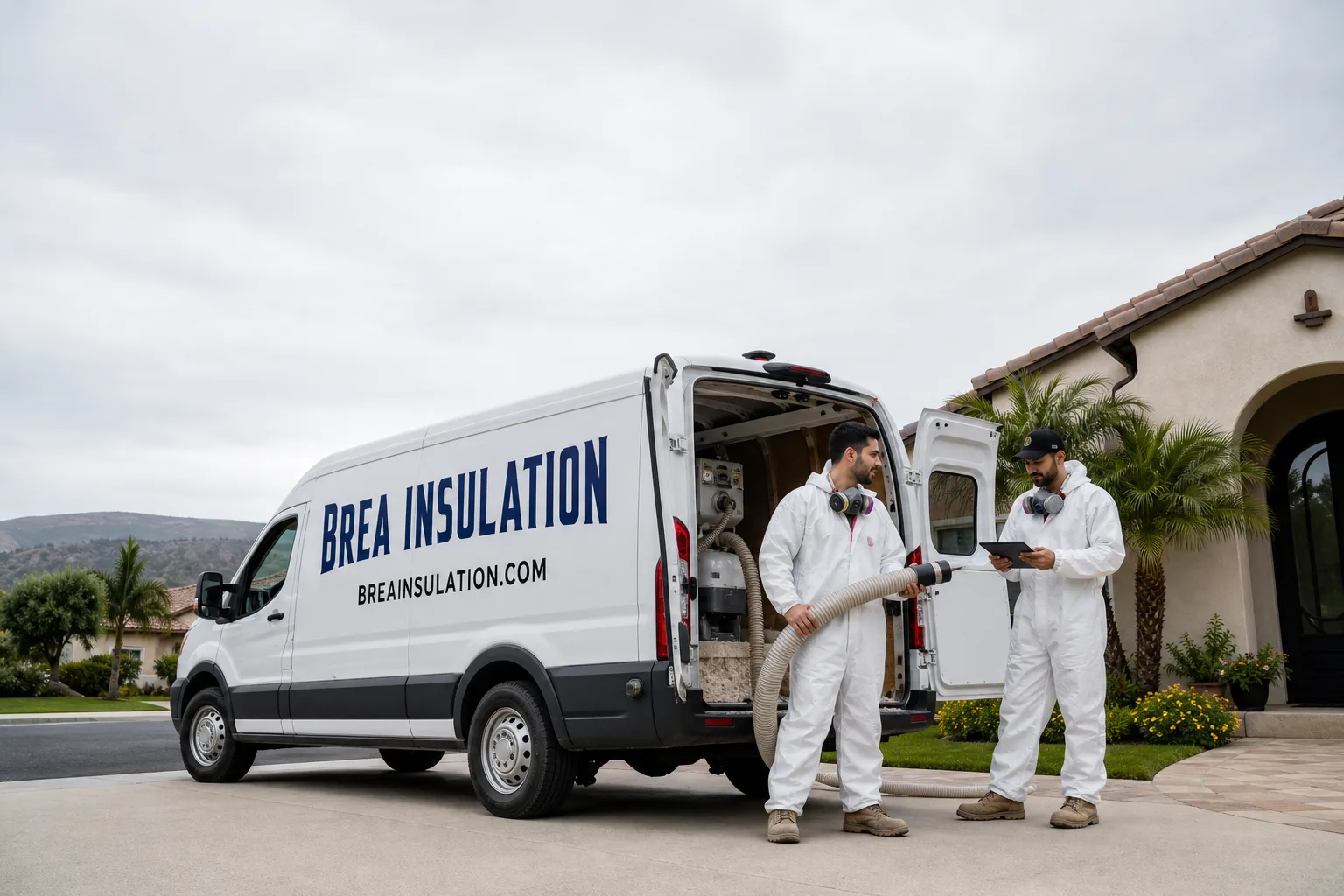
Fast, Reliable Spray Foam Insulation Across Meadowbrook
Spray foam insulation in Meadowbrook runs $2,800 – $7,400 for a typical 1,500 – 2,200 square foot home, with garage ceiling applications starting around $1,200 – $2,100. Most jobs wrap up in one to two days. We’ve worked in ZIP 92532 long enough to know that attics up here bake past 140°F most summer afternoons, which changes everything about which foam we recommend and how we install it. Call Phil at (866) 858-4033 and we’ll talk through your home’s specific situation before any quote gets written.
Meadowbrook isn’t a place where you can copy-paste a coastal insulation strategy or a valley-floor approach. The elevation, the dry heat, the Santa Ana winds, and the wildfire exposure all push us toward specific materials and methods. That local knowledge is why homeowners and property managers in Meadowbrook keep calling us back.
Why Brea Insulation Is Meadowbrook’s Preferred Spray Foam Insulation Company
We’re an insulation contractor. That’s the whole list. No roofing side hustle, no HVAC add-on, no general handyman work. When we show up to a home off Meadowbrook Drive or up on one of the ridgeline lots, insulation and air sealing are the only things on the work order. That narrow focus means we’ve seen the failure patterns in this specific mountain community hundreds of times. We know exactly what happens to a ridge-vent-only attic after a decade of 140°F summer afternoons. We know what salt-laced wind from Lake Elsinore does to exposed hardware. And we know which foam chemistry survives this thermal cycling without off-gassing or losing R-value.
Our material bench runs eight brands deep: Owens Corning, Johns Manville, Knauf, Rockwool, CertainTeed, Icynene, Demilec, and GreenFiber. For Meadowbrook attics, we lean heavily on closed-cell lines like Demilec because the chemistry handles high heat cycling far better than open-cell alternatives. For walls and garage ceilings where ember resistance matters, closed-cell wins again. We don’t stock one cheap product and push it on every job. We carry eight so we can match the material to the house, not the other way around.
Our response time to Meadowbrook runs same-week for most estimates and installations. If you’ve got corroded garage-door hardware and failing batts in August, we get to you fast because we know the garage is often the first room to become unbearable when attic temperatures spike.
Garage Spray Foam Insulation in Meadowbrook
Garage Spray Foam Insulation in Meadowbrook is one of the most impactful upgrades we install, especially for homes where the garage faces afternoon sun or sits on the western edge of the property. Most Meadowbrook garages we inspect are under-insulated or completely uninsulated, with thin drywall separating the garage cavity from the living space above it. In summer, that gap translates into a room that feels 15 – 20 degrees hotter than the rest of the house by mid-afternoon. Closed-cell spray foam applied to the garage ceiling and shared walls seals the air leaks, blocks radiant heat transfer, and turns that dead space into a buffer zone instead of a heat source. Typical garage ceiling spray foam jobs in Meadowbrook run $1,200 – $2,100 depending on square footage and access.
We also pay attention to what’s behind the foam. Years of exposure to salt-laced wind coming off Lake Elsinore corrodes garage-door springs, hinges, rollers, and opener chains faster than you’d expect at this elevation. We don’t replace springs. But we flag the corrosion so you can get ahead of a snapped spring before it fails, because a spring that breaks at 6 a.m. on a workday is a worse problem than one you replace on your schedule. And if corroded hardware means the garage door sits misaligned or won’t fully seal, it undermines everything the insulation is doing.
Air Sealing the Garage Ceiling
Most Meadowbrook garages we open up have visible gaps between the drywall and framing, plus penetration holes around wiring and plumbing that leak conditioned air straight into the attic. Before we spray foam, we walk the garage with a thermal camera to find every leak point. Sealing those gaps before applying foam is the difference between a garage that stays comfortable and one that still bakes despite new insulation.
Ember-Resistant Garage Design
Wildfire ember entry is a real concern for Meadowbrook homeowners, especially on hillside lots with dry brush within 100 feet of the garage. Closed-cell spray foam tightens the garage envelope enough to slow ember intrusion through soffit vents and foundation gaps. It’s not a fireproofing system, but it’s a meaningful passive defense for a mountain community that lives with evacuation maps on the fridge.
Closed Cell Spray Foam Insulation in Meadowbrook
Closed Cell Spray Foam Insulation in Meadowbrook is our default recommendation for nearly every attic and garage application, and the reason comes down to heat. Standard open-cell foam begins to off-gas and lose R-value when attics sustain temperatures above 140°F, and Meadowbrook attics hit that mark routinely from June through early October. Closed-cell foam from Demilec or Icynene handles the thermal cycling without degrading, holds its R-value across a wider temperature range, and adds structural rigidity to aging rooflines. For a typical 1,500 square foot attic in Meadowbrook, expect to pay $4,200 – $6,800 for a full closed-cell roof deck application.
We mention open-cell because some homeowners ask why we don’t just use the cheaper option. The answer is simple: Meadowbrook’s attic temperatures aren’t a mild-climate scenario. An open-cell install here would fail within a few summers, and we’d rather install the right product once than return to replace a degrading one. The hot ridge-vent-only attic designs so common in the 1960s and 1970s ranch homes around Meadowbrook Drive are exactly the structures that bake open-cell foam past its useful life.
Radiant Barrier Coating for Mountain Attics
For homes on full-sun ridgeline lots, we specify closed-cell with a radiant-barrier coating to reject the worst of the late-afternoon heat before it ever reaches the foam layer. This combination is the most effective defense we’ve found against Meadowbrook’s 140°F-plus attic conditions. The foam insulates, the radiant barrier reflects, and the attic stays measurably cooler even on triple-digit August days.
What Replaces Failed R-11 Batts
When we open a 1970s Meadowbrook attic and find collapsed R-11 batts, the fix isn’t just adding more insulation on top. We remove the failed material, air-seal every ceiling penetration and top-plate seam, then apply closed-cell directly to the roof deck. That sequence keeps the foam where it works and eliminates the gaps that let hot air bypass whatever insulation you install. It also restores ember resistance at the eaves, which matters a lot when the Santa Anas kick up in the fall.
Trusted Brands We Service in Meadowbrook
We install spray foam from Demilec and Icynene, the two names in professional spray polyurethane foam we trust most for Meadowbrook’s climate. For homeowners prioritizing recycled materials, we also offer GreenFiber blown-in cellulose. And our full brand bench includes Owens Corning, Johns Manville, Knauf, Rockwool, and CertainTeed, which means we’re never forcing a product that doesn’t fit the house in front of us. We maintain local stock in the Meadowbrook and greater Lake Elsinore area so material delays don’t stretch a two-day install into two weeks.
Common Spray Foam Insulation Problems We See in Meadowbrook Homes
- Collapsed and degraded original R-11 batts. Homes built between the 1960s and 1990s in Meadowbrook were insulated to the standards of their day, which were thin. After 40 – 60 years of mountain heat cycling, those batts compress, sag, and leave huge gaps in the attic floor. The fix starts with removal and air sealing before any new foam goes in.
- Off-gassing open-cell foam in hot attics. We’ve pulled out open-cell installs from other contractors that turned brittle and lost R-value after a few Meadowbrook summers. At sustained 140°F attic temperatures, open-cell chemistry simply can’t hold up. Closed-cell is the correction here.
- Ridge-vent-only attic designs that fail under heat. Many older Meadowbrook homes rely on passive ridge vents that work fine in milder climates and do almost nothing when the attic hits 140°F on a still August afternoon. The venting strategy can’t be fixed without addressing the insulation, and closed-cell roof deck application reframes the whole problem.
- Salt-air corrosion on garage hardware. Lake Elsinore’s moisture and the dry wind combine to accelerate rust on garage-door springs, hinges, tracks, and fasteners. We flag this during every garage insulation job because a snapped spring or a seized roller means the garage door won’t seal, and an unsealed garage door works against the insulation we just installed.
Pricing for Spray Foam Insulation in Meadowbrook, CA
A typical whole-home spray foam insulation project in Meadowbrook runs $2,800 – $7,400. Garage ceiling applications fall between $1,200 and $2,100. Attic-specific closed-cell roof deck work lands around $4,200 – $6,800 for a standard 1,500 square foot Mountain-community home. What moves the number: total square footage, whether the roof deck or the attic floor is the application surface, access constraints on steep hillside lots, and whether we’re removing degraded existing material first. Homes with septic and well systems don’t change the insulation price, but crawlspace or well-house insulation as an add-on runs $500 – $1,200 depending on size. Estimates are free. Call (866) 858-4033 and we’ll give you a real number, not a placeholder.
We Also Serve Cities Near Meadowbrook
Our Spray Foam Insulation crews also handle work across Canyon Lake, Sedco Hills, Lakeland Village, and Quail Valley. If you’re in one of those communities and dealing with the same inland-mountain heat, the same wildfire exposure, and the same aging housing stock, we can help. See Meadowbrook for more on our local coverage.
Serving Meadowbrook, CA — Our Local Coverage Area
We’re based in the Meadowbrook area and know this community well. Use the map below to see our service coverage — if you’re nearby, we can almost certainly help.
FAQs About Spray Foam Insulation in Meadowbrook
Spray foam itself holds up fine against salt-laced air, but the surrounding garage hardware doesn’t. Springs, hinges, tracks, rollers, and opener chains corrode faster in Meadowbrook than they do further inland, which means the garage door can fail before the foam’s thermal benefits are realized. We flag corrosion during every garage insulation job so you can address it early. Call (866) 858-4033 if you’re seeing rust on your springs or hearing the opener strain.
Closed-cell foam retains its R-value and chemical stability at sustained attic temperatures above 140°F, while open-cell foam begins to off-gas and degrade under those same conditions. Meadowbrook attics hit 140°F routinely from June through October, so closed-cell is the only spray foam we recommend here for attic and roof deck applications.
Yes, when applied correctly to close gaps at the eaves, soffit vents, and foundation level. Closed-cell spray foam tightens the envelope and slows ember intrusion. It is not a fireproofing system, but it’s a meaningful passive defense for a mountain community with real wildfire exposure. Every house on a hillside lot above Lake Elsinore should have its ember entry points sealed.
Have them replaced before they snap. We can’t replace springs, but we’ll flag the corrosion during your garage insulation estimate so you know it needs attention. A broken spring at 6 a.m. on a workday is a far bigger headache than a planned replacement. Call (866) 858-4033 and we’ll walk you through what we’re seeing back there.
Every 3 – 5 years. Meadowbrook’s thermal cycling and dry heat stress insulation faster than mild climates, and early degradation is easier to correct than a full replacement. We inspect garage hardware corrosion at the same time, since both problems tend to show up together in this community.
Written by Phil Darnell, Owner at Brea Insulation, serving Meadowbrook and the Lake Elsinore mountain communities.