
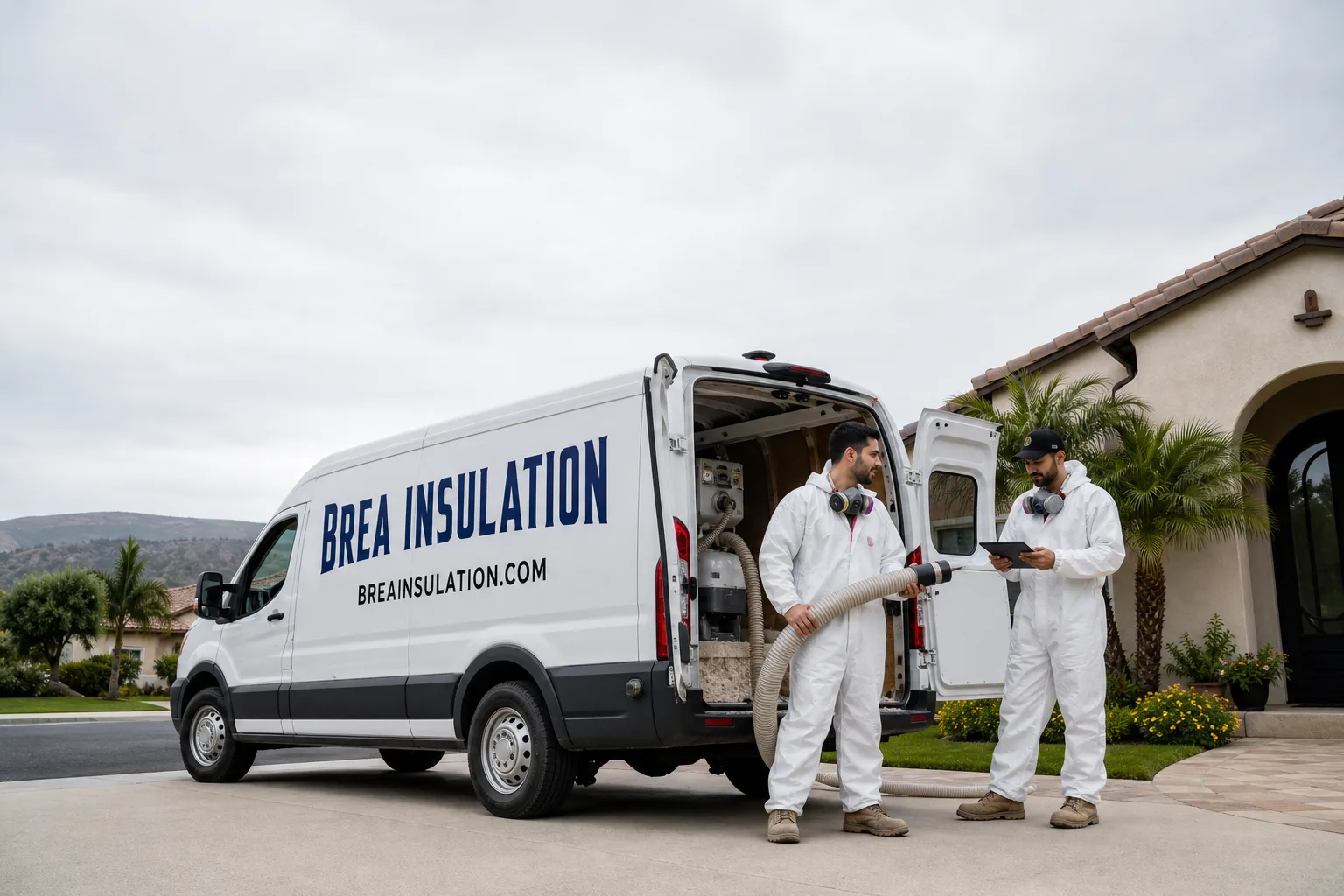
Fast, Reliable Spray Foam Insulation Across March Air Force Base
Spray foam insulation in March Air Force Base addresses two problems most homes here battle every summer: triple-digit attic heat gain and air leakage through walls built to 1940s-through-1960s military construction standards. As a dedicated insulation contractor working throughout the 92551 zip code, we measure the actual cavity depth in your home before recommending any product, because the shallow attics and original framing on base-demand solutions that fit the structure, not just the R-value on a spec sheet. Phil Darnell and the Brea Insulation team know which areas of March Air Force Base have the oldest housing stock, and we schedule around your availability, not the other way around. Call (866) 858-4033 for a free estimate on open-cell, closed-cell, or rim joist spray foam.
Why Brea Insulation Is March Air Force Base’s Preferred Spray Foam Insulation Company
Insulation is the only thing on our menu. We don’t split attention across roofing, HVAC, or drywall, so when we assess a March Air Force Base home, we’re looking at the full thermal envelope with a tradesperson’s eye*. That narrow focus is why we carry eight manufacturer lines, including Icynene and Demilec spray foam, and why the recommendation you get is driven by your home’s needs, not by what’s cheapest to stock or easiest to install.
March Air Force Base homeowners tell us the same thing: previous contractors treated their crawl space or attic like a standard suburban job, then the foam underperformed because nobody checked eave clearance or wall cavity depth first. We don’t make that mistake. Our team works regularly in the base’s older duplexes, barracks-conversion homes, and block-base family housing, so we arrive already familiar with the framing styles and the failure points specific to this area.
Response time to March Air Force Base is quick. Brea Insulation is based in Brea, but we route crews through Riverside County on a weekly schedule, which means most March Air Force Base jobs can be quoted within a couple of days and scheduled within the week. Call (866) 858-4033 and we’ll give you a straight answer on timing.
Crawl Space Spray Foam Insulation in March Air Force Base
Crawl Space Spray Foam Insulation in March Air Force Base means sealing the underbelly of older military-construction homes against the dry, hot air that pushes up through floor joists in summer and the cool air that settles down from feet-cold floors in winter. Many of the block-base family homes in March Air Force Base sit over vented crawl spaces that were never insulated at all, or have a thin layer of fiberglass that has been torn, drooped, or turned into a rodent highway over 60-plus years. Closed-cell foam works well here because it adds rigidity to older floor framing while creating a continuous air and moisture barrier.
A typical crawl space spray foam job in March Air Force Base runs $2,400 to $5,800 depending on square footage, access height, and how much old material needs removing first. Homes with tight crawl access or existing batt remnants to pull out land on the higher end. We give you a fixed quote before we start, and you’ll know exactly what’s being removed and what’s going in.
Since March Air Force Base sits in inland Riverside County, where summer heat is the dominant issue, closed-cell foam typically makes more sense here than open-cell for crawl spaces. The higher R-value per inch (about R-6.5 to R-7) gives you real thermal performance in a confined depth. Call (866) 858-4033 and we’ll inspect your crawl space before recommending anything.
Sealing Rim Joists in Base Housing
Every crawl space has a rim joist, and in March Air Force Base’s older homes, the rim joist is usually the single biggest air leak in the entire floor assembly. We see this constantly in duplexes and converted barracks units, where the original builders never caulked or sealed the joist-to-foundation gap.
Rim joist spray foam runs $900 to $2,200 for a typical March Air Force Base home, depending on linear footage and joist depth. Sealing this one area often cuts floor drafts and dust intrusion dramatically, and it keeps crawl space air from migrating into your living space.
Moisture and Vapor Control Under Mid-Century Homes
March Air Force Base doesn’t get much rain, but cool winter nights can create condensation in vented crawl spaces, especially under homes with exposed dirt floors and no ground vapor barrier. Closed-cell spray foam on the crawl space walls and rim joists acts as a vapor retarder, which helps keep the framing dry and the air inside the home cleaner.
If your crawl space has old batt insulation touching the subfloor, removing it before spraying is non-negotiable. Spraying over dusty, settled batt remnants leads to poor adhesion and hidden voids, which in a March Air Force Base home means you’re paying for insulation that isn’t actually insulating.
Garage Spray Foam Insulation in March Air Force Base
Garage Spray Foam Insulation in March Air Force Base is a practical retrofit for homeowners using the garage as a workshop, gym, laundry area, or even a secondary living space. On base, garages in mid-century family housing are often attached, sharing a wall and sometimes a ceiling with conditioned rooms, and those garages were almost never insulated at time of construction. In summer, an uninsulated garage ceiling radiates heat upward into bedrooms above it or through the shared wall into the kitchen.
A typical garage ceiling spray foam job in March Air Force Base runs $1,400 to $3,600, depending on ceiling square footage, roof pitch, and whether the wall shared with the house also needs treatment. Garage walls generally add $800 to $2,000. Open-cell foam is often sufficient for garage ceilings that are not directly conditioned, while closed-cell is the better call if the garage has living space above it or if you’re trying to isolate noise from an air-handling unit.
The thing to watch for in March Air Force Base garages is the roof-deck connection. Many of the older homes have shallow-pitch rafters above the garage, and if you’re finishing the garage to use it year-round, you’ll want the roof deck sprayed, not just the ceiling joists. That typically adds $2,000 to $5,000 to the project, but it prevents the hot-air pocket that forms between the joists and the roof sheathing in July.
Garage Wall and Shared-Wall Sealing
If your garage shares a wall with a bedroom or living space, that wall is a heat pump in summer and a cold sink in winter. We regularly spray closed-cell foam into the shared wall cavity from the garage side in March Air Force Base’s attached-garage homes, which means we don’t have to tear out drywall inside the house.
Shared-wall garage foam runs $400 to $1,100 in most March Air Force Base homes. It’s a fast job and one of the cheapest ways to stop a hot bedroom or a cold hallway at the point where the heat is actually entering.
Roof Deck Spray Foam for Unvented Garages
Some of the older garages in March Air Force Base were built with no eave vents at all, which makes traditional attic insulation ineffective and can trap heat between the ceiling and the roof deck. Spraying the underside of the roof deck with closed-cell foam turns that dead space into a conditioned, quiet buffer.
Roof deck spray foam in March Air Force Base runs $5 to $9 per square foot of roof deck area. For a two-car garage, that’s usually $3,000 to $6,500. It’s a bigger investment, but it solves the unvented-garage heat problem permanently and also reduces dust and pollen entry through the soffits.
Trusted Brands We Service in March Air Force Base
We install and service Icynene and Demilec spray foam in March Air Force Base, two manufacturers known for low-VOC formulations and consistent cell structure. We also stock GreenFiber blown-in cellulose for homes where spray foam isn’t the right fit for a shallow cavity, and we work with Owens Corning batt products where they actually make sense. Carrying eight brands means the material decision is never forced. If your March Air Force Base attic can’t handle a full open-cell lift, we won’t sell you one. We’ll tell you what fits and why.
Common Spray Foam Insulation Problems We See in March Air Force Base Homes
- Foam over settled batt remnants in shallow attics: Older barracks-style and duplex units off Cactus Avenue and Riverside Drive often have original fiberglass batts that are 40 to 60 years old, compressed, and covered in dust. Sprayed foam won’t adhere properly to those surfaces, leaving voids that let hot air loop around the insulation. The batts have to come out first, and the top plates need air-sealing before any foam goes down.
- Block-base walls sprayed without a thermal barrier: Some of the block family homes near the base perimeter have original uninsulated masonry walls. Foam applied directly to bare block without proper surface prep can wick moisture in Riverside County’s cool winter nights and degrade over time. We check for existing moisture and seal the masonry surface before spraying.
- Low-pitch attics with blocked eave vents: The shallow 4-to-6-inch cavities above the ceiling joists in March Air Force Base’s military-era homes leave almost no room for error. If a tech sprays too close to the soffit, the eave vents clog and the attic can’t breathe. In the WWII-era wood-frame homes off Cactus Avenue, we’ve measured 5-inch clearance above the top plates and had to remove old batts, air-seal the wiring penetrations, and apply Icynene spray foam to the attic floor to reach R-38 without sacrificing that eave clearance.
- Fresh spray foam off-gassing in tight, unvented attics: When a March Air Force Base attic has minimal venting in the first place, the curing smell from spray foam can linger for days if the tech doesn’t verify ventilation before spraying. We check eave and roof venting before we spray, and we schedule the job so you’re not living with the odor longer than necessary.
Pricing for Spray Foam Insulation in March Air Force Base, CA
Open-cell spray foam in March Air Force Base typically runs $1.10 to $1.90 per board foot for attic and wall applications. Closed-cell foam runs $1.70 to $3.00 per board foot. In real numbers, that means a standard 1,200-square-foot attic with 5 inches of depth usually lands between $1,800 and $4,200 depending on prep work needed, while a full crawl space encapsulation with closed-cell foam starts around $5,000 and goes up from there. What moves the number on base is the amount of old material removal, access difficulty in tight military-era attics, and whether we’re sealing rim joists and top plates at the same time. We give a free written estimate with a fixed price, so you know the number before we start. Call (866) 858-4033 for an exact quote, and we’ll walk you through what’s needed in your specific unit.
We Also Serve Cities Near March Air Force Base
Brea Insulation also handles Spray Foam Insulation projects in Moreno Valley, Woodcrest, Perris, and Good Hope. Our crews are already working across Riverside County each week, so extending a March Air Force Base project to a rental property or family member’s home nearby is straightforward. Call (866) 858-4033 to check our schedule for your neighborhood.
Serving March Air Force Base, CA — Our Local Coverage Area
We’re based in the March Air Force Base area and know this community well. Use the map below to see our service coverage — if you’re nearby, we can almost certainly help.
FAQs About Spray Foam Insulation in March Air Force Base
Yes, and it’s often the best option, but only if the tech measures usable cavity depth first and removes any original batt remnants. Open-cell or high-density closed-cell foam can reach R-38 in a 5-inch cavity if applied correctly, but spraying over settled fiberglass or too close to eave vents creates voids and ventilation problems. We’ve applied Icynene spray foam directly to the attic floors of barracks-style homes off Cactus Avenue with less than 5 inches of eave clearance and achieved R-38 without blocking airflow. Call (866) 858-4033 and we’ll measure your specific attic before recommending anything.
Spray foam outperforms fiberglass batts in March Air Force Base’s climate because it stops air movement, not just heat transfer, and the primary driver of discomfort here is hot air pushing through wall cavities and top plates during triple-digit heat. Batt insulation slows conductive heat but does nothing to stop convective air loops, while properly installed spray foam seals the cavity completely. The dry climate also works in your favor with spray foam, since low ambient humidity means faster, more consistent curing and less risk of moisture-related adhesion issues.
Yes. Original block walls in March Air Force Base’s mid-century family housing were never insulated, and spraying foam directly onto bare masonry can trap moisture during cool winter nights, especially if the block has absorbed ground moisture over the decades. We check for existing dampness, seal the masonry surface, and in some cases install a thin thermal break before spraying closed-cell foam. The prep work is quick, but skipping it is how spray foam jobs fail prematurely in Riverside County’s temperature swings.
Yes, closed-cell spray foam is a good fit for the vented crawl spaces under older March Air Force Base duplexes, provided the crawl area is dry and any old fiberglass is removed before spraying. Closed-cell foam adds structural rigidity to older floor joists and acts as both an air barrier and a vapor retarder, which helps with the dusty air and cool-floor drafts common in these units. We do not recommend open-cell foam in contact with ground moisture, so we inspect the crawl space before giving you a recommendation. Estimates are free at (866) 858-4033.
With 5 inches of usable cavity depth, closed-cell spray foam delivers about R-32 to R-35, and open-cell delivers about R-19 to R-22. To hit the R-38 target in a shallow March Air Force Base attic, we use closed-cell foam or combine open-cell with a thin high-density cap, or we stack high-density blown insulation where eave clearance allows. The specific approach depends on your eave venting, and we’ll show you the math for your unit before we quote. Call (866) 858-4033 and Phil Darnell’s team will give you exact numbers for your attic.
Get a Spray Foam Insulation Estimate in March Air Force Base
If you’re in March Air Force Base and tired of sweating through summer in a home built before insulation standards existed, call Brea Insulation at (866) 858-4033. We’ll inspect your attic, crawl space, or garage, tell you exactly what’s failing, and give you a fixed price to fix it. No pressure, no vague answers. Phil Darnell and our crew know these homes, and we’ll treat your base housing or rental property like the specific structure it is, not a generic job. Estimates are free, and you’ll leave the call knowing more about your home than you did before you dialed.
Written by Phil Darnell, Owner at Brea Insulation, serving March Air Force Base and Riverside County since [year].