
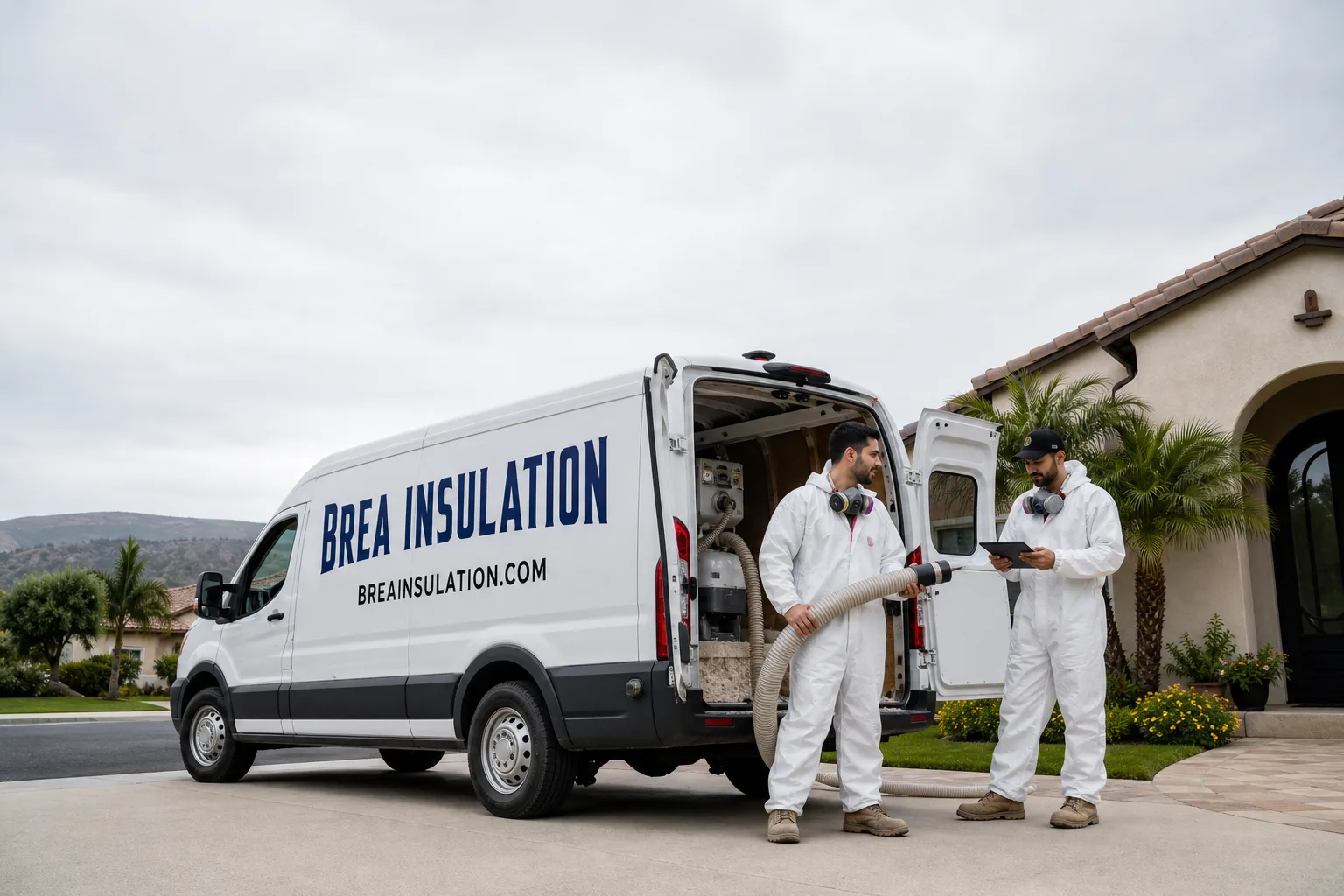
Fast, Reliable Spray Foam Insulation Across Claremont
Spray foam insulation in Claremont typically runs $2.50 to $6.50 per board foot installed, and most attic or closed-cavity retrofit jobs land between $3,500 and $9,800 depending on square footage, foam type, and access conditions. We reach most Claremont neighborhoods within the same week, often faster during shoulder seasons. If your ranch or Spanish Colonial Revival home off Foothill Boulevard or Indian Hill Boulevard struggles with afternoon heat that won’t quit, call (866) 858-4033. Phil Darnell and the Brea Insulation crew know exactly what these post-war homes need because we’re in them constantly, working around original plaster, legacy wiring, and attics that bake under the Inland Empire sun.
This page is written specifically for Claremont homeowners, because this city’s housing stock is different from what you’d find ten miles west. The insulation work here is almost never new construction. It’s retrofit, careful, and detail-heavy work on homes that were built before wall insulation was standard. We’ll cover what that means for your foam choices, your budget, and your timeline.
Why Brea Insulation Is Claremont’s Preferred Spray Foam Insulation Company
Insulation is all we do. That single-trade focus matters most in a city like Claremont, where the right retrofit approach hinges on understanding how 1950s framing, original plaster, and attic heat interact. A generalist contractor sees a hot attic and sells batts. We see the unsealed top plates, the knob-and-tube runs, the tree-crowded access hatch, and the 2×4 walls with nothing but air between the studs. Better diagnosis, better install.
We carry eight manufacturer lines – Owens Corning, Johns Manville, Knauf, Rockwool, CertainTeed, Icynene, Demilec, and GreenFiber – because no single foam or batt fits every Claremont home. A closed-cavity injection into original lath-and-plaster walls calls for one product. A roof-deck application over a sun-baked attic calls for another. We match material to job, not job to whatever’s sitting in the warehouse. Homeowners near the Claremont Colleges and the Village have called us specifically because we carry Demilec and Icynene closed-cell lines, which handle the radiant heat that defines Claremont summers better than open-cell or blown-in alternatives.
Response time to Claremont is consistent because we’re based just over the county line in Brea. We schedule dedicated Claremont days, which means we’re not treating your job as a distant afterthought. Phil Darnell personally reviews material specs on every Claremont estimate, especially where original plaster and legacy wiring are involved. That level of oversight is standard for us, not a premium tier.
Spray Foam Insulation Contractors in Claremont
Spray Foam Insulation Contractors working in Claremont need to understand the difference between foaming a new build and retrofitting a post-war home, because the approach changes everything. In Claremont, the typical job involves either sealing and foaming an attic whose roof deck sees 140°F+ in August, or injecting foam into uninsulated 2×4 walls behind original plaster without cracking it. Our Spray Foam Insulation team handles both, but the material selection and application method differ sharply between the two. An attic retrofit in the 91711 zip code runs roughly $4,200 to $9,800 for a full roof-deck application. A wall-cavity injection for a single-story ranch runs $6,000 to $12,000 depending on wall area and access.
Plaster-Safe Wall Cavity Injection
Homes near the Village and the Claremont Colleges often have original plaster interior walls that are 60 to 80 years old. Spray foam expands. Apply it wrong and you crack the plaster from inside the cavity. We use low-expansion injection foams and calibrated application rates for these walls, working in controlled lifts rather than filling the cavity in one pass. The goal is a sealed, insulated wall that looks exactly like it did before we arrived.
Attic Top-Plate Sealing and Roof Deck Foam
Claremont attics are the real battleground. The sun pounds these roofs from June through September, and if the top plates aren’t air-sealed, that superheated air radiates straight down into your living space. We seal top plates, soffit transitions, and any penetrations before applying closed-cell foam to the roof deck itself. This creates a true thermal boundary, not just a thicker layer of fluff.
Spray Foam Attic Insulation in Claremont
Spray Foam Attic Insulation in Claremont is the single highest-impact upgrade for most of these post-war homes, because the attics here were built with minimal insulation and almost no air sealing. A 1954 ranch near the college district might have R-19 fiberglass batts that have compacted to R-8 or less, sitting on an unsealed top plate that lets 140°F attic air pour into the wall cavities. Foaming the roof deck instead changes the attic from a heat trap into conditioned space. That job in Claremont runs $4,500 to $9,500 for a typical 1,200 to 2,000 square foot single-story home, with the spread driven by roof pitch, access clearance, and whether legacy wiring needs isolation first.
Closed-Cell Roof Deck Application
Closed-cell foam at 2 to 3 inches on the underside of the roof deck creates an air barrier and an R-value of roughly 13 to 21, which in Claremont’s climate performs better than R-38 fiberglass on the attic floor because it actually stops the radiant heat transfer at the source. We use Demilec and Icynene closed-cell lines for these applications. The foam forms a continuous seal across the deck and gable ends, which also cuts dust and pollen intrusion, something homeowners near the foothills notice immediately during Santa Ana season.
Open-Cell for Attic Floors and Sound Control
Open-cell spray foam on attic floors works well when the attic is unconditioned and you want both insulation and sound dampening. It’s less expensive than closed-cell, typically $2.50 to $4.00 per board foot versus $4.50 to $6.50, and it seals air channels effectively. We recommend open-cell for Claremont homes where the attic will remain vented and the priority is tightening the envelope rather than creating a conditioned attic space. The tradeoff is that open-cell doesn’t perform as well against relentless radiant heat, so we’re direct with homeowners about which goal they’re actually solving for.
Trusted Brands We Service in Claremont
We install and service spray foam from Demilec and Icynene, two manufacturers whose closed-cell formulas handle sustained heat better than most. We also stock blown-in and batt options from Owens Corning, Johns Manville, and GreenFiber for hybrid jobs where foam does the sealing and another material does the filling. The reason we carry eight brands is simple: a Claremont homeowner with original plaster and knob-and-tube wiring needs a different material plan than a Pomona homeowner with a 1990s tract build. We keep our Claremont van stocked with the foam systems and accessories most commonly needed on these retrofits, so we’re not driving back to Brea mid-job because we guessed wrong on a fitting or sealant. Turnaround matters when your utility bill is climbing every afternoon.
Common Spray Foam Insulation Problems We See in Claremont Homes
- Foam blown over live knob-and-tube wiring: Homes near the colleges and the Village still carry original ungrounded knob-and-tube circuits in attic spaces. Spray foam encapsulating live knob-and-tube traps heat around the conductors and violates code. We map and isolate wiring runs before any foam application, and we’ll tell you if an electrician needs to address circuits first.
- Closed-cell expansion cracking original plaster: The Spanish Colonial Revival homes along the tree-lined streets off Yale and College Avenues have plaster that’s 70 to 90 years old. Closed-cell foam expands with serious force. A careless install can spider-crack entire wall sections. We use expansion-controlled injection methods specifically for these walls.
- Incomplete top-plate sealing from blocked attic access: Mature shade trees near the colleges make attic access hatches tight and awkward. A crew that can’t fully reach soffit edges skips the most important air-sealing points. We work from the interior as well as the exterior roof line when access is constrained, so the seal is complete.
- Foam applied without addressing the single-pane window load: Foaming the attic without acknowledging that original single-pane windows still leak conditioned air leaves the home half-sealed. We don’t replace windows, but we’ll spec the foam to account for the heat gain those windows introduce, and we’ll tell you plainly what foam can and can’t fix.
Pricing for Spray Foam Insulation in Claremont, CA
Closed-cell attic roof deck applications in Claremont run $4,500 to $9,500 for a typical single-story home. Closed-cavity wall injection behind original plaster runs $6,000 to $12,000. Rim joist and garage ceiling foam jobs are smaller, typically $1,200 to $3,500. Per-board-foot pricing breaks down roughly like this: open-cell at $2.50 to $4.00, closed-cell at $4.50 to $6.50. Three factors move the number in Claremont specifically: whether knob-and-tube isolation is needed, how tight the attic access is under mature tree canopies, and whether the walls are original plaster or drywall. We give free estimates, and every quote from Brea Insulation includes a line-by-line material and labor breakdown. Call (866) 858-4033 and Phil or a senior tech will walk the job with you.
We Also Serve Cities Near Claremont
Brea Insulation serves Spray Foam Insulation in Claremont along with Montclair, La Verne, Upland, and San Antonio Heights. Same dedicated crews, same eight-brand bench, and the same focus on retrofit work in older Inland Empire housing stock. If you’re in a neighboring city with a similar mid-century home, call (866) 858-4033 and we’ll schedule a walkthrough.
Serving Claremont, CA — Our Local Coverage Area
We’re based in the Claremont area and know this community well. Use the map below to see our service coverage — if you’re nearby, we can almost certainly help.
FAQs About Spray Foam Insulation in Claremont
Yes, and this is the centerpiece of most retrofits we do in the 91711 zip code. We use low-expansion injection foams and controlled lift rates so the cavity fills without stressing 60- to 80-year-old plaster. The alternative is blowing in dense-pack cellulose, which also works behind plaster but doesn’t air-seal as aggressively. For a Claremont ranch with original plaster, we typically spec a low-expansion foam injection or a hybrid plan, depending on how much air movement the walls are actually seeing. Call (866) 858-4033 and we’ll tell you which approach fits your walls.
We stop and flag it. Any live knob-and-tube circuits in the attic must be isolated from the foam application, both for code compliance and for basic safety because encapsulated foam traps heat around old conductors. In most Claremont homes near the colleges, this means having a licensed electrician decommission or re-route those circuits before we foam. We coordinate directly with the electrician so the project doesn’t stall. Anyone who says they’ll just foam over live knob-and-tube is cutting a corner that shouldn’t be cut.
For Claremont’s specific heat profile, closed-cell spray foam on the roof deck beats adding more blown insulation to the attic floor, because blown insulation only slows heat transfer while foam actually seals the air and radiant pathway. A thick layer of blown-in fiberglass on the attic floor still leaves the top plates and air channels unsealed, so superheated attic air leaks into the wall cavities. Closed-cell roof deck foam creates a continuous thermal barrier. It costs more up front but solves the actual problem. For budget-conscious homeowners, we sometimes spec a hybrid: air-seal with foam and top up with GreenFiber blown-in cellulose. The right call depends on your attic’s access and your long-term comfort goals.
They make attic access tighter and roof-deck spraying more physically constrained, especially on older homes where the access hatch sits under a sprawling limb. A tree-crowded attic often means we have to work from multiple interior points and sometimes from the roof line itself to reach soffit edges and gable ends. It also means the roof deck may have years of organic debris and minor moisture staining that should be addressed before foam goes on. None of this makes the job impossible, but it does mean you want a crew that’s used to working in these conditions rather than one that’s never seen a Claremont oak before.
Yes, but only if you understand what foam can and can’t do. Spray foam sealing the attic and wall cavities will dramatically reduce the heat load those single-pane windows let in, simply because the home’s envelope stops leaking everywhere else. The windows themselves will still transmit heat, but a sealed home with original windows is far more comfortable than a sealed home with double-panes but every wall cavity still open to the attic. We never push window replacement. We spec foam that works with what’s already there. For an exact quote on your Claremont home, call (866) 858-4033, estimates are free.
Written by Phil Darnell, Owner at Brea Insulation, serving Claremont and the Inland Empire with dedicated spray foam, attic, and blown-in insulation services.