
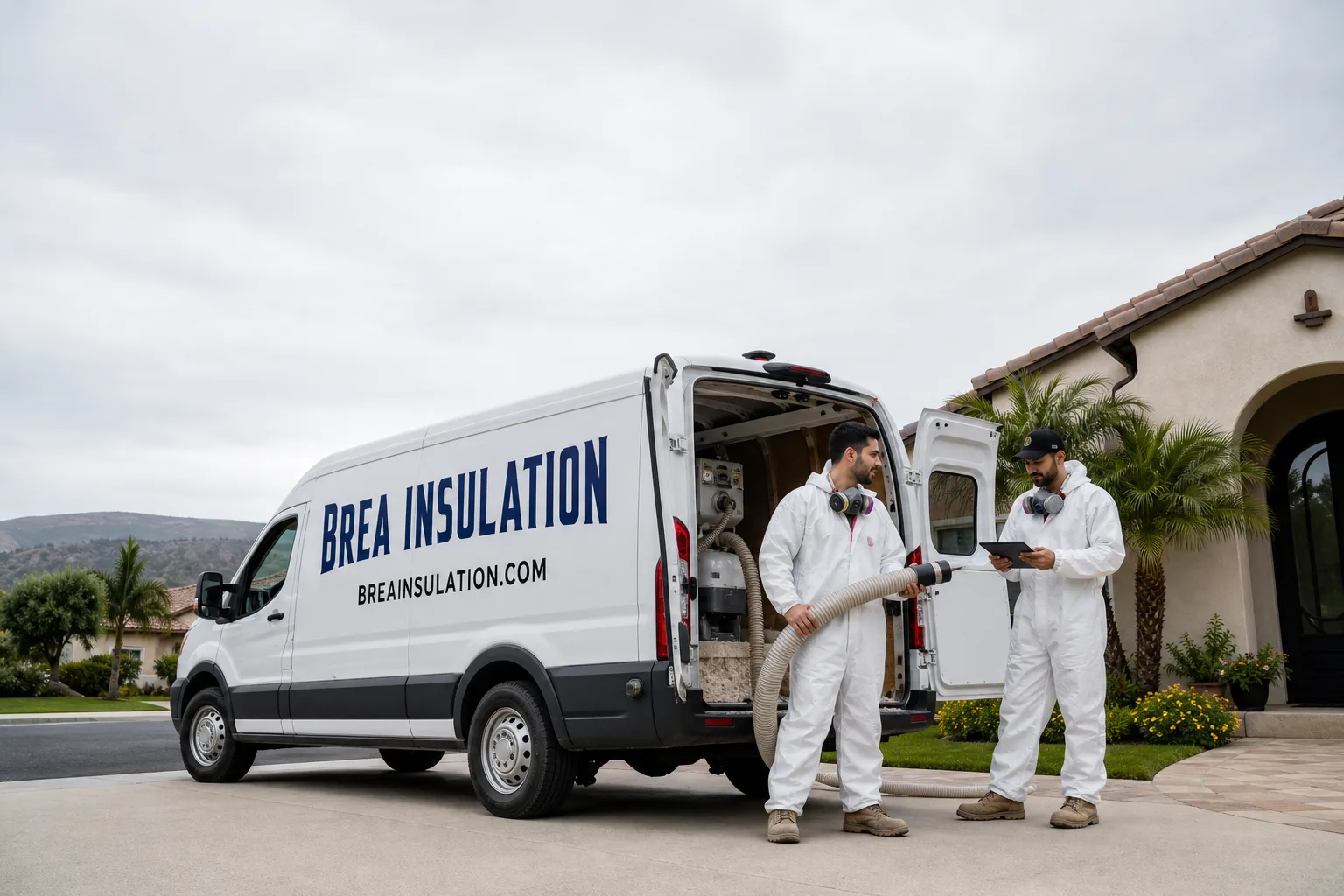
Fast, Reliable Attic Insulation Across Walnut
Attic insulation in Walnut typically runs $1,800 – $5,400 for a full upgrade, with most single-family ranch homes landing between $2,200 and $3,800 depending on square footage and whether you’re adding a radiant barrier and venting fix at the same time. We’re Brea Insulation, and insulation is all we do. Our crews know the hillside streets off Walnut’s south edge, the 1960s tract homes near Valley Boulevard, and the custom builds off Lemon Avenue. When you call (866) 858-4033, you reach a specialist who understands why your attic hits 140°F by mid-afternoon, not a generalist guessing from across the county.
Why Brea Insulation Is Walnut’s Preferred Attic Insulation Company
We work in Walnut regularly, and that consistency matters. Our techs can tell you which streets off the south edge carry the worst afternoon heat load before we even open the attic hatch. That local repetition means faster diagnosis, accurate quotes the first time, and crews who show up knowing what a 1974 California ranch with original batts actually looks like inside.
Walnut homeowners tend to research before they call. We respect that. You’ll get straight talk about R-values, venting math, and why certain materials make sense for inland sun exposure. We’re not here to push the cheapest product on the truck. We carry eight brands so we can match the material to the job, not the other way around. If you’re comparing insulation contractors in Walnut, ask each one how many attics they’ve opened in the 91789 zip code this summer. The answer matters.
Phil Darnell, who leads Brea Insulation, built the company around a single-trade focus for exactly this reason. Insulation is all we do, and that specialization shows in every install across Walnut’s ranch homes, hillside custom builds, and everything in between.
Attic Ventilation in Walnut
Attic Ventilation in Walnut is usually the missing piece when a homeowner has already added insulation and seen no change on their cooling bill. Most Walnut homes from the 1960s through the 1980s were built with shallow ridge or gable vents that simply can’t exhaust the heat a low-pitch roof absorbs under unbroken afternoon sun. The fix involves calculating the attic’s cubic footage, checking soffit intake clearance, and upgrading to a balanced intake-and-exhaust system that moves hot air out instead of letting it sit and radiate down through the ceiling.
A ventilation correction on a typical Walnut ranch runs $350 – $950 depending on whether we’re adding soffit vents, upgrading ridge venting, or installing powered exhaust. It’s almost always paired with insulation work because venting alone won’t fix an R-11 attic, and insulation alone gets cooked by trapped heat. The two jobs belong together.
Soffit and Ridge Vent Upgrades
Homes off Grand Avenue and Lemon Avenue often have soffits that were painted over or blocked by years of accumulated dust and debris. We clear intake paths and add continuous ridge venting where the roof geometry allows. The goal is simple: hot air leaves at the peak, cooler air enters at the eaves.
Powered Attic Exhaust for Low-Pitch Roofs
Some Walnut homes, particularly the ranch styles with nearly flat roof sections, can’t get enough passive airflow no matter how much venting you add. Those attics need a thermostatically controlled powered exhaust unit. We install them with safety shutoffs and set the trigger temperature for inland valley conditions, not coastal defaults that would leave the fan running from 10 a.m. to sunset.
Radiant Barrier in Walnut
Radiant Barrier in Walnut is the single highest-impact upgrade for homes that don’t have one, especially on the exposed south-facing hillsides where afternoon sun pounds the roof deck for six hours straight. A radiant barrier is a reflective material stapled to the underside of the rafters. It reflects radiant heat back toward the roof instead of letting it re-radiate down into the insulation and living space. In a Walnut attic that hits 140°F without one, a radiant barrier can drop peak temperatures by 15 – 25 degrees.
Radiant barrier installation for a standard Walnut attic runs $1,100 – $2,600 depending on roof area and access. It’s one of the few insulation upgrades that pays for itself almost entirely through summer cooling savings in this climate. Inland sun is your attic’s biggest enemy. This is the direct countermeasure.
Installed Under Rafters, Not Laid on the Floor
A radiant barrier only works when there’s an air gap below the reflective surface. That’s why we staple it to the underside of rafters, not lay it across the top of insulation. Laid flat on top of batts, it collects dust and stops reflecting within a couple of years. Installed correctly under the roof deck, it works for decades.
Pairing Radiant Barrier With New Insulation
We recommend radiant barrier as part of any full Attic Insulation upgrade on the south and west exposures of Walnut. The barrier blocks the heat before it reaches the insulation. The insulation then handles what gets through. Without the barrier, even R-38 batts absorb and slowly release that afternoon heat load straight into your bedrooms by evening.
Trusted Brands We Service in Walnut
We install materials from Owens Corning, Johns Manville, Knauf, Rockwool, CertainTeed, Icynene, Demilec, and GreenFiber. That’s an eight-brand bench, which means your Walnut home gets the right product for its specific problem. For most inland attics here, we lean on Owens Corning fiberglass for blown-in coverage or CertainTeed batts where joist spacing is standard. When a homeowner on a south-facing slope wants maximum heat rejection, GreenFiber cellulose can deliver a denser, more settled R-value. We keep the most-requested materials staged for Attic Insulation in Walnut work, so we’re not waiting on a supply run when your job is scheduled.
Common Attic Insulation Problems We See in Walnut Homes
- Original 1960s – 80s batts that are compressed and failing. The label says R-19, but after 40 years of sitting in a 140°F attic, those batts have settled to a few inches and lost most of their actual performance. We pull them out, air-seal, and start fresh.
- Shallow venting that can’t handle inland sun loads. Many Walnut ranch homes have a single gable vent or a short stretch of ridge vent. That’s not enough ventilation for a low-pitch roof absorbing full afternoon sun. The attic becomes an oven that pushes heat down through the ceiling.
- Homeowners adding batts without fixing the heat path. A common situation: someone tops up insulation, the attic still hits 140°F, and the cooling bill doesn’t move. The missing piece is almost always a radiant barrier or a venting correction, not more fiberglass.
- Air leakage at top plates and recessed light fixtures. Walnut homes from the 1970s and 1980s were framed with minimal air sealing. Conditioned air leaks up through wall top plates and around can lights, carrying humidity and heat with it. We seal these paths before installing new insulation.
Pricing for Attic Insulation in Walnut, CA
A full attic insulation replacement in Walnut runs $2,200 – $5,400 for a typical 1,400 – 2,400 square foot single-story home. Blown-in fiberglass or cellulose top-ups on a house that just needs more R-value land between $1,200 and $2,800. Radiant barrier adds $1,100 – $2,600. Ventilation corrections run $350 – $950. The biggest cost drivers are attic square footage, whether old insulation needs removal, roof pitch for venting work, and how much air sealing is required. We give you a line-item quote before any work starts, and estimates are free. Call (866) 858-4033 to schedule a walkthrough.
We Also Serve Cities Near Walnut
Brea Insulation serves Walnut and the surrounding San Gabriel Valley communities. If you’re in South San Jose Hills, Rowland Heights, West Covina, or Pomona, we run crews there regularly and know those housing stocks just as well. Whether you’re in a 1978 ranch in Walnut or a hillside custom home a few exits away, the diagnosis process is the same: measure the heat load, find the air leaks, fix the venting, and install the right material for the job.
Serving Walnut, CA — Our Local Coverage Area
We’re based in the Walnut area and know this community well. Use the map below to see our service coverage — if you’re nearby, we can almost certainly help.
FAQs About Attic Insulation in Walnut
Walnut sits well inland and doesn’t get the coastal marine layer that keeps temperatures moderated in places like Long Beach or Torrance. By 2 p.m. in summer, attics on the unshaded south-facing slopes routinely exceed 140°F because the low-pitch roof deck absorbs hours of direct sun and shallow venting can’t exhaust it. Coastal attics rarely see those sustained temperatures. Your attic needs a different insulation strategy than a coastal home, and that’s exactly what we design for. Call (866) 858-4033 for an attic assessment.
Usually not. If your attic already has some insulation and your upstairs rooms still bake by late afternoon, the problem is radiant heat loading through the roof deck, not a lack of R-value. Adding batts without a radiant barrier and a venting fix can trap that heat in the assembly and leave your cooling bill unchanged. We evaluate the whole heat path, not just the R-value number. Call (866) 858-4033 for a free estimate on a full fix.
Look in the attic. If you see dark, compressed fiberglass batts that sit level with or below the top of the joists, you’re looking at the original install. Those batts were rated R-11 or R-19 when new, but after 40-plus years of heat cycling in a Walnut attic, they’re performing far below that. A quick visual check is usually enough, and we confirm with a thermal camera during the estimate. Call (866) 858-4033 and we’ll take a look.
We install Owens Corning, CertainTeed, Johns Manville, Knauf, Rockwool, GreenFiber, Icynene, and Demilec products. For most Walnut attic work, Owens Corning blown-in fiberglass or CertainTeed batts handle the insulation layer, while GreenFiber cellulose works well for dense coverage on exposed hillside homes. Eight brands means we match the material to your attic’s conditions, not to what’s cheapest on the truck. Call (866) 858-4033 to discuss what fits your home.
Yes. Standard venting formulas assume a balanced climate, but a Walnut attic on a south-facing slope absorbs heat for hours longer than a shaded lot or a coastal home. We calculate venting for that worst-case load and often add powered exhaust or additional ridge venting beyond what a basic formula would specify. The goal is an attic that stays within a reasonable range even at 3 p.m. on a 95-degree July day. Call (866) 858-4033 for an attic ventilation evaluation.
Written by Phil Darnell, Owner at Brea Insulation, serving Walnut and the San Gabriel Valley.