
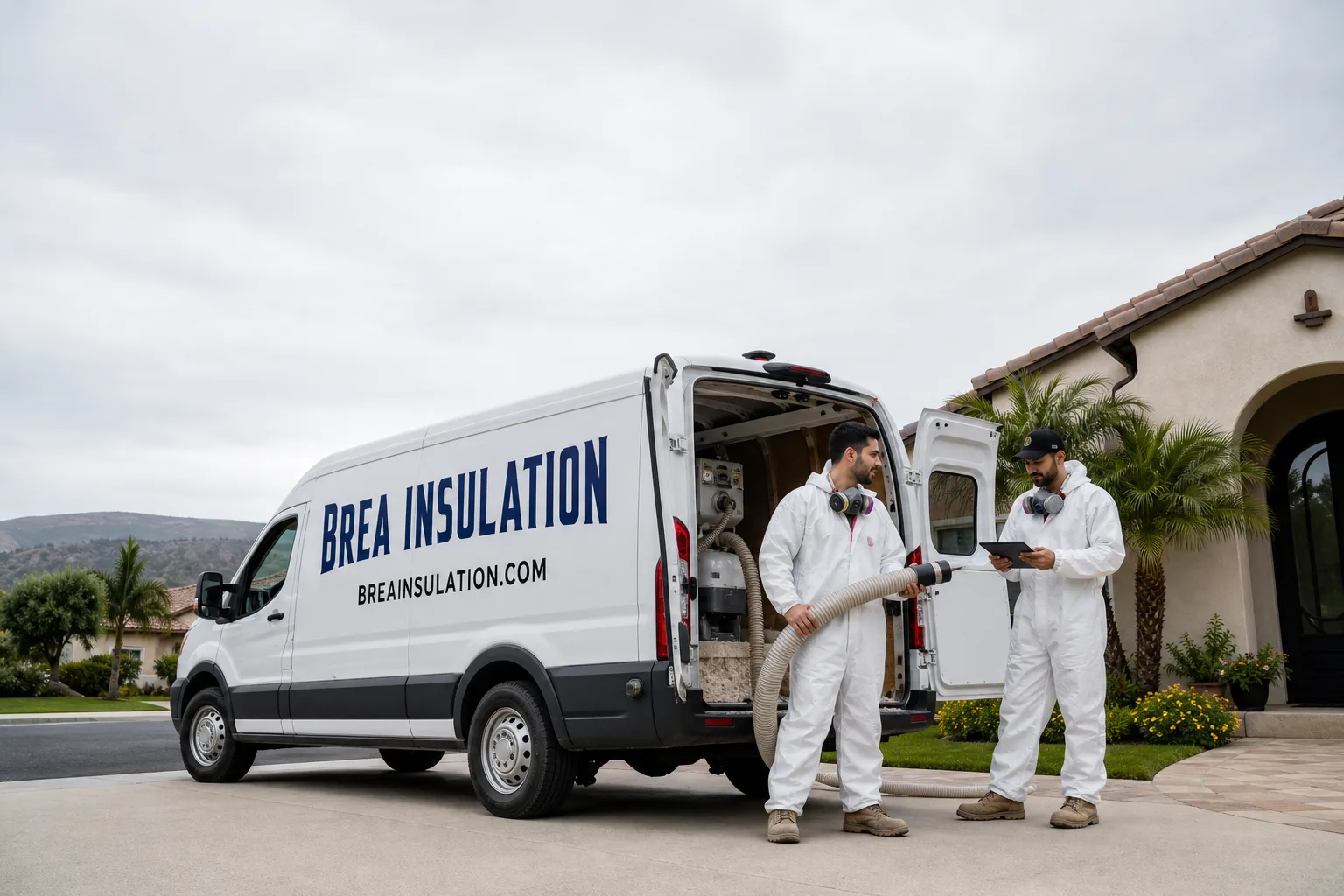
Fast, Reliable Attic Insulation Across Desert Edge
Attic insulation replacement in Desert Edge typically costs $1,800 – $4,200 for a full retrofit on a 1,500 – 2,000 sq ft home, and most jobs finish in a single day. The bigger story here isn’t just R-value. Desert Edge sits at the western edge of the Coachella Valley, where the San Gorgonio Pass funnels wind and fine sand straight into attics on the windward side. That sand compacts fiberglass batts and fills every gap it can find, which means insulation alone won’t fix your energy bills. Air sealing has to happen first. If your Desert Edge home runs hot all summer and dust settles on every surface no matter how often you clean, call us at (866) 858-4033. We’ll diagnose what’s actually happening in your attic, not just sell you more material.
Why Brea Insulation Is Desert Edge’s Preferred Attic Insulation Company
Phil Darnell built Brea Insulation around one idea: insulation is all we do, and that narrow focus shows in every install. We’re not a handyman service that tacks insulation onto a list of other trades. We carry eight manufacturer lines – Owens Corning, Johns Manville, Knauf, Rockwool, CertainTeed, Icynene, Demilec, and GreenFiber – so the product we recommend is driven by what your Desert Edge home needs, not what’s easiest for us to stock.
Our crews know the 92240 ZIP code well. We’ve pulled apart attics off Dillon Road, worked through older owner-built homes near the wash, and retrofitted newer tract builds on the valley’s west side. The recurring finding? Windward-side insulation packed with sand and dust, losing half its R-value before anyone notices. That’s the kind of local pattern you only learn by working here consistently. Our Attic Insulation team responds to Desert Edge calls within 24 to 48 hours in most cases, and we schedule free estimates around your availability, not ours.
Insulation Contractors in Desert Edge
Insulation Contractors in Desert Edge earn their keep the hard way: diagnosing homes where decades of thermal cycling and wind-driven sand have quietly wrecked the original insulation. A proper contractor walks the attic, checks vent placement, looks for dust trails that show air movement, and measures existing R-value before recommending anything. For Desert Edge homeowners, this matters more than in most places because the failure mode is specific: fiberglass batts sag and separate after years of 110°F summers and winter frosts, creating convective loops that let hot attic air bypass the insulation entirely.
Retrofit Approach for Older Homes
Homes built in the 1960s through 1980s in Desert Edge often started with R-11 or R-19 ceiling insulation, which is nowhere near enough for this climate. We remove degraded material, seal top plates and penetrations with foam, then bring the attic up to R-38 or higher. The fix isn’t just adding more on top – it’s correcting the air movement that made the original insulation fail.
Windward-Side Reinforcement
On the windward slope facing the pass, we routinely specify blown-in GreenFiber cellulose because it resists wind washing better than loose-fill fiberglass. The leeward side can take standard batts without the same degradation risk. This two-material approach is something we developed after seeing the same compaction pattern in dozens of Desert Edge attics.
Attic Ventilation in Desert Edge
Attic Ventilation in Desert Edge has to account for a climate that punishes both extremes: summer attic temperatures that hit 150°F and strong spring winds that push sand through every soffit gap. Proper ventilation isn’t just about adding more vents – it’s about balance. Too little exhaust and heat builds up, cooking your roofing materials from underneath. Too much intake on the windward side and you pull sand into the attic every time the wind gusts. The sweet spot is calculated based on your attic’s square footage, roof pitch, and orientation to the pass.
Baffles and Airflow Correction
Older Desert Edge homes often have blocked or missing soffit vents, especially after years of dust accumulation. We install attic baffles at every rafter bay to keep the intake path open, then verify exhaust capacity at the ridge or gable ends. Without baffles, blown-in insulation settles over the soffits and chokes airflow within a season.
Radiant Barrier Integration
In a desert climate with this much sun exposure, a radiant barrier stapled to the underside of the roof deck can cut attic temperatures by 20 – 30°F. It’s not a substitute for R-value, but it’s a meaningful addition for single-story Desert Edge homes with dark shingle roofs and long afternoon sun exposure. We recommend it selectively, because not every roof orientation benefits equally.
Trusted Brands We Service in Desert Edge
Brea Insulation stocks materials from Owens Corning, Icynene, and GreenFiber for Desert Edge jobs, alongside five other manufacturer lines. That matters when a project calls for a specific product: Owens Corning R-38 batts for straightforward attic top-ups, Icynene open-cell spray foam for air sealing and insulating hard-to-reach cavities, GreenFiber blown-in cellulose where wind washing is the primary concern. We match the material to the job, not the other way around. If you need parts or a follow-up on an existing install, we can typically source what’s required without the multi-week delays common with online ordering.
Common Attic Insulation Problems We See in Desert Edge Homes
- Wind-compacted insulation on the west slope. The San Gorgonio Pass wind picks up fine sand and pushes it through attic vents, where it settles into fiberglass batts and compresses them to half their original thickness. A 6-inch batt carrying 2 inches of dust performs like R-11 instead of R-19.
- Sagging and separated batts from thermal cycling. Desert Edge swings from 40°F winter nights to 110°F summer days, and that expansion and contraction gradually pulls fiberglass batts away from framing. The gaps create convective loops that quietly bypass your insulation all day long.
- Missing or degraded air sealing in older owner-built homes. Many Desert Edge homes from the 1960s and 1970s were built before air sealing was standard practice. Top plates, wire penetrations, and recessed lights leak hot attic air (and dust) directly into living spaces, which is why indoor dust levels stay high even with new windows.
- Blocked soffit vents from decades of dust. The same wind that compacts insulation also clogs soffit intakes, which starves the attic of airflow and drives temperatures even higher. We see this on nearly every pre-1990 home we open up in the 92240 ZIP code.
Pricing for Attic Insulation in Desert Edge, CA
Attic insulation top-ups in Desert Edge run $1,100 – $2,400 depending on attic size and existing material. Full replacement on an older home, including old-insulation removal, air sealing, new blown-in or batts, and baffles, lands between $2,800 and $5,500. Spray foam retrofits for roof decks or rim joists add $2,000 – $5,000 depending on square footage and whether you’re doing open-cell or closed-cell. Radiant barriers run $0.80 – $1.50 per square foot installed. The biggest cost variable in Desert Edge is whether we’re fixing wind damage – homes on the pass-facing side often need more air sealing work, which adds labor but pays for itself in energy savings and indoor air quality. Call (866) 858-4033 for a free estimate with exact numbers for your house.
We Also Serve Cities Near Desert Edge
Our Desert Edge customers often refer us to friends in nearby communities. We regularly run jobs in Garnet, Desert Hot Springs, Morongo Valley, and Palm Springs, where the same San Gorgonio Pass wind and desert heat create identical insulation and air sealing challenges. If you’re in any of these areas, the same crew and the same brand bench covers your job.
Serving Desert Edge, CA — Our Local Coverage Area
We’re based in the Desert Edge area and know this community well. Use the map below to see our service coverage — if you’re nearby, we can almost certainly help.
FAQs About Attic Insulation in Desert Edge
The San Gorgonio Pass wind pushes fine sand through your attic vents, and that sand settles into the insulation on the windward slope, compacting it and filling the air pockets that give fiberglass its R-value. In Desert Edge, the windward side is typically the west or northwest slope. The fix is removing the contaminated material, sealing the gaps that let sand in, and replacing it with a material that resists wind washing, like blown-in GreenFiber cellulose. Call (866) 858-4033 for an inspection if you’ve noticed this pattern.
Most Desert Edge homes need both, but insulation comes first. If your attic has less than R-38, adding a radiant barrier without correcting the insulation is putting a bandage on the wrong wound. A radiant barrier makes sense after your insulation depth and air sealing are dialed in, especially on homes with dark shingle roofs and unobstructed western sun exposure. We assess attic temperature, existing R-value, and roof orientation before recommending a barrier.
R-38 is the practical minimum for Desert Edge, and R-49 is better if you’re doing a full replacement and have the framing depth for it. That’s higher than the national R-30 recommendation because our summer heat load is extreme and air conditioning runs for six months straight. The R-value only counts if the material is installed correctly and air sealing is done first – R-49 with gaps and leaks performs like R-19 with good air sealing, which is exactly the problem we fix in older homes here.
Measure the depth of your existing insulation with a tape measure. Blown-in fiberglass or cellulose at R-38 should be 14 to 16 inches deep, and R-49 is 18 to 20 inches. If you can see the tops of your ceiling joists, you’re under-insulated. Other signs include a hot second story, rooms that never cool down in late afternoon, AC that runs constantly from May through October, and dust settling on furniture within days of cleaning. All point to the same root causes we see in Desert Edge attics every week.
Yes, and it’s one of the most common jobs we do in the 92240 ZIP code. Older owner-built homes often have undersized or blocked soffit vents, no baffles, and limited exhaust capacity. We can retrofit intake and exhaust ventilation without touching your roof covering in most cases, usually by correcting soffit airflow, adding baffles at every rafter bay, and verifying ridge or gable exhaust. The work typically happens as part of an insulation replacement so everything is coordinated in one pass. Call (866) 858-4033 and we’ll assess your attic within a few days.
Written by Phil Darnell, Owner at Brea Insulation, serving Desert Edge and the Coachella Valley with dedicated attic insulation, spray foam, and blown-in services.